| Type | Description | Contributor | Date |
|---|---|---|---|
 | Post created | Pocketful Team | Mar-20-26 |
Read Next
- Middle East Tourism Crisis 2026: Impact on Travel, Airlines & Tourism
- What Is Quick Commerce? Meaning & How It Works
- Urban Company Case Study: Business Model, Marketing Strategy & SWOT
- Rapido Case Study: Business Model, Marketing Strategy, Financial, and SWOT Analysis
- Trump Tariffs on India: Trade vs Russian Oil
- NTPC vs Power Grid: Business Model, Financials & Future Plans Compared
- Exxaro Tiles Vs Kajaria Tiles
- Adani Power Vs Adani Green – A Comprehensive Analysis
- Blinkit vs Zepto: Which is Better?
- UltraTech Vs Ambuja: Which is Better?
- Tata Technologies Vs TCS: Which is Better?
- Tata vs Reliance: India’s Top Business Giants Compared
- HCL Vs Infosys: Which is Better?
- Wipro Vs Infosys: Which is Better?
- Voltas vs Blue Star: Which is Better?
- SAIL Vs Tata Steel: Which is Better?
- JK Tyre Vs CEAT: Which is Better?
- Lenskart Case Study: History, Marketing Strategies, and SWOT Analysis
- Parle Case Study: Business Model, Marketing Strategy, and SWOT Analysis
- Tata Motors Vs Ashok Leyland: Which is Better?
Impact of Iran War on Indian Shipping Sector and Shipping Stocks
Written by : Pocketful Team
|Updated by : Pocketful Team
Published on : 21st March 2026
|Updated on : 20th March 2026



The news around the war involving Iran has caused a lot of tension around the world. For India, this is not just a distant conflict. It is a major event that changes how we trade and how our markets move. If you are an investor, you must understand the impact of the Indian shipping sector & impact of Iran war.
When a major power like Iran is involved in a conflict, the sea routes become dangerous. This leads to a direct Iran war impact on shipping stocks because companies have to pay more for fuel and insurance.
The Middle East is the center of global energy. Most of the oil and gas we use comes from this region. When war breaks out, investors usually get scared. They sell their stocks and move their money to safe things like gold. In India, we have already seen the Sensex and Nifty drop when news of the war first came out. This happens because India depends heavily on the Middle East for energy. We also sell a lot of goods like rice and clothes to these countries. If the ships cannot move safely, our economy feels the pain.
Strategic Importance of the Strait of Hormuz?
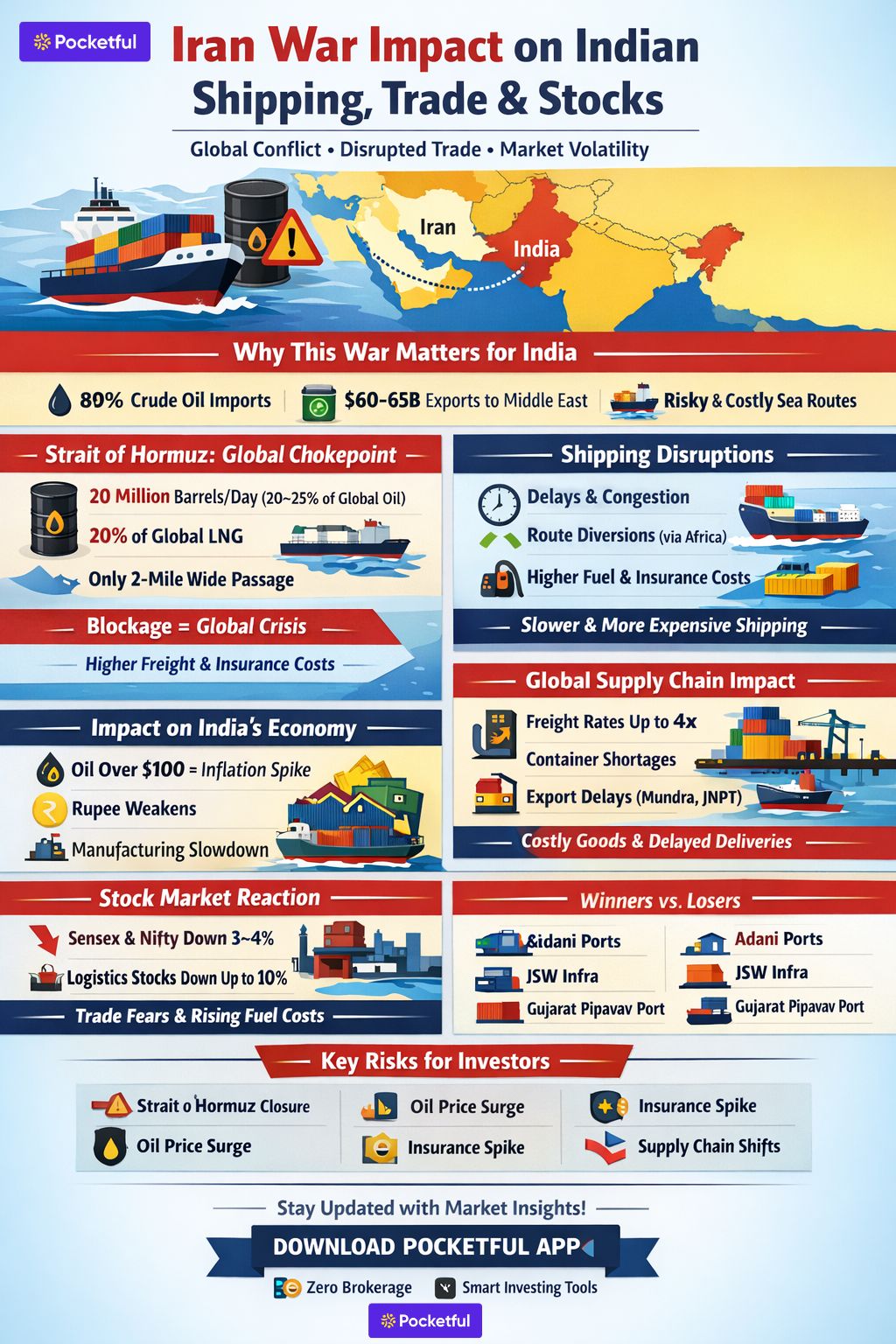
The Strait of Hormuz is a very narrow piece of water between the Persian Gulf and the Gulf of Oman. It is the only way for tankers to carry oil out of the Middle East to the rest of the world. Even though it is very small, it is the most important chokepoint in the global economy. At its narrowest point, the shipping lanes are only two miles wide in each direction. If this passage is blocked, there is no easy alternative to move such a large amount of oil.
About 20 million barrels of oil pass through this strait every single day. This is about 20% to 25% of all the oil used in the world. It is not just about oil. About 20% of the world’s Liquefied Natural Gas (LNG) also comes through here, mostly from Qatar. For India, this gas is very important for power and making fertilizers. When there is a threat of war, the cost of moving these goods goes up instantly. This happens because shipping companies have to pay much higher prices for fuel and for the safety of their ships.
The reason this affects global shipping costs is simple. When the strait is at risk, insurance companies charge a “war risk” fee. Also, some ships might choose to avoid the area altogether. If fewer ships are willing to go there, the cost to rent a ship increases. These higher costs eventually make everything more expensive for the common person. For India, which imports about 89% of its crude oil, any trouble in the Strait of Hormuz is a big risk to our economic stability.
How the Iran Conflict Disrupts Global Shipping Routes
When war starts, the normal paths that ships take are no longer safe. The first problem is vessel delays and congestion. Ships often have to wait in safe areas until they get permission to move. This creates a “traffic jam” at sea. Sometimes, tankers are seen waiting on both sides of the Strait of Hormuz because they are afraid of being attacked. These delays mean that raw materials do not reach factories on time, which can stop production in many industries.
The second big change is route diversions. To stay safe, many ships are now avoiding the Middle East and the Red Sea. Instead, they go all the way around the bottom of Africa, known as the Cape of Good Hope, making the journey way much longer. It adds about 14 to 25 days to a single trip. Because the journey is longer, ships use much more fuel. This also means there are fewer ships available globally because each ship is busy for a longer time on a single trip.
Rising war risk insurance premiums are another hidden cost. Normally, insuring a ship is a standard cost. But during a war, insurance companies may raise their prices by 50% or even more. Some insurers might even refuse to cover ships going to certain ports. This makes it very expensive for companies to operate. All these extra costs are passed down to us, the consumers. This is why we see the prices of imported goods going up during a conflict.
Impact on Global Supply Chains and Trade
The war creates a shock that is felt by every country. The most direct impact is the jump in freight rates. This is the price paid to move goods in a container or a tanker. When routes are longer and risks are higher, these rates can shoot up very fast. For example, some container shipping prices rose by 8% in just one week. For oil tankers, the cost of moving oil to India can become four times more expensive than usual.
We also face container shortages and shipping delays during this situation as longer routes are taken by the ships via Africa. This leads to a shortage of empty containers for the next batch of exports. Goods at ports like Mundra or JNPT in India. When products are stuck at the port, the cash flow of businesses is hit which then leads to empty shelves in stores.
There is also a big impact on commodity exports and imports. The Middle East is a huge supplier of fertilizers and metals like aluminum. About one third of the world’s urea passes through the Strait of Hormuz. If this supply is cut off, the price of fertilizer goes up, which eventually makes food items more expensive. This portrays that tension in one region can lead to higher prices of goods and commodities in a different region.
Impact on India’s Trade and Logistics Sector?
India has very strong trade ties with the Middle East and products worth $60 billion to $65 billion are sold in this region every year. Higher shipping costs make the exporters suffer. They have to pay 20% to 30% more for freight and insurance. This makes Indian products more expensive in the global market. For example, exporters of Basmati rice have already faced trouble because their ships are stuck or the costs are too high to manage.
Energy imports are the biggest risk for India, as we get a huge part of our oil and gas through the Strait of Hormuz. If oil prices stay above $100 per barrel, it costs India billions of extra dollars. This also makes the Indian Rupee weaker against the US Dollar. A weaker Rupee makes everything we import, like electronics and machinery, more expensive resulting in higher inflation across the whole country.
The logistics sector inside India is also on high alert, because ships are getting delayed and goods are piling up at our ports. It is estimated that nearly 6 to 7 lakh containers linked to Gulf trade were affected by the uncertainty. This delay hurts our manufacturing companies. For instance, the pharmaceutical industry gets raw materials from China by sea. If these ships are delayed, the cost of making medicines can go up by 30% or more.
Immediate Market Reaction in Indian Shipping & Logistics Stocks
When the conflict started, the Indian stock market reacted with a lot of volatility. The Sensex and Nifty fell by about 3% to 4% in just two days. Port and logistics stocks were hit even harder, with some falling as much as 10% in a single day. Investors were worried that if trade slowed down, these companies would make much less profit. They also feared the impact of high fuel costs on their margins.
Volatility is common during such times as stock prices swing up and down based on the latest news. For example, if there is talk of a ceasefire, the stocks might recover. But if an oil facility is attacked, they fall again. Experts say that while this looks scary, you should not panic. History shows that markets usually recover from such events after a few months. However, the initial reaction is always one of fear and caution.
Investors are also concerned about cargo volumes. If fewer ships come to Indian ports because of the war, the port operators earn less money. There is also the risk of physical damage. Some Indian companies have assets in the Middle East. If a storage tank or a terminal is damaged in the conflict, it directly affects the company’s value. This is why investors track these stocks so closely every day.
Indian Shipping Stocks That Could Benefit from Higher Freight Rates
It might sound strange, but some companies can actually benefit from a crisis. This is true for shipping lines that own their own ships. When there is a shortage of ships, the price to rent one goes up. During these times companies can even charge higher freight charges resulting in high profits.
- Shipping Corporation of India (SCI): This is one of the largest shipping companies in India. This company has its own fleet of tankers and gas carriers. When oil routes become dangerous and rates go up, SCI can earn more from its ships. Investors often buy SCI stocks during such times because they see it as a way to profit from rising shipping prices.
- The Great Eastern Shipping Company: This is another major player in the private sector. It has a lot of tankers that carry crude oil and petroleum products. Like SCI, it benefits when global freight rates rise. It also has a subsidiary that provides services for oil exploration, which can see more demand if countries try to produce more of their own oil.
Port and Logistics Stocks That Could Face Headwinds
While shipping lines might benefit, port and logistics companies often face difficulties. These companies need a steady flow of ships to make money.
- Adani Ports and Special Economic Zone: This is the biggest private port operator in India. About 15% of the container volume at its Mundra port is linked to the Middle East. If trade with the Gulf slows down, its cargo volumes could drop. This is why its stock price often falls when the war intensifies.
- JSW Infrastructure: This company has a liquid storage terminal in the UAE. This facility was reportedly hit by drone debris, which caused some damage. Any such disruption in the conflict zone is bad for the company’s profits. It also has plans to expand in the region, which could be delayed because of the war.
- Gujarat Pipavav Port: This port relies on services that move through the Red Sea and the Gulf. In the past, when there was trouble in these waters, shipping lines skipped this port to save time. This leads to lower volumes and lower income for the company.
Secondary Impact on Other Logistics-Linked Companies
The impact of the war spreads to other related businesses too.
- LPG Logistics: India imports about 90% of its LPG which comes through the Strait of Hormuz and companies like Aegis Logistics take care of the cooking gas imports.
- Container Operators: In India container movement within India is done by trains and companies like CONCOR handle this. Delayed international shipments makes it very unpredictable for companies to manage the right train schedule.
- Airport Logistics: For urgent needs like medicines or electronics air freight is used and with closed airspace over the middle eastern region planes have to travel through longer routes. This results in costlier air freight and companies managing these cargo tend to witness higher cost and lower volumes.
Key Risks Investors Should Watch
If you are planning to invest during this time you shall keep the following point in mind:
- Strait of Hormuz Closure: If there is a full blockade it could affect 20% of the world’s oil trades which can lead to a huge economic shock.
- Oil Prices: If the Brent crude price will be above $100 it can cause a very high inflation situation in India.
- Insurance Costs: With high insurance costs many ships might simply stop travelling.
- Supply Chain Shifts: If the war lasts for a long time, companies might look for new ways to trade which could lead to exclusion of Indian ports, resulting in long term loss for the nation.
Conclusion
The Iran war shows us how countries are connected, for India the impact on shipping and logistics can directly affect the economy. Some shipping companies might look for higher profits but overall the economy will suffer. Investors shall stay calm and look for long-term reliable companies. The war in Iran is a reminder of how connected the world is. For India, the impact on shipping and logistics is real and markets have faced such situations earlier as well and are also aware about how to recover.
For more market news and insights, download Pocketful – offering users zero brokerage on delivery trades and an easy to use platform designed for both beginners and experienced investors Pocketful.
Frequently Asked Questions (FAQs)
01
Why do shipping stocks go up during a war?
During war ships have to take longer routes, there are fewer vessels available for everyone else. This allows shipping companies to charge much higher prices, which can increase their profits.
02
How does the Iran war affect the price of things in India?
The war makes oil more expensive. Since almost everything in India is moved by trucks or ships that use fuel, the cost of transport goes up. This leads to higher prices for groceries, electronics, and even flight tickets.
03
Will the war stop India’s exports to the Middle East?
Exports haven’t stopped, but they are facing huge delays. About $4 billion of Indian exports could be at risk every month if the conflict continues.
04
What happens if the Strait of Hormuz is closed?
If it is closed, about 20% of the world’s oil and gas supply would be cut off. This would cause a global energy crisis, very high petrol prices in India, and a major shock to the stock market.
05
Should I sell my logistics stocks now?
While the market might be volatile in the short term, historical data shows that stocks often recover once the situation stabilizes.
Disclaimer

The securities, funds, and strategies discussed in this blog are provided for informational purposes only. They do not represent endorsements or recommendations. Investors should conduct their own research and seek professional advice before making any investment decisions.
Article History


 Facebook
 Twitter
 Instagram
 LinkedIn
 Youtube