



| Type | Description | Contributor | Date |
|---|---|---|---|
 | Post created | Pocketful Team | Jan-16-25 |
 | Update Meta Tags and H1 | Ranjeet Kumar | Feb-14-25 |
| Heading Update | Ranjeet Kumar | May-14-25 |
| Add new links | Nisha | Sep-03-25 |
| Add new links | Nisha | Sep-03-25 |
| Content and Pricing Updated | Ranjeet Kumar | Nov-06-25 |
| Updated Data Table | Ranjeet Kumar | Jan-09-26 |
| Update Content | Nisha | Jun-04-26 |
| Update Content | Nisha | Jun-04-26 |
Read Next
- What Is Collateral Amount In Demat Account?
- Best Retirement ETFs in India
- How to Protect Demat Account from Fraud: 15 Safety Tips
- How to Open a Demat Account for a Private Limited Company in India
- How to Open a Demat Account for Partnership Firms & Required Documents?
- How to Change Name in Demat Account
- What is a Repatriable Demat Account?
- How to Open an LLP Demat Account in India: Documents & Process
- What Is Power of Attorney (POA) in a Demat Account?
- Benefits of HUF Account in India
- FIFO in Demat: Meaning, Rules & Tax Impact
- Difference Between Individual and HUF Demat Accounts
- Demat Account: Fees & Charges
- What is Ledger Balance in a Demat Account?
- What is Demat Debit and Pledge Instruction (DDPI)?
- What is Non-Repatriable Demat Account? Meaning and Definition
- जानिए 15 भारत का बेस्ट डीमैट अकाउंट
- What is Corporate Demat Account? Features, Benefits, and Eligibility
- HUF Demat Account: Rule, Documents & How to Open
- How to Buy Shares through a Demat Account?
Top Demat Account in India 2026 – Top Picks for Traders & Investors
Published on : 16th January 2025
|Updated on : 14th August 2026



A Demat account is necessary to participate in the stock market in India. Although many brokers in the market offer Demat account services, you should select one based on your needs.
In this blog, we will give you an overview of the best Demat account in India for 2026, along with the top three recommendations for traders and investors.
What is a Demat Account?
An investor can keep financial assets, including stocks, mutual funds, ETFs, bonds, and more, in an electronic demat account. Before 1996, securities were exchanged in physical certificates, which had several dangers, including damage from forgeries and theft. Demat accounts were created to remove these risks. If you wish to trade on the Indian Stock Market, you must have a Demat Account.
What to Look for in a Demat Account App?
The key considerations for selecting the best Demat Account:-
- Brokerage – Brokers typically charge a commission as a fee for using their platform to execute trades. You should choose the broker for opening a Demat account that offers you the lowest brokerage.
- Account Maintenance Fees – Customers are charged fees for maintaining their Demat accounts by the broker. Since these yearly maintenance charges differ from broker to broker, it is essential to consider brokers who offer lower annual maintenance fees.
- Account Opening Fees – A one-time fee is charged by some brokers while opening a demat account with them. However, the majority of brokers are offering zero account opening fees.
- Margin Interest – Brokers lend money to their clients and charge interest on it at a certain rate; therefore, if you wish to opt for a margin trading facility, then you must consider the broker who charges a minimum interest rate on this facility.
- Research Tools – There are various types of research tools offered by brokers; therefore, one must choose a broker who offers the most advanced trading tools.
- Customer Support – One of the most important things to consider when opening a Dement account is customer service. Customer service is crucial because you want any issue you encounter when managing a Demat account to be fixed as soon as possible.
Read Also: Best Trading Apps in India
The 15 Best Demat Accounts in India for 2026 – AMC Free/Paid
Detailed Comparison Table of the Best Demat Account in India.
| Broker | Account Opening Fee | Annual Maintenance Fee (AMC) | Equity Delivery Brokerage | Equity MTF | Intraday Brokerage | Futures Brokerage | Options Brokerage | Commodities F&O Brokerage | Unique Features |
|---|---|---|---|---|---|---|---|---|---|
| Groww | ₹ 0 | ₹ 0 | ₹20 or 0.01% per order Which ever is lower Minimum ₹5 | 0.041% (or 14.95% annually) | Flat ₹20 per order | Flat ₹20 per order | Flat ₹20 per order | Flat ₹20 per order | Zero AMC, a user-friendly platform |
| Zerodha | ₹ 0 | ₹300 + GST | ₹20 or 0.03% per executed order, whichever lower | 0.04% per day | 0.03% or Rs. 20/executed order whichever is lower | 0.03% or Rs. 20/executed order whichever is lower | Flat Rs. 20 per executed order | 0.03% or Rs. 20/executed order whichever is lower | User-friendly platform, educational tools |
| Pocketful | ₹ 0 | ₹ 0 | ₹ 0 delivery charges. | 0.1% of turnover per order | ₹20 per executed order or 0.03% of turnover, whichever is lower | ₹20 or 0.03% per executed order, whichever is lower | ₹20 per executed order | ₹20 per executed order | Innovative technology lets you invest in different asset classes in one place. |
| Angel One | ₹ 0 | ₹240 (1st year free) | ₹20 or 0.1% per executed order | 0.041% per day | ₹20 or 0.03% | ₹20 per executed order | ₹20 per executed order | ₹20 per executed order | Comprehensive research, versatile mobile app |
| ICICI Direct | ₹ 0 | ₹ 700 | 0.07% for equity delivery | 0.0265% daily (9.65% p.a.) | Flat Brokerage per order of ₹20 | Flat Brokerage per order of ₹20 | Flat Brokerage per order of ₹20 | Flat Brokerage per order of ₹20 | 3-in-1 account, extensive research |
Kotak Neo | ₹ 0 | ₹99 Account Opening Fee | 0.49% for equity delivery | 0.041% per day (approx. 14.99% p.a.) | Flat Brokerage per order of ₹10 | Flat Brokerage per order of ₹10 | Flat Brokerage per order of ₹10 | – | Advanced trading tools, personalized advisory |
| Upstox | ₹ 0 | ₹ 0 | ₹20 or 0.05% per order | ₹20/day for every ₹40,000 borrowed | 0.01% or Rs. 20/executed order whichever is lower | 0.05% or Rs. 20/executed order whichever is lower | Flat Rs. 20 per executed order | 0.05% or Rs. 20/executed order whichever is lower | Low brokerage fees, intuitive platform |
| 5paisa | ₹ 0 | ₹ 300 | ₹20 per order | 0.026% per day | Flat ₹20 per order | Flat ₹20 per order | Flat ₹20 per order | Flat ₹20 per order | Flat brokerage rates, mutual fund investments |
| Sharekhan | ₹ 0 | ₹ 400 | 0.30% on trade price or minimum 1 paisa per share | 0.026% per day | 0.02% on trade price or minimum 1 paisa per share (each side) | 0.02% per transaction value (each side) | ₹39 per lot (each side) | 1% on premium or ₹150, whichever is higher (one side) | Training programs, advanced trading platforms |
| Motilal Oswal | ₹ 0 | ₹ 199 | 0.2% for equity delivery | 0.053% per day | 0 | Flat 0.02 % per order | Flat ₹20 per order | 0.02% for futures & ₹20 on Options | Personalized advisory, portfolio management |
| SBI Securities | ₹ 0 | ₹ 750 (1st year free) | 0.5% for equity delivery | 0.04% per day | Flat ₹20 per order | Flat 0.05 % per order | Flat ₹50 per order | – | 3-in-1 account, strong banking integration |
| Axis Direct | ₹ 0 | ₹ 750 | 0.5% for equity delivery | 9.99% to 10.99% p.a. (or ~0.03% daily) | 0.5% for equity Intraday | 0.5% for equity Futures | Flat ₹20 per order | 0.03% for Futures & ₹50 per orderFor Options | Seamless fund transfers, advanced research tools |
| IIFL Securities | ₹ 0 | ₹ 250 | 0.25% for equity delivery | 0.04% per day (₹40 per lakh) | 0.025% for intraday | , 0.05% for Futures | Flat ₹25 per order | 0.025% for Commodities | Free research reports, advisory services |
| Edelweiss Broking | ₹ 0 | ₹ 500 | Flat ₹10 per order | 0.04% to 0.05% daily (14-18% p.a.) | Flat ₹10 per order | Flat ₹10 per order | Flat ₹10 per order | Flat ₹10 per order | Research-driven advisory, diverse investment options |
| Paytm Money | ₹ 0 | ₹ 0 | ₹20 per executed order or 2.5% whichever is low | 0.022% per day & 7.99% p.a. | ₹20 per executed order or 0.05% whichever is low | ₹20 per executed order or0.01% whichever is low | ₹20 per executed order | – | Integrated with the Paytm ecosystem, low transaction costs |
Read Also: Top 10 Option Trading Books in India
Overview of the Top 15 Demat Accounts Apps for Traders and Investors
An overview of 15 Best Demat Accounts for traders and investors is given below:-
1. Groww
It was incorporated in 2016 by the four Flipkart employees. Over time, this platform has grown in popularity among beginners in trading because of its easy-to-use interface.
Key Features
- It charges minimal fees from its customers.
- They provide investment in stocks, ETFs, mutual funds, etc., along with credit and bill payment services.
Best For: It is suitable for investors who wish to have access to all their investments in one place or at a single application.
2. Zerodha
Zerodha is one of the major players in the Indian stock broking industry. It was established in 2010 by the Kamath Brothers and offers a distinctive trading platform focusing on Advanced technology. It introduced a new pricing structure in the broking industry, which was known as flat brokerage for trading. Many traders searching for the best demat account in India consider Zerodha due to its transparent pricing and tech-driven ecosystem.
Key Features
- Zerodha is renowned for its user-friendly trading platform.
- It has a dedicated customer service team that assists its clients in resolving their queries.
- Varsity is a free education platform offered by Zerodha to enhance the knowledge of their client.
Best For: Investors who want to trade in the stock market with the broker that offers the lowest brokerage can opt for this platform.
3. Pocketful – Free Demat Account App
Pocketful is a new-age discount broking firm offering a wide range of investment options such as equity, commodity, derivatives, etc. Pocketful is developed by professionals with more than 30 years of experience, which ensures enhanced user experience. Pocketful is different from other discount brokers as it offers one of the best trading platforms and does not charge any fees for equity delivery-based trades, account opening, or yearly maintenance fees. offers a complete investment ecosystem as a discount broker , it is the best option for both traders and investors.
Key Features
- Pocketful provides a free trading platform since there is no brokerage on equity delivery trades, zero account opening fees and zero annual maintenance fees for the first year. These benefits make it a strong contender for users searching for the best demat account in India.
- An online account can be opened with Pocketful within five minutes.
- Pocketful offers many advanced features for investors, including Curated Pockets, Superstar Investor portfolios, IPOs, stock-specific news, Screeners for Analysis and in-depth technical and fundamental analysis – helping investors research better, track opportunities, and make more informed investment decisions. Also Pocketful launches Mutual Funds Services from 2026 offer’s 2000+ Mutual funds.
- For traders, Pocketful offers advanced TradingView charts, an advanced option chain, Scalper Mode, basket orders, and several other professional tools to analyze markets efficiently—making it a strong choice for opening a Demat account.
- Pocketful offers MTF interest rates starting at 5.99%*, which are among the lowest available in the market, helping traders reduce funding costs while maintaining flexibility.
- You can create your trading strategies using free Pocketful APIs.
- Therefore, one can consider opening a Demat account with Pocketful.
Best For: Because of its user-friendly design, zero brokerage on equity delivery transactions, and no annual maintenance fees for the first year, Pocketful is the best broker for traders and investors. Additionally, it offers advanced trading tools to analyze the market. Therefore, one can consider opening a Demat account with Pocketful.
4. Angel One
Angel One is one of India’s top full-service brokers. It was established in 1996. It offers trading and investing in a variety of assets such as equity, commodity, derivatives, etc., and investment advisory services. Their Smooth software platform prioritizes customer requirements, making it a strong choice for individuals evaluating the best demat account in India.
Key Features
- The main advantage of opening a demat account with Angel One is their customer-focused approach.
- Advanced trading tools are available in Angel One’s application.
- The company has a strong offline presence across the nation.
Best For: Angel One is suitable for traders who prefer offline broking services.
5. ICICI Direct Securities
One of the top stockbrokers in India is ICICI Direct Securities. One of the biggest banks in India’s private sector, ICICI Bank, owns ICICI Direct as a subsidiary. It offers a three-in-one account, which combines savings, trading and a Demat account through which an investor can effortlessly move funds from their savings account to their trading account. They offer a large variety of investment products that are tailored to meet the customers’ requirements.
Key Features
- Through its local offices, the company maintains a strong national presence, assisting its investors with any questions they may have.
- ICICI Direct also provides its clients with consultancy and research services.
- Additionally, it provides its investors with individual or customized wealth management solutions.
Best For: ICICI Direct Securities is a good option for investors who need assistance from local branch offices.
6. Kotak Securities Limited
Kotak Securities is a division of Kotak Mahindra Bank, one of the largest private sector banks in India. It makes it simple for their customers to link their bank account to their trading and demat accounts. Kotak Securities provides its investors with a variety of investment products, such as equities, commodities, and derivatives. Kotak Securities’ desktop-focused Neo Web and the mobile application Kotak Neo both provide real-time market data to traders and investors.
Key Features
- Apart from trading in equity and commodities, it also offers a wide range of investment options, such as mutual funds.
- Kotak Securities educates investors through various educational initiatives.
- Because Kotak Bank supports the company, it enjoys a great reputation as a brand.
Best For: Kotak Securities is a good choice for investors who want to enhance their stock market knowledge through their online tutorials.
7. Upstox
Upstox offers a modern trading platform and technical tools that help investors predict the trend of a commodity or a stock price. Additionally, they provide an option chain with a strategy mode that allows you to formulate and carry out your trading plans.
Key Features
- The mobile application offered by Upstox makes it simple for a beginner to start trading.
- You can create several watchlists on the platform and add equities, commodities, etc., for intraday trading.
- There are no annual maintenance charges payable by the investor while keeping an Upstox account.
Best For: Upstox is suitable for traders who wish to utilize technical analysis as a tool for intraday and swing trading.
8. 5Paisa
One of the leading discount brokers in India, 5Paisa offers a variety of services, including commodity and equities trading. It was founded in 2016 with the main goal of providing broking services at low prices. 5Paisa is an AMFI-recognized distributor of mutual funds.
Key Features
- They offer user-friendly web-based and mobile-based trading platforms to investors that offer them a seamless trading experience.
- 5Paisa offers investment in mutual funds through its platform.
- Their FnO360 platform offers advanced tools so that investors can make informed decisions.
Best For: 5Paisa is an option for those who want to learn about the stock market through interactive workshops.
9. Sharekhan
Established in 2000, Sharekhan was among the first broking firms in India to provide online trading services to regular clients. By opening franchises around the nation, it expands its business at an exponential rate. It was purchased by the French investment banking company BNP Paribas later in 2016 and was then sold to Mirae Asset Financial Group in 2024.
Key Features
- They provide a smooth mobile application with advanced trading tools.
- Sharekhan offers an advanced training program for its investors through its online courses, popularly known as the Sharekhan Classroom.
- It has a dedicated customer support team that addresses its customers’ queries.
Best For: For people who want to learn about technical and fundamental analysis, Sharekhan is the ideal choice.
10. Motilal Oswal Financial Services Limited
Motilal was founded in 1987 and is regarded as a major participant in the Indian broking industry. It offers advisory services, portfolio management services and investment in various asset classes. With more than 30 years of experience and multiple awards in recent years, they offer research reports in addition to advanced trading tools through their website and their mobile application named RISE.
Key Features
- Motilal Oswal Financial Services Limited provides its clients with customized financial solutions.
- Their mobile application is one of the best in the industry due to its user-friendly interface.
- Loans against securities are also offered by the company.
Best For: Ideal for investors who wish to have access to a variety of specialized financial products in one location, including portfolio management services.
11. SBI Securities
It was incorporated in the year 2006, and initially, it was known as SBICap Securities Limited. It is a wholly-owned subsidiary of the State Bank of India, which is India’s largest public-sector bank. SBI Securities is known for its extensive branch network and trust among investors due to government support for SBI. Along with equity and commodity trading services, it also offers research and advisory services.
Key Features
- They have personalized relationship managers for their high-net-worth individual clients.
- SBI Securities can increase the purchasing power of existing customers by offering them margin trading facilities for intraday traders.
Best For: This platform is suitable for both new and experienced investors as it offers comprehensive services. However, the fees charged by them are comparatively higher than those of others.
12. Axis Direct
Axis Direct was founded in 2011 and is a division of Axis Securities Limited, which is a subsidiary of Axis Bank. The company used innovative technology and created the Axis Direct platform, which is now among the top trading platforms in the Indian broking industry. The customers of Axis Bank can easily link their bank account to their demat account. The company’s headquarters is situated in Mumbai.
Key Features
- It offers advanced trading and investing platforms to its customers.
- The Axis Direct provides regular, in-depth fundamental research reports on different stocks, sectors, and commodities.
- Margin funding is also an additional feature provided by Axis Direct to their investors.
Best For: Investors looking to use the margin trading facilities provided by the broker can consider Axis Direct as an option.
13. IIFL
In 1985, IIFL was established as a division of the India Infoline Group. Originally founded as an advisory firm, its primary focus was on research and related activities. In 2005, it changed its name to India Infoline and went public on the Indian Stock Exchange. The company offers an advanced trading platform and ensures that its investors make wise investment decisions through its research reports.
Key Features
- IIFL offers research and advisory services to its customers.
- It also offers a user-friendly trading platform.
- Various free educational sessions are also provided by IIFL to their customers to enhance their knowledge.
Best For: Investors may choose to open a demat account with IIFL if they would like research and advisory services in addition to quick trade execution.
14. Edelweiss Broking
The Edelweiss Group chose to expand their business in 2008, and decided to enter into the broking service industry, and established Edelweiss Broking Limited. From 2010 to 2015, the company focused on research and advisory services. Along with this, they offered their clients a user friendly investing platform. The company began to diversify its product portfolio and included mutual funds and portfolio management services in 2015.
Key Features
- It offers algorithmic trading services to its customers.
- They also suggest actively managed funds to their customers based on market conditions.
- Daily market updates are also provided by Edelweiss to their investors so that they stay updated about the market conditions.
Best For: Edelweiss broking is suitable for those investors who are looking for a comprehensive array of services, such as advisory, trading etc., in one place.
15. Paytm Money
When Paytm Money was launched in 2017, it started operations as a direct mutual fund investment platform. One97 Communications Limited, the parent firm of Paytm, gained popularity right away among individual investors looking to cut costs when investing in mutual funds. In 2019, the company decided to provide low-cost stock trading services. The company’s headquarters is situated in Bengaluru.
Key Features
- Paytm offers a user-friendly application to provide their investors with a hassle-free trading experience.
- It also offers access to direct mutual funds through which a customer can save costs.
- It offers various calculators, such as SIP, lumpsum, etc., on its platform.
Best For: It is suitable for investors who are looking for platforms that offer trading facilities at a lower cost and fulfill their investment needs.
Read Also: 10 Best Paper Trading Apps in India
Demat Account Recommendations for Traders
The 3 recommended brokers for the traders are as follows:-
- Zerodha: Due to their cost-effectiveness, investors adore Zerodha, which is regarded as the biggest broker in India with millions of customers, affordable pricing, and flat brokerage costs. Sensibull for sophisticated options trading, Streak for algo trading, KITE for web and mobile-based trading, and a tiny case for theme-based investment are some of its intelligent trading tools. Their trading tools make it easy to place orders, and Varsity, their educational program, is a special selling point.
- Upstox: In addition to offering slick trading interfaces, Upstox charges trading costs that are comparable to Zerodha’s flat rates. It has sophisticated charting capabilities, and Upstox has a special feature called Tick-by-Tick Engine that gives retail traders information regarding buy and sell orders. Previously, this capability was restricted to institutional and wealthy individual clients.
- Pocketful: Another up-and-coming stock broking company that provides a variety of investing possibilities and has no equity delivery fees. The application is simple to use and navigate. The platform aims to make investing and trading easy, affordable, and accessible for everyone. As a new-age fintech in India, Pocketful focuses on delivering a smooth, full-service trading experience by combining modern technology with trusted market expertise. Built by the Goel brothers on decades of experience from the Pace Stock Broking legacy, Pocketful bridges the gap between low-cost brokerage and comprehensive investment services.
Top 3 Demat Account Recommendations for Investors
The 3 recommended brokers for the investors are as follows:-
- Kotak Securities: One of the biggest private sector banks in India, Kotak Mahindra Bank, owns Kotak Securities as a subsidiary. Additionally, it provides its clients with bank accounts and integrated demat trading for simple money transfers. Kotak Securities offers a vast array of investing options, such as mutual funds, stocks, derivatives, fixed-income products, and more. It provides Modern trading platforms like Kotak Stock Trader, a web-based trading platform, and KEAT Pro X, a desktop-based trading platform that gives active traders access to real-time market data. It also offers sophisticated charting tools.
- Motilal Oswal Financial Services Limited: Founded in 1987, it is one of the top broking organizations in India, providing a wide range of investment alternatives, portfolio management services, and consulting services. Their advanced trading systems include. It provides the desktop trading terminal in addition to the investor and trader apps. Motilal Oswal’s research and advising services are regarded as some of the best in the business. It provides customized consulting services for its HNI clientele and has thirty years of research knowledge. One of the best PMS services available in the market is their portfolio management platform.
- Pocketful: The ideal alternative for those who want to make long-term investments is Pocketful. This finance platform is modern. There are no annual maintenance fees, account opening fees, or delivery fees with Pocketful. Their platform is built on state-of-the-art technology created by experts with over 27 years of experience. Through their site, one can invest in a wide range of assets, improving the user experience.
Also, check out our blog- Top 10 Highest Leverage Brokers in India
Benefits of Good Demat Account
The benefits of good demat account follow as:-
- Cost Efficient – A good demat account must be cost-efficient, which means the brokerage and other kinds of fees levied by the broker are less.
- Ease of Tracking and Managing Investment – As securities are held in electronic form, the tracking and managing of investments is efficient and hassle-free.
- Enhanced Trading Experience with Advanced Platforms – The trading platform offered by the broker must be equipped with advanced trading tools to enhance the trading experience of a trader.
- Ease of Account Opening – The process of opening an account with a broker should be easy and convenient. Nowadays, a demat account can be opened in just 24 hours.
- Free Research Tools— Many brokers provide demat accounts for free. However, their trading and research tools are paid; for this reason, one should consider opening a demat account with a broker that provides free research resources.
- Reliability – The broker with whom you open your demat account must be credible and reliable.
- Transparent Pricing – The pricing offered by the broker must be transparent. There must be no hidden charges.
How to Open Demat Account: A Step-by-Step Guide
Opening a Demat account with a broker is quick, fully digital, and hassle-free. Follow the simple steps below to get started with your investment journey.
Step 1: Download and Register: Download the broker app from the Google Play Store or Apple App Store and click on ‘Register’ to begin.
Step 2: Enter Personal Details: Fill in your name, mobile number, date of birth, PAN number, and address to start your application.
Step 3: Upload KYC Documents: Upload your Aadhaar card, PAN card, and a recent bank statement to complete the KYC process.
Step 4: Complete eSign & Submit: Verify your information and eSign the application using your Aadhaar-linked mobile number.
Step 5: Verification & Account Activation: Broker verifies your details, and once approved, your Demat account is activated. You’ll receive your Client ID and login credentials to start investing.
Importance of a Demat Account in Trading and Investing
There are various of having demat accounts, a few of which are mentioned below-
- Holding Securities – A Demat Account allows you to hold securities electronically.
- Transactions – If you want to sell or buy any securities, a demat account makes the process simpler.
- Nomination – An investor can nominate their close ones who will inherit the securities held in their demat account in case of the holder’s unfortunate death.
- No Minimum Balance – You are not required to have any minimum balance in your demat account.
- Corporate Actions – The demat account manages all the corporate actions like right issues, bonus shares, etc.
How to Choose the Right Demat Account for Long-Term Investment
There are various factors one should consider before choosing the right demat account, a few of which are mentioned below:-
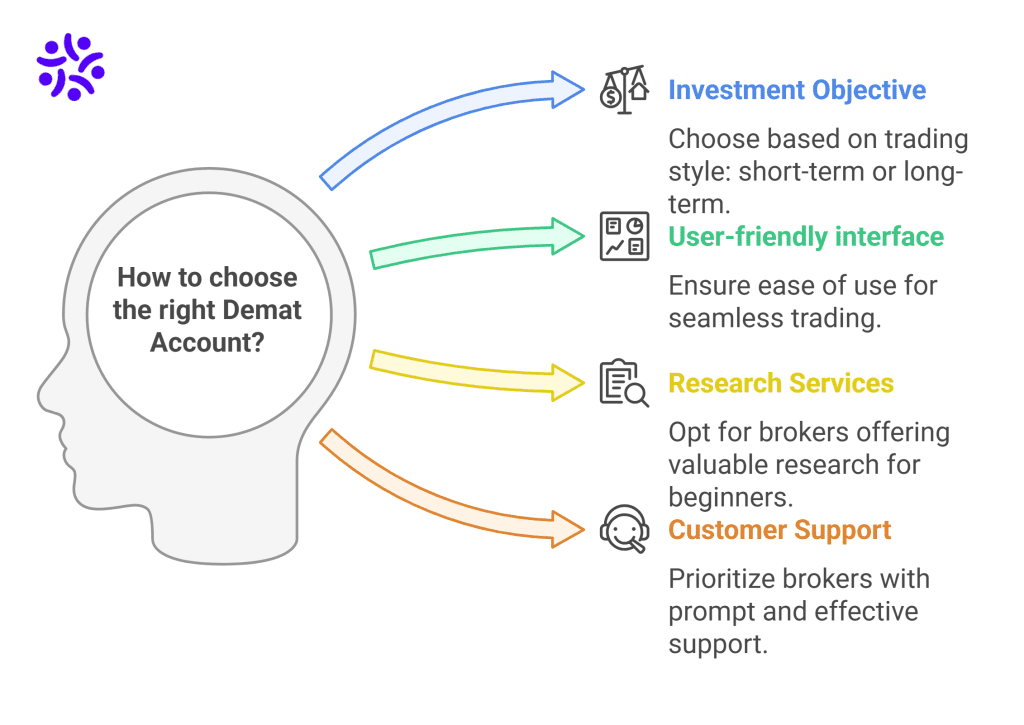
- Investment Objective: Selecting a platform that provides sophisticated trading tools and cheap transaction fees is essential if you are a short-term trader. However, you should search for a broker that offers cheap annual maintenance fees if you are a long-term investor.
- User-friendly interface: Before selecting a broker, you should confirm that the platform they provide is user-friendly and straightforward to use so that you can trade with ease.
- Research Services: If you are new to investing, then you must opt for a broker which offers you valuable research reports and research calls that can make your investments.
- Customer support: The customer support offered by the broker must be taken into consideration as Whenever you face any issues the queries must be resolved on an immediate basis.
- Hidden charges: Various brokers in the industry charge some kind of hidden fees from their customers; therefore, before choosing a broker, one must conduct proper research about the hidden charges.
- Trading Platform: Before choosing a broker, one must consider a trading platform which offers all the key features required by a trader or investor.
Conclusion
In conclusion, you should evaluate the services, fees, customer service, etc., that your broker offers if you intend to open a demat account. The investor’s investment goal also influences the broker’s choice. A Demat account, which provides the lowest brokerage and Future ready trading platforms, is something you should think about if you are a short-term investor. Choose a broker that offers the lowest or no annual maintenance fees, though, if you are a long-term investor
| S.NO. | Check Out These Interesting Posts You Might Enjoy! |
|---|---|
| 1 | Types of Demat Accounts in India |
| 2 | Features and Benefits of Demat Account |
| 3 | Can I Have Multiple Demat Accounts in India? |
| 4 | How to Open a Demat Account Online? |
| 5 | Small-Cap ETFs to Invest in India |
| 6 | Best Sip Apps in India for Investment |
Frequently Asked Questions (FAQs)
01
Which Demat Account is Best for Beginners?
Depending on their investing goal, beginners should select a Demat account. When searching for short-term trading opportunities, a Demat account with the lowest brokerage is a requirement, but when seeking long-term investment, a Demat account with the lowest yearly maintenance expenses is a must. We at Pocketful provide you with the most affordable brokerage and yearly maintenance fees.
02
What do you mean by Demat system?
The Demat system (short for Dematerialization system) is a method of holding financial securities like stocks, bonds, ETFs, and mutual funds in electronic (digital) form instead of physical paper certificates.
03
How to open a demat account online?
You can open a demat account online by completing KYC, uploading documents, and eSigning using your Aadhaar-linked mobile number. Apps like Pocketful, Zerodha, and Angel One allow fully digital onboarding.
04
Is there a difference between a demat account and a trading account?
Indeed, the trading account allows you to buy or sell assets, whereas the Demat account just keeps them in electronic form.
05
Can I open a trading and demat account with the same broker?
Yes, you can open both trading and demat accounts with any broker that offers integrated account services.
06
Who can open a trading and demat account?
Any resident or non-resident person, corporate entity, or minor may open a Demat account; however, the legal guardian must be the only person able to manage the minor’s account.
07
What is the minimum amount required to open a demat account?
To start a demat account, you simply need to pay the opening fees, which are typically waived by brokers. There is no minimum amount needed.
08
Which demat account has the lowest brokerage?
Pocketful, Zerodha, 5Paisa, and Upstox offer low or flat brokerage, making them ideal for those looking for a low brokerage demat account.
09
What are SBI demat account charges?
SBI demat account charges include account opening fees (₹0), AMC (₹750 after year 1), and brokerage charges based on the type of trade.
010
Is Groww app safe for investing?
Yes, the Groww app is SEBI-registered and considered safe for investing and trading.
011
Is Zerodha better than Groww?
Zerodha offers advanced charts and tools, while Groww is known for simplicity. For advanced traders, Zerodha may be better; for beginners, Groww may be easier.
012
What is the Groww app and how does it work?
The Groww app is a beginner-friendly investment platform that allows users to invest in stocks, mutual funds, ETFs, and more through a simple and intuitive interface.
013
Is Zerodha good for opening a demat account?
Yes, Zerodha is one of India’s most popular brokers, known for its low brokerage fees, advanced charting platform (Kite), and reliable customer support.
014
Is Angel One a good choice for trading?
Yes, Angel One offers a powerful app, advanced charting tools, and competitive brokerage, making it suitable for both beginners and experienced traders.
015
What services does SBI Securities provide?
SBI Securities offers equity trading, derivatives, mutual funds and research.
016
Is ICICI demat account good for investors?
Yes, the ICICI demat account is popular for its 3-in-1 account setup, strong research tools, and excellent customer support.
Disclaimer

The information shared in this content is intended solely for educational and informational purposes and should not be considered financial, investment, or trading advice. Any references to stocks, mutual funds, or market instruments are purely for informational purposes and do not constitute recommendations. Investments in financial markets are subject to market risks, and past performance is not indicative of future returns. Readers are advised to conduct independent research, review official documents carefully, and consult a qualified financial advisor before making any investment or trading decisions.
Article History
