| Type | Description | Contributor | Date |
|---|---|---|---|
 | Post created | Pocketful Team | Feb-04-26 |
Read Next
- SEBI Action on Jane Street: Impact on Indian Markets
- What is Personal Finance?
- Military Wealth Management: Strategies for Growing and Preserving Your Assets
- India’s Republic Day 2025: Honoring the Nation’s Defense Achievements
- 10 Essential Financial Planning Tips for Military Members
- How Do You Apply for PAN 2.0 Online and Get It on Your Email ID?
- 10 Best YouTube Channels for Stock Market in India
- LTP in Stock Market: Meaning, Full Form, Strategy and Calculation
- 15 Best Stock Market Movies & Web Series to Watch
- Why Do We Pay Taxes to the Government?
- What is Profit After Tax & How to Calculate It?
- Budget 2024: Explainer On Changes In SIP Taxation
- Budget 2024: F&O Trading Gets More Expensive?
- Budget 2024-25: How Will New Tax Slabs Benefit The Middle Class?
- Semiconductor Industry in India
- What is National Company Law Tribunal?
- What is Capital Gains Tax in India?
- KYC Regulations Update: Comprehensive Guide
- National Pension System (NPS): Should You Invest?
- Sources of Revenue and Expenditures of the Government of India
India-US Tariff Deal 2026: Tariffs Cut from 50% to 18% Explained
Written by : Pocketful Team
|Updated by : Pocketful Team
Published on : 4th February 2026
|Updated on : 4th February 2026



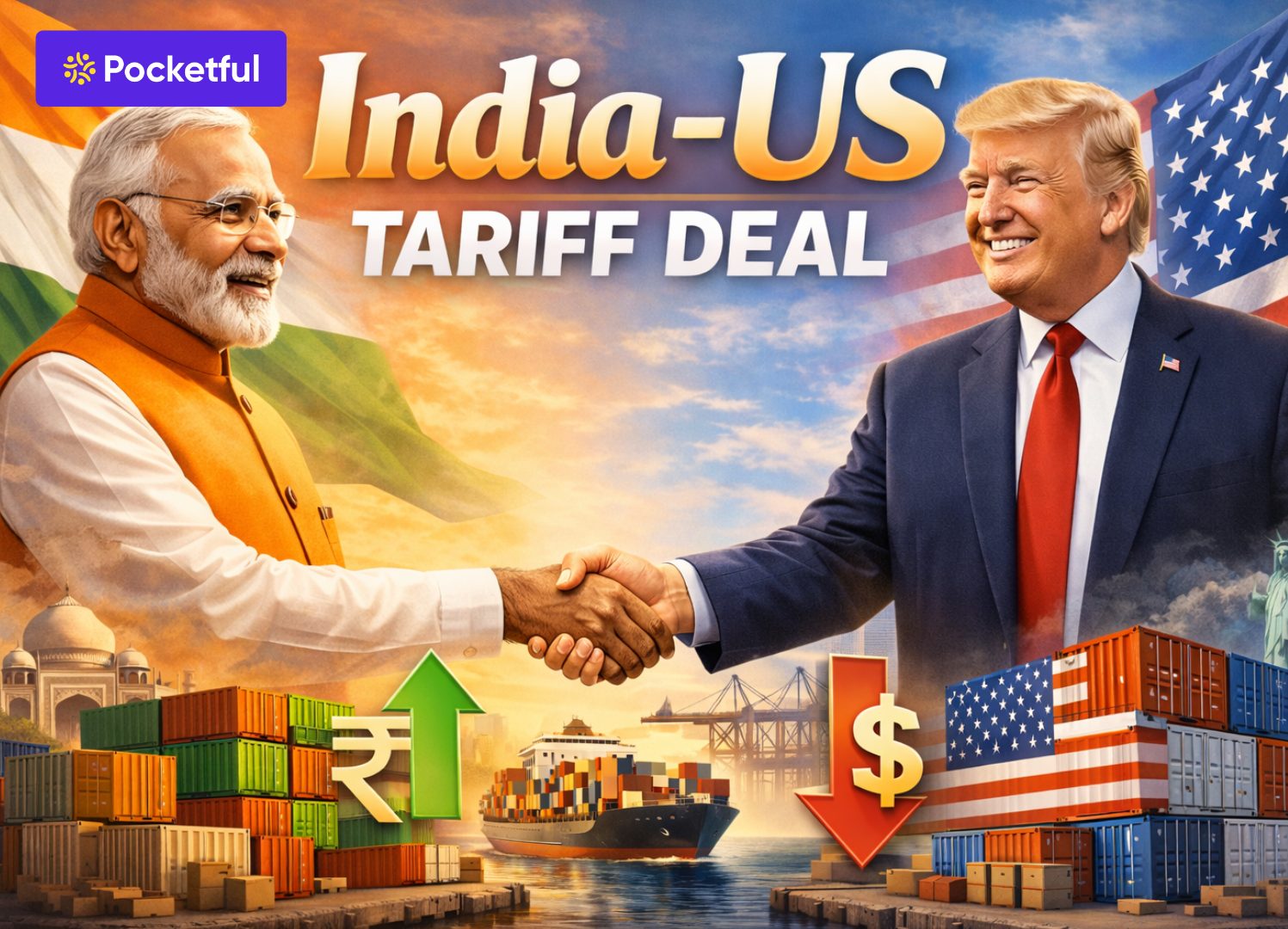
For the past few months, there had been uncertainty surrounding trade relations between India and the United States. High tariffs were putting pressure on both Indian exporters and the market. Now, a significant change has occurred. The US has reduced the tariff imposed on India from 50% to 18%. This decision came after discussions between President Donald Trump and Prime Minister Narendra Modi. This agreement will not only provide relief to trade but will also strengthen economic ties between India and the US.
India-US Tariff Deal: What Exactly Was Announced?
The biggest impact of the new trade deal between India and the United States has been on tariffs and energy imports. Following this agreement, the overall US tariff rate on Indian goods has decreased from 50% to 18%, providing direct relief to Indian exporters.
| Component | Previous situation | New agreement |
|---|---|---|
| US tariffs on Indian goods | 50% (25% reciprocal + 25% penalty) | 18% |
| Purchase of Russian oil | High dependence | Gradual reduction |
| Imports from the US by India | At a limited level | Over $500 billion (energy, tech, agri, coal) |
| Trade relations | Uncertain | Reset & stabilized |
| Investor sentiment | Weak | Improving |
Tariff Timeline: How the 50% Tariff Became 18%
The tariff dispute between India and the United States saw continuous fluctuations from 2025 onwards. Tariffs were increased at times, temporary relief was granted at others, and finally, an agreement was reached between the two countries in early 2026. The timeline below clearly shows how the total tariff imposed on India gradually rose to 50% and then decreased to 18%.
| Date | What happened |
|---|---|
| April 2, 2025 | The US has imposed a 10% baseline tariff on India. |
| April 5, 2025 | The tariff has been increased to 26%. |
| April 9, 2025 | The tariffs have been temporarily suspended for 90 days. |
| July 31, 2025 | The US announced it will impose a 25% reciprocal tariff on India. |
| August 1, 2025 | A 25% reciprocal tariff has been implemented. |
| August 6, 2025 | A 25% additional penalty tariff was imposed for buying Russian oil. |
| August 27, 2025 | The total tariff increased to 50%. |
| February 2, 2026 | The tariff on imports from India has been reduced to 18%. |
Tariff Comparison: India’s position after the India-US deal
| Country | Tariff rate |
|---|---|
| India | 18% |
| China | 34% |
| Brazil | 50% |
| Russia | 50% |
| South Africa | 30% |
| Vietnam | 20% |
| Bangladesh | 20% |
| Pakistan | 19% |
| European Union | 15% |
| Japan | 15% |
Strategic Trade-Off on Energy: Tariff India-US Deal
- Reduction in Russian Oil Purchases : Under a new trade deal, India has agreed to gradually reduce its purchases of oil from Russia. This decision is linked to a tariff agreement with the United States, which reduced the overall tariffs imposed on India from 50% to 18%. This move removed the additional penalty tariffs imposed on India and eased trade pressure.
- Increased Oil Imports from the US and Venezuela : According to US President Donald Trump, India will now buy more energy products from the United States and will also import oil from Venezuela if needed. In return, India is committing to purchasing more than $500 billion worth of energy, technology, and agricultural products from the US.
- The Purpose of This Decision : Prime Minister Narendra Modi described this agreement as a step towards strengthening relations between the two countries.
This strategic shift has three main objectives :
- To enhance alignment with the US in the global geopolitical balance
- To reduce the risks associated with sanctions
- To make India’s energy supply more secure and diversified
India-US Tariff Deal: What will be the impact on different sectors in India?
| Sector | Effect |
|---|---|
| Engineering Goods | Competition will increase in the US market. |
| Electronics & Components | The supply chain will expand. |
| Textiles & Apparel | You will get better price margins. |
| Leather & Footwear | Exports will pick up again. |
| Agriculture & Marine Products | New market and demand opportunities |
| MSMEs | Helping to connect with global supply chains |
- Economic Growth to Receive Support: The reduction in tariffs from 50% to 18% will ease the pressure on Indian exporters, and export volumes are likely to increase. This will generate new demand for the manufacturing sector and support India’s GDP growth. According to experts, the elimination of uncertainty regarding tariffs will allow companies to resume their stalled projects and expansion plans.
- Increase in Jobs and Industrial Activity: This agreement is also expected to have a direct impact on employment. New job opportunities will be created, particularly in the manufacturing, logistics, and export-related sectors. Industries linked to the Production Linked Incentive (PLI) scheme and infrastructure-based companies will also benefit from this decision.
- Benefits for Investment and the Financial Sector: A better trade environment will boost the confidence of foreign investors, and an improvement in FDI flows is expected. Banks and trade finance institutions will benefit from increased credit demand and stronger corporate balance sheets.
Economic Transmission Channels
| Channel | Expected Effect |
|---|---|
| Exports | increase |
| Manufacturing | Expansion |
| Employment | New employment opportunities |
| Corporate Profits | Stability in profits |
| Markets | Positive investment sentiment |
India-US Tariff Deal: What does this mean for multinational companies?
- Reduced Tariff Risk on US Exports : Foreign companies manufacturing in India will now face lower costs when exporting their products to the US market. This will lead to more stable profit margins and easier export planning.
- Increased Clarity in Trade Policy : Companies were previously uncertain about investment decisions due to constantly changing tariff regulations. This deal provides a clear signal that stability is returning to India-US trade relations, enabling medium and long-term planning.
- Faster Investment Decisions : Lower tariffs and a more favorable policy environment will allow foreign companies to make quicker decisions regarding new plants, supply chains, and technology investments in India.
Read Also: Trump Tariffs on India: Trade vs Russian Oil
Geopolitical and Strategic Implications: The India-US tariff deal.
- New Strength in India-US Relations : This trade deal is not limited to trade alone; it also strengthens the strategic partnership between India and the United States. The decision to reduce purchases of Russian oil and increase imports of energy and other products from the US signals trust and cooperation between the two countries. This strengthens India’s position globally as a reliable economic partner.
- India’s Role in US-led Supply Chains : With lower tariffs and a stable trade policy, India can now become a key part of US supply chains. This positions India as an alternative to China and opens up new avenues for investment in the manufacturing and technology sectors.
- Reduced Sanctions Risk : Reducing dependence on Russian oil also lowers the risk of potential sanctions against India. This move makes India’s foreign policy more balanced and pragmatic.
- Alignment with Other FTAs : This agreement also strengthens India’s broader trade strategy, which includes recent free trade agreements with:
- European Union
- New Zealand
- Oman
Key Business Questions: Tariff India-US Deal
| Question | Current situation |
|---|---|
| Will the tariff be reduced even further from 18%? | There is currently no official confirmation. |
| How much tariff will be applied to which products? | A detailed product-wise list is yet to be released. |
| What decision will be made regarding the Rules of Origin? | There is no clarity yet. |
| What is the timeline for the deal to be implemented? | Discussions are ongoing between the two countries. |
| When will the $500 billion purchase take place? | It is likely to happen in a phased manner. |
Risks and Implementation Challenges
- Delays in Policy and Notifications : While the tariff cuts have been announced, both countries need to issue official executive orders and regulatory notifications to fully implement them. Any delays in this process could mean that exporters and companies may not see the actual benefits for some time.
- Non-Tariff Barriers and Compliance Issues : Even with reduced tariffs, non-tariff barriers such as licensing requirements, quality standards, and documentation procedures may persist in certain sectors. This could increase costs for small and medium-sized enterprises (SMEs).
- Political and Global Risks : This agreement is also subject to political decisions. If the trade policies of the US or India change in the future, or if there are shifts in global politics (such as issues related to oil and conflicts), the direction of this deal could be affected.
| Risk | Impact |
|---|---|
| Policy delay (delay in government orders) | Medium |
| Trade disputes | Low |
| Oil price volatility | Medium |
| Political uncertainty | Medium |
Read Also: Recent Telecom Tariff Hike and its Impact
Conclusion
The reduction of tariffs from 50% to 18% in the India-US trade deal is a significant turning point for Indian exports and investments. This will bring stability to trade, boost market confidence, and provide new momentum to several sectors. However, the actual impact will become clear only when product-specific rules and timelines are finalized. Overall, this agreement is a practical and far-reaching step towards strengthening India-US economic relations.
Stay ahead with real-time market news and insights-download Pocketful today.
Enjoy zero brokerage on delivery & ETFs, plus advanced options trading tools on a fast, user-friendly platform.
Frequently Asked Questions (FAQs)
01
What is the India-US tariff deal about?
This is a new agreement in which the US has reduced tariffs on Indian goods to 18%.
02
Why is this deal important for India?
This will make Indian exports cheaper and give a new impetus to trade.
03
Which sectors will gain the most?
The textile, engineering, electronics, and agriculture sectors will benefit the most.
04
Will India completely stop buying Russian oil?
No, India will gradually reduce its purchases of Russian oil.
05
How much will India import from the US?
India will import approximately $500 billion worth of products from the US.
Disclaimer

The securities, funds, and strategies discussed in this blog are provided for informational purposes only. They do not represent endorsements or recommendations. Investors should conduct their own research and seek professional advice before making any investment decisions.
Article History


 Facebook
 Twitter
 Instagram
 LinkedIn
 Youtube