| Type | Description | Contributor | Date |
|---|---|---|---|
 | Post created | Pocketful Team | Nov-10-25 |
Read Next
- SEBI Action on Jane Street: Impact on Indian Markets
- What is Personal Finance?
- Military Wealth Management: Strategies for Growing and Preserving Your Assets
- India’s Republic Day 2025: Honoring the Nation’s Defense Achievements
- 10 Essential Financial Planning Tips for Military Members
- How Do You Apply for PAN 2.0 Online and Get It on Your Email ID?
- 10 Best YouTube Channels for Stock Market in India
- LTP in Stock Market: Meaning, Full Form, Strategy and Calculation
- 15 Best Stock Market Movies & Web Series to Watch
- Why Do We Pay Taxes to the Government?
- What is Profit After Tax & How to Calculate It?
- Budget 2024: Explainer On Changes In SIP Taxation
- Budget 2024: F&O Trading Gets More Expensive?
- Budget 2024-25: How Will New Tax Slabs Benefit The Middle Class?
- Semiconductor Industry in India
- What is National Company Law Tribunal?
- What is Capital Gains Tax in India?
- KYC Regulations Update: Comprehensive Guide
- National Pension System (NPS): Should You Invest?
- Sources of Revenue and Expenditures of the Government of India
What Is Loan-to-Value (LTV) Ratio in Margin Trading?
Written by : Pocketful Team
|Updated by : Pocketful Team
Published on : 10th November 2025
|Updated on : 10th November 2025



Have you ever wondered how much borrowing is safe if you trade by pledging your holdings? This question becomes the most important in margin trading. In this trading, investors borrow money from the broker by pledging their stocks and take bigger positions with the same money. But how much should this borrowing be? This is where the Loan-to-Value (LTV) Ratio comes in which determines how much you can borrow against your pledged assets. In this blog, we will understand in detail what the loan to value ratio is, how it works, and why it is very important for a trader to understand it.
What is the Loan-to-Value (LTV) Ratio
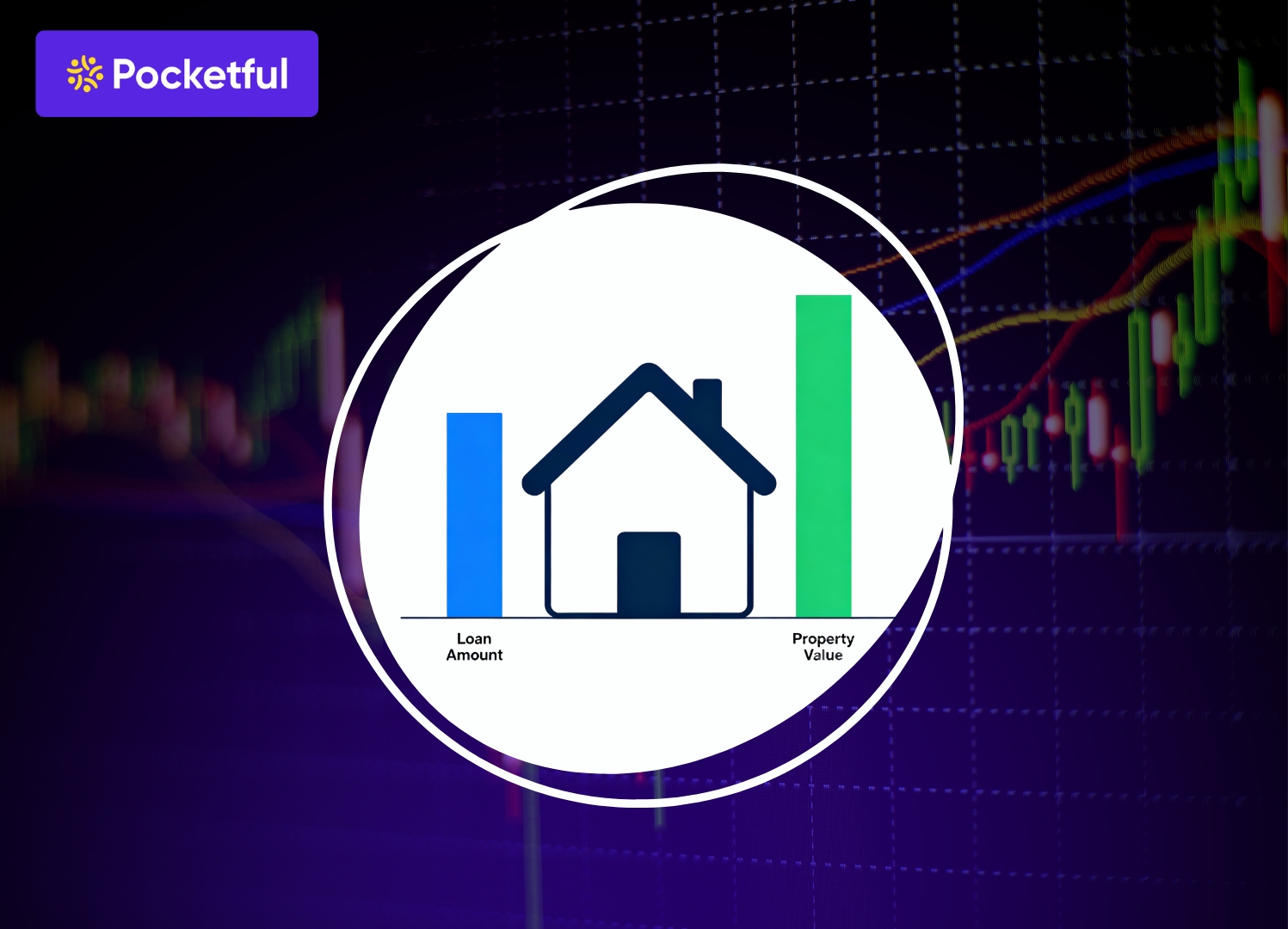
Loan-to-Value Ratio, or LTV for short, is a financial indicator that shows how much of your loan you have taken compared to the total value of a property. This ratio measures how much of your loan amount is the value of your pledged assets (such as a house, stocks or bonds). It is usually expressed as a percentage (%).
LTV is most commonly used in home loans, gold loans, and especially in investment options like margin trading. When you take a loan from a broker by pledging your securities (such as shares), the LTV ratio determines the extent of the loan you will get.
For example, if you pledged shares worth ₹1,00,000 and got a loan of ₹70,000 on it, then your LTV ratio will be 70%. That is, you have borrowed up to 70% of the total value of your property.
What is the formula for LTV?
Loan to Value Ratio Formula:
LTV Ratio = (Amount borrowed ÷ Current value of security pledged) × 100
Example : Suppose you have pledged shares worth ₹1,00,000 and you are given a margin loan of ₹70,000 by the broker Then
LTV = (70,000 ÷ 1,00,000) × 100 = 70%
What is the role of LTV in margin trading?
LTV i.e. Loan-to-Value Ratio plays a very important role in margin trading. When a trader pledges shares or mutual fund units in his demat account with a broker, the broker lends him a certain amount based on the value of these assets; this is called margin loan.
But the question is how much money will be received against the value of that collateral? The answer to this is LTV.
How does the broker decide LTV?
The percentage of LTV depends on which securities you are pledging and how stable and reliable their market value is.
- If you have pledged stocks of blue-chip companies (like TCS, Infosys, HDFC Bank), then these companies are considered less volatile. In such a situation, the broker can give you LTV ranging from 70% to 80%.
- On the other hand, if you pledge penny stocks, mid-cap or stocks of more volatile companies, then the LTV reduces to 50% to 60%, because the risk of decline is higher in such stocks.
SEBI rules and effect of haircut : According to SEBI, every broker is required to apply a haircut on pledged securities. This haircut is a safety cut in the value of the asset which reduces the risk of the broker in case of a sudden market crash or decline.
For example : If you have pledged shares worth ₹1,00,000 and SEBI has fixed a 20% haircut on it, then the broker will consider the effective value of that collateral as ₹80,000. Now if LTV of 75% is applied on it, then you will get a usable margin of about ₹60,000.
Read Also: Differences Between MTF and Loan Against Shares
Why is Loan-to-Value Ratio so important in trading?
Loan-to-Value Ratio (LTV) is one of the most important metrics in margin trading, as it directly reflects the safety of your position and your creditworthiness to the broker. A high LTV indicates that you have taken a lot more loan than the value of your assets, which means more risk.
1. Increasing LTV poses a risk of margin call
In margin trading, when the value of your portfolio decreases and it affects the LTV, the broker can trigger a margin call on your account. This means that you will have to immediately deposit additional margin to support your position or reduce the loan by selling parts. If you do not respond in time, the broker can automatically sell your holdings, thereby ensuring a loss.
2. It also affects interest rates
LTV is not only an indicator of risk, but it also affects the interest rate at which you will get a loan from the broker. A lower LTV usually results in a lower interest rate. But as the LTV increases, the broker’s risk also increases and the interest rate can be higher accordingly. This is why trading on a higher LTV can prove to be expensive.
3. Higher LTV means more leverage and more risk
When you pledge your stocks and trade with a loan from the broker, you are using leverage. LTV indicates the level of that leverage. For example, if your LTV is 75%, it means you have traded with only 25% of your capital and the remaining 75% is borrowed. This strategy can certainly increase profits, but the losses can also be huge if there is a slight fall in the market.
4. Understanding LTV is essential for successful trading
Often new investors focus only on how much credit they can get from the broker, and end up using the entire limit. But experienced and professional traders know that it is not only wise to reach the LTV limit, but it is also important to keep that ratio stable and safe. A controlled and prudent LTV is the key to success and longevity in trading.
Factors That Influence LTV in Margin Accounts
There are many important factors behind deciding LTV (Loan-to-Value) in Margin Trading. All these factors together decide how much margin an investor will get on pledged shares.
- Volatility of the stock : If a stock is more volatile, that is, its prices fluctuate rapidly, then the LTV available on it may be less. Brokers do not want to take much risk in this situation.
- SEBI Classification (Group 1 vs Group 2) : SEBI has divided the shares into Group 1 and Group 2. The shares coming in Group 1 (such as blue-chip stocks) are considered more secure and there is a possibility of getting higher LTV (60–75%) on them. On the other hand, more haircuts are given on the shares included in Group 2.
- Liquidity of the stock : Highly liquid stocks, that is, those which can be bought and sold easily, get better LTV. The broker usually gives less LTV on pledging shares with low liquidity.
- Market conditions and broker’s risk policy : If there is a sharp decline or uncertainty in the market, the broker may reduce the LTV as per its internal risk norms. Sometimes brokers apply stricter margins as per their risk appetite.
- Regulatory Updates and Circuit Breakers : If SEBI implements new rules or circuit breakers are imposed on a stock, then the LTV may also change. The broker can immediately increase the haircut or remove the MTF eligibility.
Read Also: What is Margin Money?
Common Mistakes Investors Make Around LTV
- Using excessive leverage : Many investors use all the funds they can get through LTV without thinking that the market may crash. High leverage can turn a small loss into a big one.
- Ignoring margin calls : If the value of pledged shares falls, the broker sends a margin call. Ignoring this can lead to your account being frozen or shares being confiscated.
- Pledging high-risk stocks : Stocks that have a lot of volatility (such as penny or speculative stocks) have higher haircuts and lower margins. This can lead to frequent margin shortfalls.
- Underestimating interest cost : Funds received through LTV attract interest. If this cost is not understood, the profit that is shown may actually turn out to be a loss.
- Not having a Risk Management Plan : While doing margin trading, it is important to have a proper stop-loss, diversification and capital allocation strategy. Trades done without planning can be harmful.
How to Manage and Control Your LTV Ratio
- Monitor the portfolio regularly : Keep a constant eye on your pledged shares and their market value. If the price of any stock falls, it will directly affect your LTV. Check portfolio health at least once a week.
- Diversification is important : Pledging only one type of stock or one sector can increase the risk. Pledging shares of different sectors and fundamentally strong companies reduces the haircut and keeps the LTV stable.
- Keep an emergency margin buffer : Never use your entire eligible margin. Keep a buffer of at least 10–15% so that you do not have to face margin shortfall in a sudden market fall.
- Use calculators and tools : Nowadays many platforms provide advanced LTV calculators and portfolio analytics tools. These tools can tell you in real-time what your current LTV is and how much margin is left.
- Use alerts and automation : Most brokers now offer tools that send you alerts via SMS or app notifications when your LTV is approaching the limit. Also, some platforms have an auto-margin top-up facility so that the system automatically maintains the buffer.
Read Also: What is Pledging of Shares?
Conclusion
If you do margin trading, understanding the Loan-to-Value (LTV) ratio is as important as trading. This ratio determines how much funds you can borrow against your pledged securities and how far your risk is spread. If you trade without understanding it, you may face a margin call or forced sell-off in a sudden market fall. Therefore, a smart trader is one who keeps the LTV in balance, tracks it from time to time and takes action when needed. After all, proper planning and control are the companions of good trading.
Frequently Asked Questions (FAQs)
01
What is the full form of LTV in margin trading?
LTV means “Loan-to-Value”, which tells how much loan or margin you can take against the value of pledged shares.
02
What happens if my LTV ratio increases too much?
If the LTV becomes high, the broker may send a margin call or sell your shares.
03
Is a lower LTV always better?
Yes, lower LTV is safer as it carries less risk if the market falls.
04
How can I reduce my LTV ratio?
You can reduce your LTV by adding cash or more shares, or by closing some positions.
05
Does every broker offer the same LTV limit?
No, different brokers follow different haircuts and LTV limits, depending on the category of stock.
Disclaimer

The securities, funds, and strategies discussed in this blog are provided for informational purposes only. They do not represent endorsements or recommendations. Investors should conduct their own research and seek professional advice before making any investment decisions.
Article History


 Facebook
 Twitter
 Instagram
 LinkedIn
 Youtube