| Type | Description | Contributor | Date |
|---|---|---|---|
 | Post created | Pocketful Team | Apr-02-26 |
Read Next
- Top 10 Most Traded Commodities in the World
- Import Tax on Gold in India 2026: Latest Rates, GST & Budget Impact
- 1 Pavan Gold in Grams: Conversion, Price & Calculation Guide
- Why Oil Prices Rise During War | Iran-US War
- How the Iran War Impact on Oil, LPG, Gold & Inflation?
- Will LPG Cylinder Prices Increase Due to the Iran War?
- What is Commodity Valuation?
- Exchange of Futures for Physical (EFP)
- Commodity Arbitrage – Types & Strategies in India
- Top Major Commodity Exchanges in India
- The Pros and Cons of Commodity Trading
- What is the Commodity Index?
- Types of Commodity Market in India
- Tax on Commodity Trading in India
- Understanding Commodity Market Analysis
- Risks in Commodity Trading and How to Manage Them
- 5 Tips for Successful Commodity Trading
- Best Online Commodity Trading Platforms in India: Top 10 Picks for Traders
- Commodity Trading Regulations in India: SEBI Guidelines & Impact
- What is the Timing for Commodity Market Trading?
Commodity Futures vs Options in India: Key Differences
Written by : Pocketful Team
|Updated by : Pocketful Team
Published on : 5th April 2026
|Updated on : 2nd April 2026



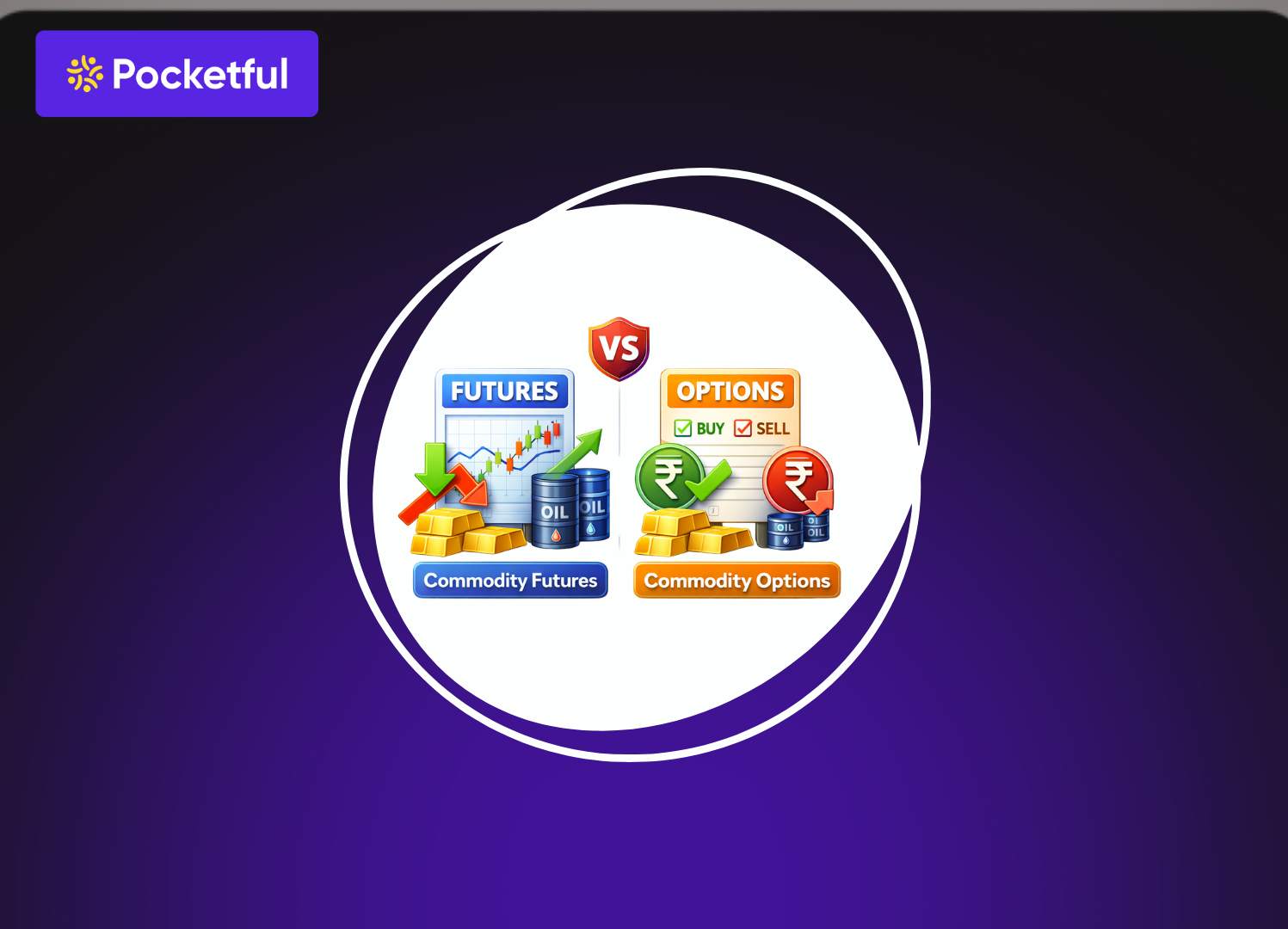
Trading in the commodity market can sometimes feel like a puzzle as there are numerous options and features. If you are looking at the Indian markets, you have probably heard about trading gold, silver, or crude oil. These types of products are known as commodities. Here you are trading raw materials that the world uses every day.
When you start, you will have to choose between commodity futures vs options. Both are popular ways to invest on the Multi Commodity Exchange (MCX), which is India’s main platform for these trades. One is a firm promise, while the other is more like an insurance policy.
Commodity Futures
A commodity futures is a direct contract cum agreement, here when you enter a futures trade, you are making a legal promise. You agree to buy or sell a fixed amount of a commodity at a set price on a specific date in the future.
In India, these contracts are standardized. This means the exchange decides the quality and the “lot size” (the minimum amount you must trade). For example, a standard Gold futures contract on MCX is for 1 kilogram, while a Gold Mini contract is for 100 grams.
How Commodity Futures Work
The main thing to understand here is the margin, here investors do not have to pay the full amount of the commodity. Rather you just have to pay a small amount usually between 5% to 15% of the total value of your trade to benign with the trade.
A contract is held by the investor every day and the exchange does a check called “Mark-to-Market” (MTM). If the price movements are in your favour the profits earned are settled directly in your account. And if the price starts to move in the other direction and you start to incur loss then losses are deducted from your account immediately.
Advantages of Trading Futures
- Easy to understand: If the price of the commodity is rising then you buy and if the prices starts to fall then you have to sell. In this no complex formulas are used.
- High Liquidity: Most of the commodities listed on exchanges have good supply and demand making it easier for the traders to enter and exit anytime.
- No Time Decay: Unlike options, a futures contract does not lose value just because time is passing. The price only changes based on the market.
Risks of Futures Trading
- Unlimited Risk: Since you are bound by a contract, your losses can be very large. If the price moves sharply against you, you could lose much more than your initial margin.
- Margin Calls: If your account balance falls too low due to daily losses, your broker will ask for more money. If you cannot provide it, they will close your position at a loss.
- Compulsory Delivery: In India, if you do not close your position before the expiry date, you might have to actually take delivery of the physical goods, like bars of gold.
Commodity Options
Commodity options are a bit more flexible. They give you the “right” to buy or sell a commodity futures contract, but you are not forced to do it. You pay a small fee, called a “premium,” for this right.
In India, commodity options are actually “options on futures.” This means if you exercise your option, it turns into a futures position in your account. This process is called “devolvement”.
How Commodity Options Work
There are two main types of options you need to know:
- Call Options: You buy these if you think the price will go up.
- Put Options: You buy these if you think the price will go down.
If the market does not move the way you expected, you can just let the option expire. The most you will lose is the premium you paid at the start.
Advantages of Trading Options
- Limited Risk: Your loss is capped at the premium you paid, which gives many traders peace of mind.
- Lower Capital: You can start trading with a very small amount. While futures might require lakhs of rupees, you can buy some options for just a few thousand rupees.
- Multiple Ways to Profit: You can create your own strategies and generate profits even if the market is going up, down or even staying flat.
Risks of Options Trading
- Time Decay: With every passing day the value of your option is decreasing even if there are no changes in the price of the commodity.
- Complexity: Options are a little complex in nature and they have different moving parts like volatility and Greeks. This makes it a little difficult to learn how they really work.
- Devolvement Margins: If your option is about to expire and it has value, the exchange will ask for a high margin because it is about to turn into a futures contract.
Read Also: Difference Between Options and Futures
Key Differences Between Futures and Options
1. Obligation vs Right
In futures, you are locked into a deal and things need to be followed accordingly. In options, you have a choice. If the trade is losing money, you can simply walk away and lose only your premium.
2. Risk Exposure
Futures have “linear risk,” meaning for every point the price falls, you lose money meaning there is no floor. In options (for buyers), the risk is capped as you know your maximum loss before you even click the “buy” button.
3. Cost of Entry
Futures trading is comparatively expensive as high margins are required by the exchange. But options are cheaper to buy, making them famous amongst the retail traders who possess less capital.
4. Profit Potential
Both investments can give you good profits. Although futures are preferred to catch small profits and steady moves. And options usually require a bigger or faster price move to overcome the cost of the premium and time decay.
5. Complexity Level
Futures are easy to get, as investors need to buy if they think the price will go up, sell if they think it goes down. However options are more like a strategy game where you have to balance price, time, and market speed.
Commodity Futures vs Options
| Features | Commodity Futures | Commodity Options (buy) |
|---|---|---|
| Your Promise | Legal obligation to trade. | Right to trade, but no obligation. |
| Maximum Possible Loss | Can be unlimited if the price crashes. | Limited to the premium you have paid. |
| Max Profit | Unlimited | Unlimited (after subtracting premium). |
| Money required | High (5% to 15% margin). | Low (only the premium amount). |
| Effect of Time | No loss due to time passing. | Value drops every day (time decay). |
| Difficulty level | Easy to understand. | Requires more learning. |
| Daily Cash Settlement | Yes (MTM happens daily). | No (only at the time of trade). |
| Flexibility | Low | High |
Read Also: Types of Commodity Market in India
Key Strategies for Investors
Futures Strategies
- Trend Following: This is about “riding the wave.” If you see that crude oil prices are steadily rising because of global news, you buy and hold as long as the price stays above a certain average.
- Spread Trading: Here, you buy one contract and sell another related one. For example, you might buy gold for this month and sell gold for next month. You are betting on the “gap” between their prices rather than just the price itself.
Options Strategies
- Covered Calls: If you already own physical gold or a long futures position, you can sell a call option to someone else. You collect a premium, which acts like “rent” on your investment.
- Protective Puts: If you own gold and you analyse that the price may fall you buy a put option. And if the price starts to crash the profit from your put option covers the loss of your gold.
- Straddles and Strangles: These are used when you are sure about the massive moves but have no idea regarding the direction. For example, before a big government announcement, you buy both a call and a put. If the price jumps or crashes, one side will make enough profit to cover the loss of the other.
Factors to Consider Before Choosing
- Risk Appetite: How much loss can be handled. If seeing a big negative number on your screen keeps you up at night, buying options might be better because the risk is fixed.
- Capital Availability: If you have Rs.20,000 in your account, you cannot trade standard gold futures. You would have to look for options or “micro” lots.
- Market Knowledge: For beginners futures are preferred in very small quantities or else one needs to spend time learning the “Greeks” of options before jumping in.
- Trading Goals: Futures are often better for very fast trades because they move exactly with the price.
Read Also: Commodity vs Forex Trading: Key Differences, Pros & Cons
Conclusion
At the end of the day, neither futures nor options are “better”, these are just two different tools used for different purposes. Futures are easy and direct for the traders as it only wants you to be disciplined and know how to manage risk by using the stop-loss feature. On the other hand options are versatile in nature and offer safety to the investors capital, but you need to be right about the market timings for the desired results.
The best way to start this is by learning the in and out about one commodity like crude oil or gold and then monitor its price movements. Also start with small investments, manage your risks, and always have a plan before you enter a trade. It is a great place to invest and earn profits only if you are patient and disciplined.
For more market news and insights, download Pocketful – offering users zero brokerage on delivery trades and an easy to use platform designed for both beginners and experienced investors.
Frequently Asked Questions (FAQs)
01
Can I trade commodities with a small amount like Rs.5,000?
Yes, you can start investing although regular futures require lakhs, but you can trade “Gold Petal” futures or buy options on certain commodities with a very small amount.
02
Do I have to pay tax on commodity trading profits?
In India, commodity trading profits are usually treated as “Business Income” and you are taxed according to your total income slab.
03
What is the biggest risk in buying options?
The biggest risk is time decay, if the market stays flat and doesn’t move quickly in your direction, your option can become worthless even if you were “right” about the long-term trend.
04
Is the MCX market different from the stock market?
Yes, the stock market deals with company shares, while MCX deals with raw goods. MCX also has much longer trading hours, staying open until late at night.
05
What happens if I forget to close my futures position before expiry?
In many cases, you might be required to take physical delivery of the goods. Most brokers will automatically close your position a few days before this happens to protect you from this complexity.
Disclaimer

The securities, funds, and strategies discussed in this blog are provided for informational purposes only. They do not represent endorsements or recommendations. Investors should conduct their own research and seek professional advice before making any investment decisions.
Article History


 Facebook
 Twitter
 Instagram
 LinkedIn
 Youtube