| Type | Description | Contributor | Date |
|---|---|---|---|
 | Post created | Pocketful Team | Apr-02-26 |
Read Next
- MTF Pledge Explained: How to Use Shares as Collateral in India
- What Is Liquidation in MTF?
- Silver Trading on MCX: Lot Size, Margin, Price Limits & Strategies Explained
- Manual Scalping vs AI Scalping Trading: Key Differences
- Is Margin Trading Facility (MTF) Safe in India?
- Commodity Futures vs Options in India: Key Differences
- Best Scalping Trading Platforms in India 2026
- GIFT Nifty vs Nifty 50: Key Differences
- MTF vs Intraday Trading: Key Differences
- Crude Oil Trading Strategy: Best Time, Tips & Indicators
- How Does MTF Work? Step-by-Step Explained with Example
- Gold Trading on MCX: How to Trade Gold in India for Beginners
- Long Vol vs Short Vol in Options Trading
- What is Gamma in Options Trading?
- Nifty Weekly Options Strategy for Beginners
- Pre-Open Market Session in India: Timings, Meaning & How It Works
- What Is Proprietary Trading?
- What Is Short Delivery in Share Market?
- What Is the Turtle Trading Strategy?
- What Is CFD Trading?
Commodity vs Equity Trading in India: Key Differences
Written by : Pocketful Team
|Updated by : Pocketful Team
Published on : 8th April 2026
|Updated on : 8th April 2026



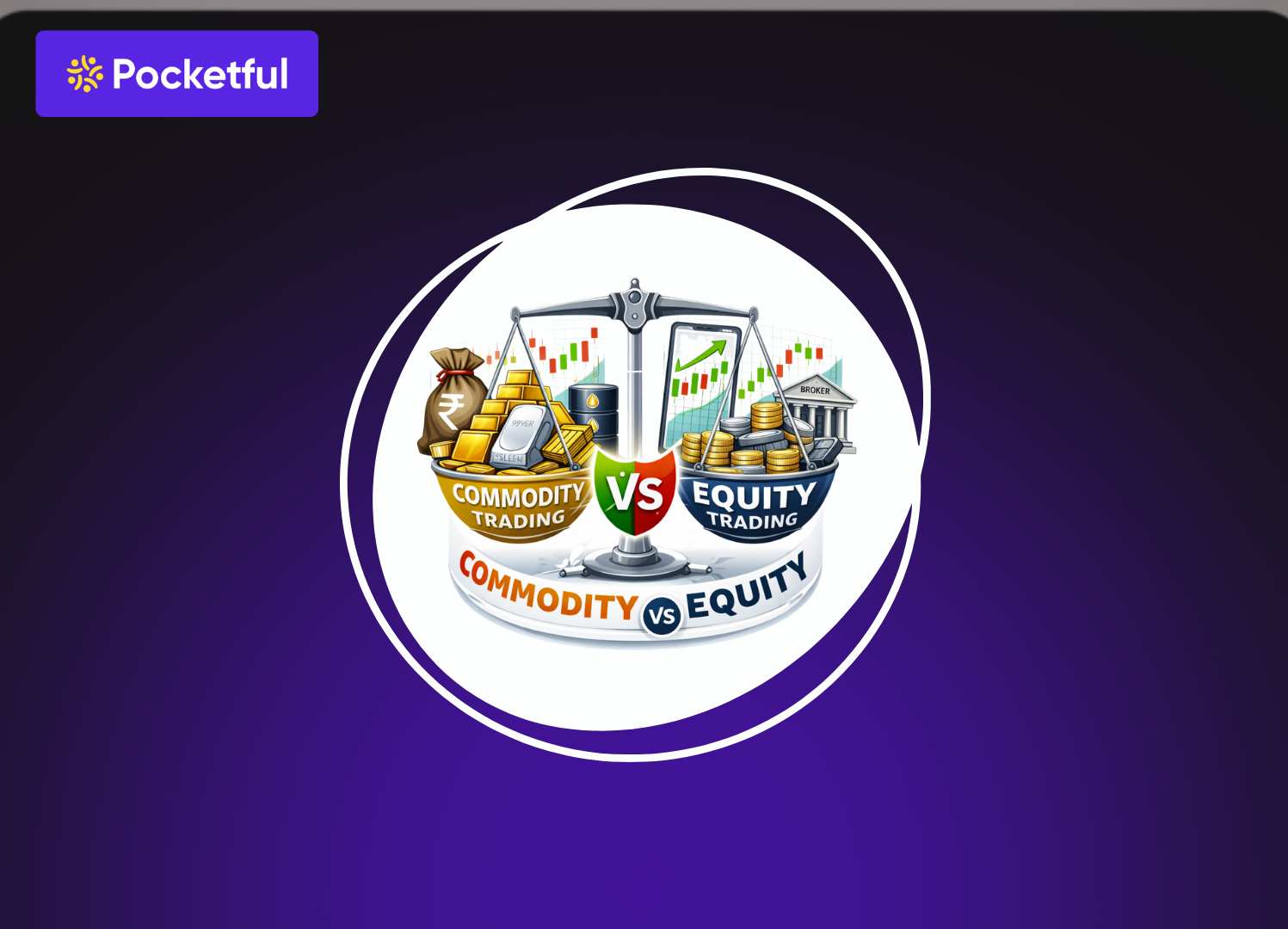
In the stock market trading is just a simple act of buying and selling financial assets to generate profit out of it. People trade in financial markets to grow their wealth and even achieve financial freedom. The main motive behind this is to tackle the rising cost of living and save for their future.
The financial market is a regulated platform where you can easily buy and sell shares safely. When you enter this market there is a major choice that investors need to make. They have to pick the market that suits them, meaning that there are two popular choices: commodity market and equity market. In this blog we will know commodity vs equity trading in India.
What is Equity Trading?
Equity represents shares or stocks of a publicly listed company. In this the investors buy the shares of the listed company and get a little ownership according to the shares bought. By getting hands on these shares you get a partial ownership of the company’s assets and profits.
When companies need to expand and require more money for working & growing they sell their ownership in small parts as shares to the general public. These shares are then listed on the stock exchange for the general public. As an investor you can look for these shares on major stock exchanges like Bombay Stock Exchange (BSE) and the National Stock Exchange (NSE).
Investors use a secure and safe digital Demat account for buying and selling shares. In commodity trading investors buy and sell the shares of famous companies. You can think of it as buying shares of a prominent IT Company or Infrastructure company. If the company performs well and makes good profit the share price increases automatically.
If the shares perform well and give a good profit, investors can sell these shares and earn profit. Equity markets run smoothly due to these key participants. The system is run smoothly due to these key participants. The main motive of the retail investors is to generate profits from their savings. Big financial companies like mutual funds act as domestic institutional investors.Foreign investors bring global money into the Indian market. Finally, regulators ensure everyone follows the rules and stays safe.
What is Commodity Trading?
Commodity trading’s main focus revolves around the physical goods present all over the market. In commodity trading basic raw materials and agricultural products are involved. Here the items included in this are standardised in nature, meaning one kg of silver will be exactly the same everywhere. These materials act as the building blocks of the economy.
There are two main types of commodities in the market. Hard commodities are natural resources that must be extracted or mined from the earth. Examples include gold, silver, copper, and crude oil. Soft commodities are agricultural items that farmers grow and harvest, examples of soft commodities are wheat, cotton, and soybean.
Unlike the stock market, retail traders rarely take physical delivery of these goods. They do not keep barrels of oil at home. Instead, they trade using special digital agreements called derivative contracts. They agree to buy or sell the commodity at a set price on a future date. Let us look at an example, suppose a trader knows that festival season is coming soon. They expect the demand for gold to rise significantly. They buy a gold contract on an exchange like the Multi Commodity Exchange (MCX). When the gold price jumps, they sell the contract for a cash profit.
Read Also: Stock Market vs Commodity Market
Key Differences Between Commodity and Equity Trading
In this table we will look at the key differences between the commodity and the equity market, comparing both markets side by side.
| Feature | Equity Trading | Commodity Trading |
|---|---|---|
| Nature of assets | Ownership in publicly listed companies (shares). | Standardized physical goods and raw materials. |
| Market behavior | Driven by company performance and corporate growth. | Driven by global supply, demand, and weather. |
| Trading hours | Fixed daytime hours (9:15 AM to 3:30 PM). | Extended hours (9:00 AM to 11:55 PM). |
| Volatility | Generally moderate with daily price limits. | Highly volatile due to sudden global supply shocks. |
| Liquidity | Generally high for top market stocks. | Varies greatly depending on the specific commodity. |
The nature of assets is the most obvious difference. Equity gives a person a real stake in the companies/business. Commodities are just physical goods used to make other things.
Market behavior and price drivers also stand apart. A stock price changes based on how well a company runs its operations. A commodity price changes based purely on global supply and demand forces.
In these two markets trading hours and exchanges are very different. Stock markets have fixed daytime hours from morning to mid-afternoon. Commodity markets stay open late till the night. This extended timing happens for a specific reason. Indian commodity prices must match global market timings to give the accurate data.
Volatility levels also show a total difference between the two. Stocks generally move at a steady pace. This makes the equity cash market moderately volatile. Commodities can see huge and sudden price jumps making it more volatile.
Liquidity differences exist across both spaces. Top equity shares are very easy to buy and sell in the market due to good trading activity. In the Commodity market liquidity depends heavily upon the specific item being traded.
Factors That Influence Prices
Prices go up and down for very specific reasons. Investors shall always keep an eye on the following factors:
Equity Market Drivers
- Company performance is the biggest factor to look for. If a business reports high sales and generates good profits, its stock price naturally goes up. Investors prefer to put their money in highly profitable companies as they are reliable.
- Economic growth helps the entire stock market to rise. When the country’s economy grows it results in people having secure jobs and high purchasing power. This increased spending boosts the company’s earnings everywhere.
- Investor sentiment is a strong psychological driver. When people feel positive and hopeful about some company, they buy more shares. This buying leads to pushing the share price up.
- Government policies change the scope and growth of businesses. Good tax rules and new infrastructure budgets help companies to expand. This directly increases the overall value of their shares.
Commodity Market Drivers
- Supply and demand control everything here. If factories need copper but mines are closed, the price of copper will shoot up. This simple rule dictates all raw material pricing.
- Weather conditions heavily impact agricultural items. A bad monsoon in India will quickly ruin important crops. This makes items like cotton and soybean very expensive.
- Geopolitical events cause instant market panic. If a conflict breaks out in an oil-producing region, global crude oil prices jump instantly. Traders react quickly to the fear of sudden supply shortages.
- Global economic trends decide how much material the world needs. When big countries build new cities, they buy massive amounts of steel and energy. This global buying activity pushes commodity prices higher.
Risk and Return Comparison
Every financial choice involves balancing risk and reward. Risk levels in equity trading are generally moderate. A person might lose money if a specific company fails. However, investing in large and famous companies keeps this risk low.
Risk levels in commodity trading are significantly higher. Raw material prices react wildly to unexpected global news events. A sudden storm or political fight can erase profits in minutes.
Potential returns in both markets look very different over time. Equity offers steady wealth growth over many years. Investors earn returns through share price increases and dividends.
Commodity returns happen very fast through quick price movements. The role of leverage in commodity trading makes it unique. Leverage lets a trader control a huge asset amount by paying only a small margin. This facility magnifies potential profits greatly. However, it also magnifies potential losses.
Read Also: Commodity vs Forex Trading: Key Differences, Pros & Cons
Investment Horizon
The time a person plans to hold an asset is their investment horizon. Long-term investing in equities is highly recommended. People buy strong shares and hold them for decades. This patience builds massive wealth over time.
Short-term and hedging strategies are common in commodities. Derivative contracts expire quickly, so traders cannot hold them for years. These contracts are even used by the businesses for hedging prices. For example, an Indian oil company might buy oil contracts at today’s rate and lock it for sometime. This results in protecting your margins for the upcoming month.
Equity cash markets are perfect for beginners to start their investing career as this market is safe, simple and easy to learn.
Commodity trading is best suitable for experienced traders as this market requires the investor to understand complex risks and fast-moving global markets. Finding a good platform like Pocketful is key for a smooth experience.
Advantages of Equity Trading
- Company ownership: When you buy shares of a company you become a fractional owner of that company.
- Dividend payout: When companies make good profit they share a part of this profit with their investors as dividends.
- Wealth creation: If you hold a share for a long term, the price eventually rises and even beats the inflation.
Disadvantages of Equity Trading
- Market volatility: Prices can fluctuate highly due to rumours, global panic, economic news or change in government policies.
- Company-specific risks: If the company has a weak board of directors or the company goes bankrupt the investors can lose their money.
- Overexposure: Putting all your money in one industry can become very risky as one factorial change can lead to huge losses.
Advantages of Commodity Trading
- Hedge against inflation: When the cost of living goes up, the prices of raw materials usually rise too, which protects the investors money.
- Diversification benefits: Commodities move very differently than stocks Commodities often move differently than stocks. Diversifying your portfolio and adding commodities can help in minimizing the risk.
- Profit from global trends: Investors can look out for multiple global and domestic factors which can help in investing at the right place, resulting in profit.
Read Also: Tax on Commodity Trading in India
Disadvantages of Commodity Trading
- High volatility: Prices can fluctuate instantly due to sudden global or domestic issues and investors can face negative results.
- Complex market dynamics: Beginners can face problems in managing everything right like lot sizes, margins, and contract expiry dates etc.
- Requires active monitoring: There is high movement in this market and it operates till late hours. Continuous watch is required on events, news and share activity on screen.
Tips for New Traders
New investors shall start slow and focus on learning the depths of how the market functions. You should have a solid plan before entering the financial market as a plan could help in making better decisions regarding buying and selling of these items.
Trading based on emotion can trigger impulsive decisions which can result in losses. As a new trader you should rely on strict risk management tools to avoid risky trades. Also you should put a stop-loss order in ongoing trades to save your money during market downturns. As it automatically sells off the shares before a small loss turns into a massive disaster.
One shall always know the core rules of the financial market like contract details and timings of both the market. And one shall only enter the market after doing proper research.
Conclusion
These markets provide good opportunities to the investors to grow their wealth. Equities help you to build a good financial future but the growth requires patience. In the Commodity market there is a quick action that takes place and you also stay protected against inflation.
The right option totally depends upon the future goals and the risk appetite you have. Acquiring knowledge plays a major role as it can help you to make better informed decisions.
For more market news and insights, download Pocketful – offering users zero brokerage on delivery trades and an easy to use platform designed for both beginners and experienced investors.
Frequently Asked Questions (FAQs)
01
What is the fundamental difference between commodity and equity trading?
Equity represents buying ownership in a company through shares. A commodity refers to trading raw materials like gold, crude oil, or wheat.
02
Where are these assets traded in India?
Equities are traded on financial markets like the BSE (Bombay Stock Exchange) and NSE (National Stock Exchange) whereas Commodities trade only on certain exchanges like Multi Commodity Exchange (MCX) and National Commodity & Derivatives Exchange (NCDEX).
03
What factors drive the prices in each market?
Prices in the equity market are derived by the company’s performance, earnings growth, and overall market sentiment about the company. And commodity market prices are derived by global supply and demand, geopolitical events and even due to external factors like weather.
04
Which market is better suited for a beginner?
The equity cash market is generally recommended for beginners because they understand things in this market easily and it also involves a little risk as compared to commodity markets. Commodity trading is highly volatile and uses complex contracts, making it better for experienced traders.
05
Do commodity traders earn regular dividends?
No, commodities do not pay dividends because they are physical goods, not profit-making businesses. Profits in commodity trading come strictly from short-term price movements.
Disclaimer

The securities, funds, and strategies discussed in this blog are provided for informational purposes only. They do not represent endorsements or recommendations. Investors should conduct their own research and seek professional advice before making any investment decisions.
Article History


 Facebook
 Twitter
 Instagram
 LinkedIn
 Youtube