



| Type | Description | Contributor | Date |
|---|---|---|---|
 | Post created | Pocketful Team | Apr-08-26 |
Read Next
- Short Selling vs Put Options: Key Differences
- Spin-Off vs Split-Off: Key Differences, Examples & Tax in India
- Trendline Trading: Types, Strategies & How to Draw
- What Is Freak Trade in the Stock Market?
- What Is Active Trading? Types, Strategies & Risks
- USD INR Trading: Lot Size, Strategies & How to Trade
- What Is a Trading Halt in the Stock Market?
- Binary Options Trading: How to Trade?
- What is Carbon Credit Trading Scheme? Types & Example
- How to Reactivate a Trading Account Online: Step-by-Step Guide
- Equity Curve in Trading: Meaning, Analysis & Examples
- How to Place an Order During CAS Window
- What is the Impact Cost in Trading?
- Stock Market Crash in India: History & Causes
- Fundamental Trading: A Beginner’s Guide
- What is MetaTrader 4 (MT4)?
- Types of Financial Instruments available for Trading in the Capital Market
- Importance Of Algo Trading In Futures And Options For Traders
- Convexity in Options Trading: Meaning, Benefits & Risks
- Best AI Trading Tools in India 2026: Top 5 Tools
How to convert MTF to Delivery (CNC)?
Published on : 14th April 2026
|Updated on : 7th August 2026



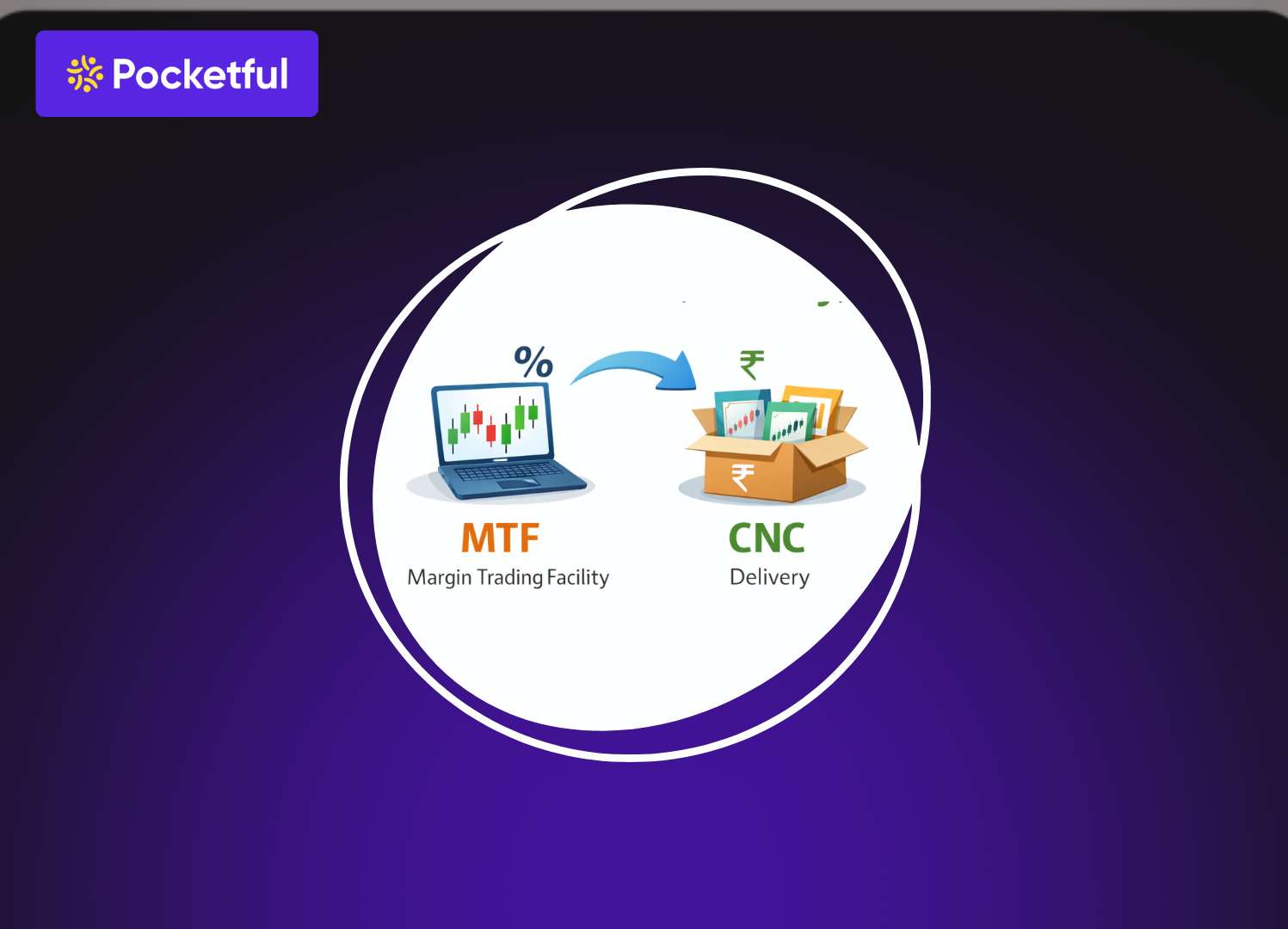
Many traders initially execute trades with limited capital using MTF; however, when it becomes necessary to hold a stock for an extended period, converting it to Delivery becomes essential. In such scenarios, understanding the process of MTF-to-CNC conversion is crucial. Since the interest charged on MTF positions can impact your returns over time, executing the conversion at the right moment constitutes a prudent decision.
What is MTF and CNC?
MTF (Margin Trading Facility)
MTF is a facility that allows you to purchase shares by borrowing funds from a broker. It enables you to take a larger position with a smaller amount of capital; however, in exchange, you are required to pay interest, and the shares remain with the broker as collateral.
CNC (Cash and Carry / Delivery)
Under CNC, you purchase shares using your own full capital, thereby acquiring complete ownership of them. Since it involves no leverage or interest charges, it is considered a safer option for long-term investments.
Difference Between MTF vs CNC
| Feature | MTF | CNC |
|---|---|---|
| Ownership | Shared Ownership with a Broker | Full ownership belongs to you. |
| Interest | Interest is charged (MTF interest rate applies). | No interest |
| Holding Period | Better for the short term | Suitable for the long term |
| Capital Required | You can take a position with a small amount of capital. | You have to pay the full amount. |
How to convert MTF position to delivery (CNC)
Step 1 – Open the Portfolio Section :
First, log in to the Pocketful app and navigate to the Portfolio section, where all your holdings and MTF positions are displayed.
Step 2 – View MTF Positions :
Within the Portfolio section, you will see an MTF option. Clicking on this will open a list of all your MTF positions.
Step 3 – Select the Stock :
Click on the specific stock you wish to convert into Delivery (CNC) and review its details.
Step 4 – Select ‘Convert to Delivery (CNC)’ :
After selecting the stock, you will find a ‘Convert’ option, through which you can initiate the MTF-to-CNC conversion process.
Step 5 – Add Required Funds :
Before proceeding with the conversion, it is essential to ensure that the required margin (comprising the remaining amount plus interest) is available in your account. If your funds are insufficient, you must first make a deposit.
Step 6 – Confirm the Conversion :
After verifying all the details, confirm the conversion. Upon confirmation, your MTF position will be converted into Delivery (CNC), and you will become the full owner of the stock.
Charges in MTF to CNC Conversion
- Direct Conversion Charges : At Pocketful, no direct charges or fees are levied for converting an MTF position to CNC. In other words, there is no separate cost incurred solely for the act of conversion.
- Payment of Remaining Amount : At the time of conversion, you are required to pay the full remaining amount for the stock (the portion funded by the broker); only upon making this payment are the shares transferred to your delivery holdings.
- MTF Interest (MTF Interest Rate) : Interest accrues on your position for as long as it remains under MTF. At the time of conversion, you are also required to clear this accrued interest.
When Should You Convert MTF to Delivery?
- When You Want to Avoid Interest Costs : Interest accrues continuously on MTF positions, which can erode your profits over time. In such cases, converting the position to ‘Delivery’ is the better option.
- When You Intend to Hold the Stock for the Long Term : If your outlook shifts from short-term to long-term, converting the position to CNC (Cash & Carry) to take full ownership of the stock is the right decision.
- When Leverage Risk Becomes Excessive : MTF positions can become risky when market volatility increases. At such times, converting the position helps mitigate this risk.
- When You Have Sufficient Funds : To convert a position, you are required to pay the remaining balance; therefore, this step should only be taken when you have sufficient funds available.
- When There is Margin Pressure or a Risk of Square-Off : If your account margin is running low and there is a risk of the broker squaring off your position, converting it to ‘Delivery’ beforehand serves as a safer option.
Try our MTF Interest Calculator
MTF Eligible Stocks List
What Are MTF-Eligible Stocks?
Not every stock is available for MTF (Margin Trading Facility). Only those shares that meet the specific rules and regulations set by both the broker and the exchange are included in the MTF category.
Where to Find the List on Pocketful
You can easily check the list of MTF-eligible stocks on Pocketful’s official website, where the updated list is provided on a regular basis.
Which Stocks Are Included in MTF?
Typically, the stocks included are those that:
- Possess high liquidity
- Are large-cap or selected mid-cap stocks
- Are exchange-approved securities
What Happens After MTF to CNC Conversion?
- Shares Are Transferred to the Demat Account : Following the conversion, the shares are credited to your Demat account, and the MTF tag is removed.
- Full Ownership Is Acquired : You now hold full ownership of these shares, and the broker retains no control over them.
- MTF Interest Charges Cease : After the conversion, the MTF interest rate no longer applies, thereby saving on additional costs.
- The Position Becomes a Long-Term Holding : The position is now converted to CNC (Cash & Carry) mode and can be held as a long-term investment.
- Margin Risk Is Eliminated : Post-conversion, the risk of a margin call or a forced square-off is eliminated, making the position more stable.
How to Exit MTF Position Without Conversion
- Exit by Selling the Stock : If you wish to close your position, you can exit an MTF position simply by selling the stock. In this scenario, you are not required to pay the remaining outstanding amount.
- Reduce Risk Through Partial Selling : Instead of closing the entire position, you can sell a portion of your holdings to reduce your market exposure and lower interest costs.
- Time Your Exit According to Market Conditions : It is advisable to make a timely exit either when the market moves in your favor or when your target price is achieved to avoid incurring unnecessary losses or accumulating additional interest charges.
- Utilize Stop-Loss Orders : Since MTF trading involves higher risk, setting a stop-loss order to trigger an automatic exit is a prudent strategy.
- Exit Before Facing Margin Pressure : If your account’s margin level is depleting, it is safer to voluntarily exit the position yourself rather than waiting for the broker to execute a forced square-off.
Read Also: What Is Liquidation in MTF?
Key Points to Check Before Converting
- Are Sufficient Funds Available : To convert an MTF position to CNC, you are required to pay the remaining balance; therefore, first ensure that your account holds adequate funds.
- Is the Stock Suitable for the Long Term : Not every stock is suitable for delivery. Convert only those stocks that hold potential for long-term growth.
- Is the Interest Cost Impacting Returns : If the MTF interest rate is eroding your profits, converting the position may prove to be a prudent decision.
- What Are the Market Conditions : Leverage can be risky in a volatile market; therefore, converting to CNC is a sensible move to ensure stability.
- Is There a Risk of Margin Pressure : If your account margin is depleting and there is a risk of a forced square-off, converting the position proactively is the safer course of action.
Conclusion
Converting from MTF to CNC is advisable when your focus shifts from short-term trading to long-term holding. In such a scenario, it is more practical to take ownership of the shares in your own name, thereby avoiding interest costs. However, before initiating the conversion, ensure you make a decision only after carefully considering your available funds, the strength of the stock, and the prevailing market conditions, so as to avoid unnecessary risks. Stay ahead in the market with Pocketful. Enjoy lowest MTF rates, zero AMC, and free account opening.
Frequently Asked Questions (FAQs)
01
Can I convert MTF to delivery at any time?
Yes, as long as your MTF position is active and the required funds are available in your account, you can perform the conversion.
02
Does converting MTF to CNC stop interest charges?
Yes, MTF interest charges cease to apply after the conversion.
03
Is there any charge for converting MTF to delivery on Pocketful?
No, there is no direct conversion fee; you simply need to pay the remaining outstanding amount and the accrued interest.
04
What is the MTF interest rate?
This depends on the broker; typically, it ranges from around 9% to 18% per annum.
05
Can I partially convert my MTF position?
Yes, if you wish, you can convert just a portion of the quantity to CNC
Disclaimer

The information shared in this content is intended solely for educational and informational purposes and should not be considered financial, investment, or trading advice. Any references to stocks, mutual funds, or market instruments are purely for informational purposes and do not constitute recommendations. Investments in financial markets are subject to market risks, and past performance is not indicative of future returns. Readers are advised to conduct independent research, review official documents carefully, and consult a qualified financial advisor before making any investment or trading decisions.
Article History