



| Type | Description | Contributor | Date |
|---|---|---|---|
 | Post created | Pocketful Team | May-07-26 |
Read Next
- Delta in Options: Meaning, Formula, Uses & Examples
- What is Commodity Pool Operator (CPO)?
- Best Penny Stock Trading Platforms, Brokers & Apps
- Bid Price and Ask Price: Key Differences
- What is After Hours Trading: Definition, Benefits & Risks
- Minimum Capital Required for Options Trading in India
- Trading Terminal: Meaning, Features, Types & Benefits
- MTF Charges vs Normal Trading Charges: Key Differences
- Slippage in Trading: Meaning, Types, Causes & How to Reduce It
- Types of Stock Market Orders Explained
- What Is Cash Trading? Meaning, How It Works & Benefits
- What is Max Pain Theory?
- What is Averaging Up in Stock Trading?
- What Is an After Market Order (AMO)? Meaning, Timing & How It Works
- How to Reduce Risk in Options Trading: 10 Tips
- What is Speculative Trading in Stock Market?
- What is Pair Trading?
- What is Quoted Price in Commodity Trading?
- Best Strategies to Trade from Charts
- How To Use Directional Movement Index In Trading?
Best Exit Strategies for Day Traders
Published on : 10th May 2026
|Updated on : 12th May 2026



Have you ever bought a stock and watched it go up, only to see it crash before the market closed? We all have been there at some point. Day trading can be very exciting and rewarding. However, it requires a lot of strict discipline and a strong plan.
Many beginners spend all their time finding the right stock to buy. They think a good entry is all they need to make money. But entering a trade is only half the battle. Your real success depends on your intraday entry and exit strategies.
Knowing when to exit in intraday trading is what helps you keep your profits safe. It also helps you limit your losses when things go wrong in the market. If you do not have a proper plan, fear and greed can easily take over your mind.
In this blog, we will talk about how you can plan your trades better. Let us dive into the world of smart trading and learn how to protect our hard-earned money.
Meaning of Exit Strategies for Day Traders
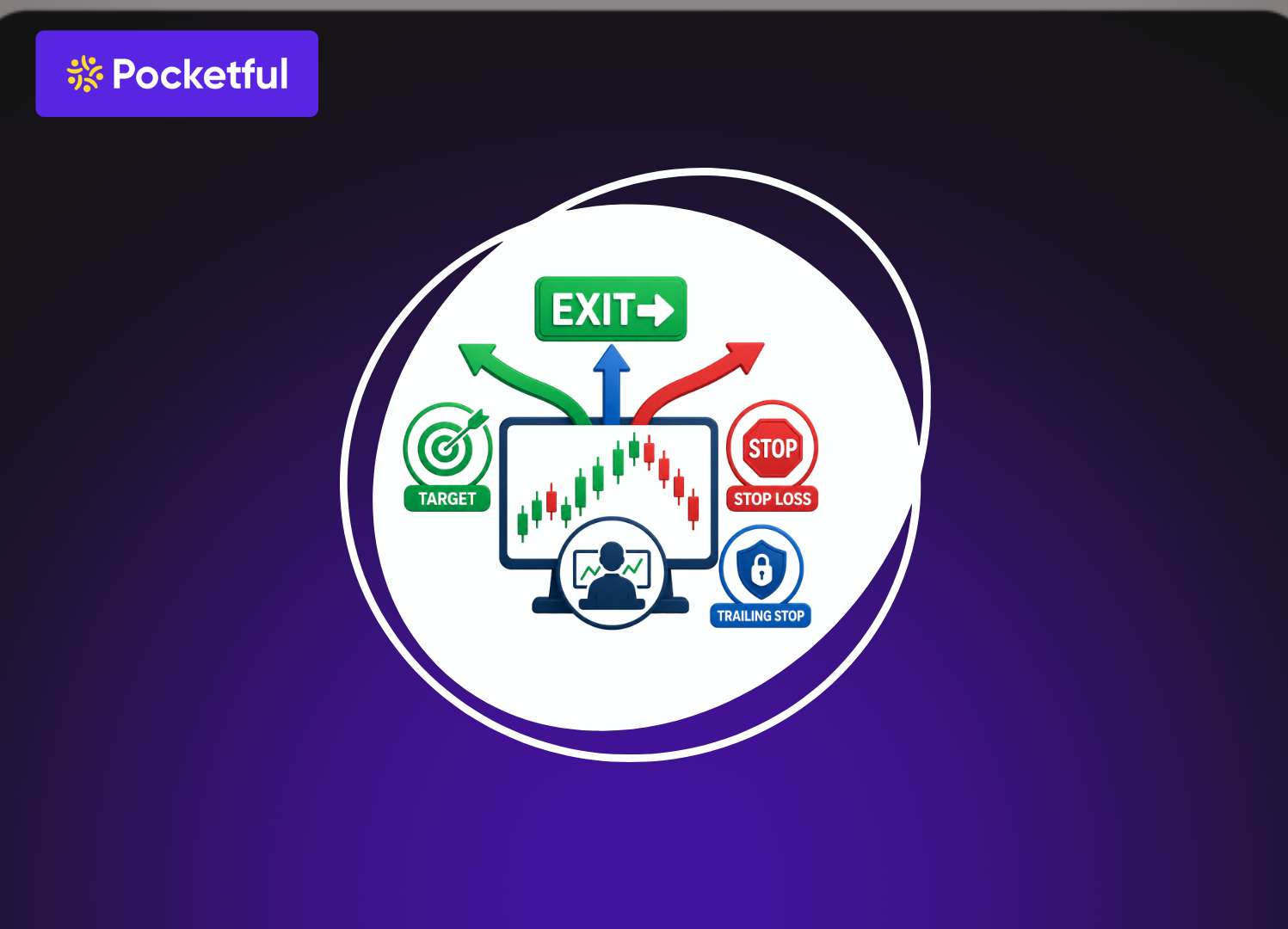
An exit strategy is a clear plan you make before you even start a trade. It tells you exactly when you will close your open position. In the stock market, closing a trade on the same day is often called squaring off.
When you do day trading, you have to square off all your open trades before the market closes. If you forget to do this, your stock broker might do it for you. A good exit plan should always have three main parts to keep you safe.
The first part is your target price. This is the exact price level where you will sell your stock to book a happy profit.
The second part is your stop-loss price. This is the danger level where you will sell your stock to stop any further loss.
The third part is a daily time limit. For example, you might decide to close all your trades by 3:10 PM every day. You do this no matter if you are in profit or loss. This saves you from sudden wild market moves at the very end of the day. Platforms like Pocketful make it very easy to set these targets and stop-losses right when you place your buy order.
Good Exit Strategies for Day Traders
Now that we know why a clear plan is so important, let us look at three very effective exit strategies. You can easily use these methods every single day to protect your trading capital and lock in your profits safely.
1. The Fixed Target and Stop-Loss Strategy
This is the most common and simple strategy for anyone starting in the share market. In this method, you decide two exact price points before you even buy the stock. The first point is your target price. This is where you will sell the stock to take your profit home. The second point is your stop-loss price. This is your emergency exit. If the stock drops to this level, you sell it immediately to stop any bigger losses
Let us understand this with a quick example. Suppose you buy a share of a company at 1000 Rupees. You decide your target price is 1050 Rupees and your stop-loss is 980 Rupees. Here you are risking 20 Rupees to make a profit of 50 Rupees. Once you place the order, you do not need to panic. If it hits 1050, you make money. If it hits 980, you take a small loss and move on.
2. The Trailing Stop-Loss Strategy
Imagine you buy a stock, and it starts going up very fast. You want to capture more profit, but you are scared it might suddenly fall and wipe out your current gains. This is exactly where a trailing stop-loss becomes your best friend in the market.
A trailing stop-loss is a smart digital tool that moves up right along with your stock price. Let us say you buy a stock at 1000 Rupees and set a trailing stop-loss at 950 Rupees. If the stock has a great run and goes up to 1100 Rupees, trail your stop-loss at 1050 Rupees.
Now, you are in a completely safe zone. Even if the stock suddenly crashes,You still walk away with a happy 5 Rupee profit.
3. Exiting at Support and Resistance Levels
If you like reading price charts, this strategy is perfect for you. This method uses the natural bouncing points of the stock market. You can look at a chart to find the support and resistance zones. Support acts like a strong floor where a falling stock stops and bounces back up. Resistance acts like a hard ceiling where a rising stock struggles to cross and falls back down.
If you buy a stock and it is rising nicely, you can plan your exit right near the upcoming resistance level. Since the stock will likely hit this ceiling and fall, it is the perfect spot to book your profits.
Read Also: Top 10 Intraday Trading Strategies & Tips for Beginners
How to determine Entry, Target and Stop-Loss for Exit strategies for day trader
Finding the exact points to enter and exit might sound like rocket science. But we can easily do it using some simple market tools. First, you need to find the main market trend.
You must ask yourself if the stock is going up, going down, or just moving sideways. You should always try to place your trades in the direction of the main trend. Trading against the trend is very risky for beginners.
To find a safe entry price, you can look for support and resistance levels on your chart. Support is a bottom price level where a falling stock stops and bounces back up. Resistance is a top price level where a rising stock stops and falls back down.
If a stock is in an upward trend, you can buy it near a strong support level. This gives you a safe entry point with less risk. Now, let us look at some technical tools, how you can use these tools to find your targets and stop-losses.
| Technical Tool | How it helps you in Day Trading | How to use it for Exits |
|---|---|---|
| Moving Averages | It smooths out messy price changes to show you a clear line of the trend. | You can quickly exit your buy trade if the stock price falls below this moving average line. |
| RSI (Relative Strength Index) | It is a number that tells you if a stock is overbought or oversold by traders. | If RSI goes above 70, the stock is overbought. You can use this signal as a target to book your profits. |
| VWAP | It shows the real average price of a stock based on both volume and price. | If the current price goes very far above the VWAP, it might fall soon. This is a good place to plan your exit. |
Once you find your perfect entry, you absolutely must set a stop-loss. You should place your stop-loss just slightly below the support level for your buy trades. This way, if the support level breaks, you are out of the trade with a very small loss.
You need good software to see all these price levels clearly. Pocketful offers great and fast charting software to help you spot these entry and exit levels quickly.
Advantage of Exit strategies for day trader
Having a strict exit plan has many wonderful benefits for you. It helps you become a calm, disciplined, and relaxed trader. Let us look at the main advantages of having these strategies.
- Protects Your Money: A stop-loss ensures that one single bad trade does not wipe out your whole account. It cuts your losses automatically without any delay.
- Secures Your Profits Stock markets can go up and down very fast. A preset target helps you book your profits in cash before the market trend reverses.
- Reduces Your Stress : When you know your exit points before trading, you do not panic. It removes negative emotions like fear and greed from your decisions.
- No Overnight Tensions Since you exit everything on the same day, you sleep peacefully. You do not have to worry about bad global news coming after market hours.
By deciding your exit point early, you also save yourself from sitting in front of the screen all day with a fast-beating heart. You simply let the system do the hard work for you.
Disadvantage of Exit strategies for day trader
While exit strategies are great, they do have a few downsides too. You need to be aware of these facts so you can manage your daily expectations well. Let us look at the disadvantages in a simple way.
- Limited Daily Profits Since you must exit on the same day, you might miss out on bigger profits if the stock keeps going up the very next morning.
- Needs Constant Attention Even with a plan, you have to watch the live market closely. This can take a lot of your time and mental energy every day.
- Higher Trading Costs Day trading means you buy and sell very often. This frequent trading leads to higher brokerage fees and government taxes.
- Early False Exits Sometimes, the price drops just enough to hit your stop-loss, and then goes back up. You exit with a loss, which feels very frustrating.
Even with these negative points, the safety provided by an exit strategy is far better than trading blindly based on luck. It is always better to have limited profits than to face unlimited losses.
Read Also: What Is Day Trading and How to Start With It?
Conclusion
Day trading can be a wonderful way to grow your money if you do it with strict rules. The stock market can be a very wild place, but your solid plan will keep you grounded. Always remember that saving your capital is much more important than making huge profits on a single day.
We truly hope this guide helps you make much better choices in the stock market. You can use modern platforms like Pocketful to get advanced tools that make your daily trading journey smooth and easy. Keep learning new things, stick to your written plan, and enjoy the beautiful process of becoming a better trader every single day.
Frequently Asked Questions (FAQs)
01
What is the exact meaning of an exit strategy in day trading?
What is the exact meaning of an exit strategy in day trading? An exit strategy is a clear, written plan you make before entering any trade. It tells you the exact price to sell for a profit and the exact price to sell for a loss.
02
What are key advantages of using a stop-loss?
The biggest benefit is that it limits your financial loss if the stock price moves against your wish.
03
How to use technical tools for my daily exit plan?
You can easily use simple tools like Moving Averages or RSI on your live stock charts.
04
How do I easily decide my daily profit target?
You should always look at the risk and reward balance. If your stop-loss risks 100 Rupees, your profit target should be at least 150 Rupees or more.
05
What happens if I forget to exit my intraday trade?
If you do not exit your trade by yourself, your stock broker will do it for you just before the market closes.
Disclaimer

The information shared in this content is intended solely for educational and informational purposes and should not be considered financial, investment, or trading advice. Any references to stocks, mutual funds, or market instruments are purely for informational purposes and do not constitute recommendations. Investments in financial markets are subject to market risks, and past performance is not indicative of future returns. Readers are advised to conduct independent research, review official documents carefully, and consult a qualified financial advisor before making any investment or trading decisions.
Article History