| Type | Description | Contributor | Date |
|---|---|---|---|
 | Post created | Pocketful Team | Apr-01-26 |
Read Next
- Manual Scalping vs AI Scalping Trading: Key Differences
- Is Margin Trading Facility (MTF) Safe in India?
- Commodity Futures vs Options in India: Key Differences
- Best Scalping Trading Platforms in India 2026
- MTF vs Intraday Trading: Key Differences
- Crude Oil Trading Strategy: Best Time, Tips & Indicators
- How Does MTF Work? Step-by-Step Explained with Example
- Gold Trading on MCX: How to Trade Gold in India for Beginners
- Long Vol vs Short Vol in Options Trading
- What is Gamma in Options Trading?
- Nifty Weekly Options Strategy for Beginners
- Pre-Open Market Session in India: Timings, Meaning & How It Works
- What Is Proprietary Trading?
- What Is Short Delivery in Share Market?
- What Is the Turtle Trading Strategy?
- What Is CFD Trading?
- What are the Upper Circuit and Lower Circuit in the Stock Market?
- What Is Colour Trading?
- How to Buy MCX Gold in India 2026?
- What Is Leverage in the Stock Market?
GIFT Nifty vs Nifty 50: Key Differences
Written by : Pocketful Team
|Updated by : Pocketful Team
Published on : 3rd April 2026
|Updated on : 2nd April 2026



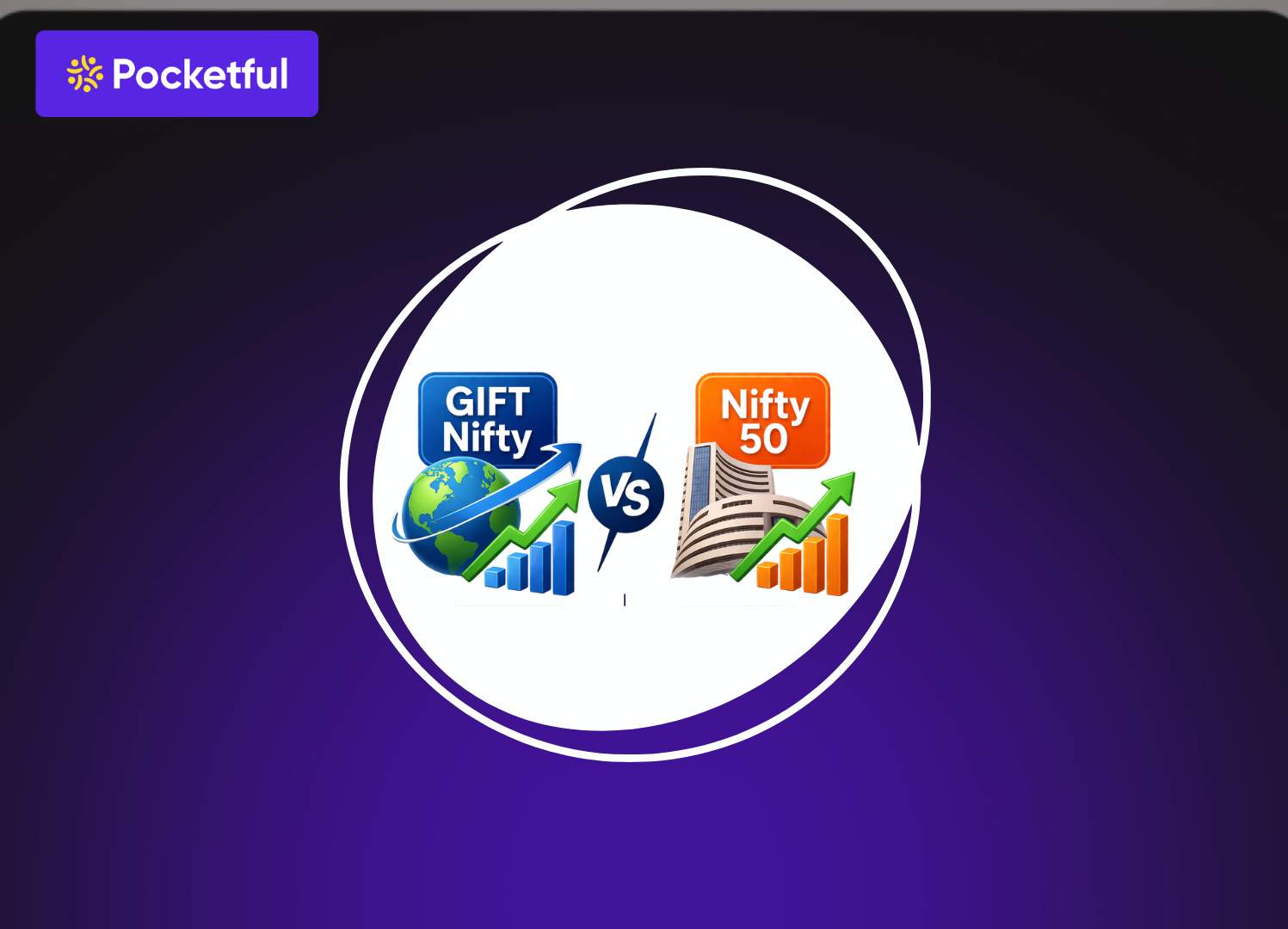
As an investor, you must have tracked multiple market indices. Some of these are GIFT Nifty and Nifty 50. While most people know what the Nifty 50 is, there are various investors who are still searching for what is GIFT Nifty.
This is where you need to start by understanding the GIFT Nifty meaning, especially when markets react before opening hours. Both of these are linked to the same market but their aims are different.
Where one is showcasing the performance, the other is reflecting the expected position. Understanding GIFT Nifty vs Nifty 50 can help you a great deal. So, let us explore the details here.
What Is GIFT Nifty?
GIFT Nifty is an offshore derivative contract. It is the one that tracks the Nifty 50 index. It is traded on the NSE International Exchange at Gujarat International Finance Tec-City.
In simple terms, it reflects how global investors expect the Indian market to move before domestic trading begins. That is why many traders use it as an early indicator of market sentiment.
The GIFT Nifty reflects expectations driven by global cues, such as US markets, crude oil prices, and currency movements.
Features of GIFT Nifty
- Trades for extended hours, allowing participation across different time zones including US and Asian sessions.
- Based on the Nifty 50 index and mirroring its performance.
- Settled in US dollars, making it convenient for foreign investors.
- Operates under Indian regulatory oversight.
- Offers a high level of transparency even in offshore trades.
- High institutional participation.
- Supports liquidity and better price discovery.
Pros of GIFT Nifty
- Provides early signals of how the Indian market may open.
- Helps investors hedge positions outside Indian market hours.
- Reflects real-time global sentiment impacting Indian equities.
- Strengthens India’s position as an international financial hub.
- Offers better control and transparency under Indian exchanges.
Cons of GIFT Nifty
- Does not always match the exact opening direction of the Nifty 50.
- Highly sensitive to global volatility and overnight news.
- Limited participation of the retail investors.
- Currency movements have a great impact.
- Requires understanding of futures trading and derivatives.
How GIFT Nifty Works
GIFT Nifty functions as a futures contract based on the expected value of the Nifty 50. Understanding how it works helps in using it correctly rather than blindly following its movement.
- Based on Nifty 50 Futures Pricing: GIFT Nifty is not the actual index. It is a futures contract. The price of these contracts depends on expected future levels of the Nifty 50. This includes factors like interest rates, dividends, and market expectations.
- Trades Across Global Time Zones: Unlike Indian markets, GIFT Nifty trades for longer hours. This allows investors from different regions to react to global developments such as US market movements or geopolitical events.
- Driven by Global Cues: Its movement is largely influenced by international factors. For example, if US markets fall sharply overnight, GIFT Nifty usually reflects a negative sentiment even before Indian markets open.
- Acts as a Pre-Market Indicator: Indian traders track GIFT Nifty early in the morning. A strong rise or fall often gives a rough idea of how the Nifty 50 might open, though it is not always exact.
- Adjusts When Indian Market Opens: Once the Indian market opens, actual Nifty 50 prices take over. This is where the domestic factors start impacting as well. So, while the Gift Nifty shares an insight, the real performance might vary based on the actual market situations.
Read Also: Understanding GIFT Nifty Trading Timings and Their Impact on Your Trades
What Is Nifty 50?
The Nifty 50 is India’s benchmark stock market index. It represents the performance of the top 50 companies listed on the National Stock Exchange.
In simple terms, the Nifty 50 index shows how the overall Indian market is performing. It covers major sectors like banking, IT, energy, FMCG, and others . This makes it a strong indicator of economic and market trends.
For most investors, tracking the Nifty 50 is the starting point for understanding market direction.
Features of Nifty 50
- Comprises 50 large-cap companies across diverse sectors of the economy.
- Weighted based on free-float market capitalisation.
- Regular review and balancing for better outcomes and relevance.
- High liquidity is there which ensures better transparency.
- The price distortion is quite low.
- Widely used as a benchmark for funds tracking the Nifty 50 index.
Pros of Nifty 50
- Provides a clear picture of overall market performance.
- Helps with better diversification and low risk.
- Good for long-term investors.
- Guides in curating index funds and ETFs as well.
- Transparent and regulated, ensuring investor confidence.
- Lower volatility compared to mid-cap and small-cap indices.
Cons of Nifty 50
- Limited to 50 companies, missing out on emerging businesses.
- Sector concentration, especially in financial stocks, can impact balance.
- Growth may be slower compared to mid-cap and small-cap segments.
- Movements can be influenced by a few heavyweight stocks.
- Does not fully represent the entire Indian stock market.
How Nifty 50 Works
The Nifty 50 index works as a real-time measure of the performance of its constituent companies. Understanding this helps investors use it effectively.
- Based on Free-Float Market Capitalisation: The Nifty 50 is calculated using free-float market cap. This means only publicly available shares are considered, which gives a more accurate market picture.
- Real-Time Index Movement: The value of the Nifty 50 index changes throughout the trading day. This is all based on stock price movements of its 50 companies.
- Periodic Rebalancing: The index is reviewed twice a year. Companies that no longer meet criteria are replaced. The main aim here is to maintain the quality of the index.
- Benchmark for Performance: Mutual funds and investors compare their returns with the Nifty 50. Beating the index is often seen as strong performance.
- Investment Through Index Funds: You cannot directly invest in the index, but you can invest in funds or ETFs that replicate the Nifty 50 index.
GIFT Nifty vs Nifty 50: Key Differences
When you plan to invest in the market, you must know the details well. This applies to knowing the GIFT Nifty vs Nifty 50 clearly. When you know these details, you will be in a better position to make a decision linked to where to invest. So, let us explore all the details you need over here.
| Basis | GIFT Nifty | Nifty 50. |
|---|---|---|
| Definition | Offshore futures contract based on Nifty 50. | Benchmark stock market index of India. |
| What it shows | Expected market direction. | Actual market performance. |
| Trading Location | Gujarat International Finance Tec-City on NSE International Exchange. | National Stock Exchange. |
| Trading Hours | Extended global hours covering multiple time zones. | Fixed Indian market hours. |
| Currency | US Dollar (USD). | Indian Rupee (INR). |
| Participants | Mostly global institutional investors. | Domestic and global investors. |
| Nature | Derivative (futures contract). | Equity index (spot market). |
| Usage | Pre-market indicator and hedging tool. | Benchmark for investment and performance. |
| Impact Factors | Driven mainly by global cues and currency movements. | Influenced by both domestic and global factors. |
| Direct Investment | Not directly accessible for most retail investors. | Can invest via index funds and ETFs. |
Read Also: Gold ETF vs Gold Mutual Fund: Differences and Similarities
Who Should Invest in GIFT Nifty vs Nifty 50?
There are various factors that impact your choice of investment. Some people go for long-term investment with moderate risk, while others may prefer short-term investment with high risk. The choice is all based on the investment type, analysis, and other factors.
So, if you are comparing the Nifty 50 and GIFT Nifty, here is what will help you to make a better call.
Who Should Consider GIFT Nifty
- Traders who want to track early market signals before Indian markets open.
- Those who are looking for global market investments.
- Institutional or high-net-worth participants with access to offshore derivatives.
- People who are looking to hedge as per the global news impacts.
- Experienced traders who understand futures and derivative pricing.
Who Should Invest in Nifty 50
- Beginners who want exposure to top Indian companies with lower risk.
- Long-term investors who prefer transparency and wealth building with stability.
- Investors who prefer simple options like index funds or ETFs.
- People who are looking for diversification of the risk.
- Individuals who want a benchmark-based investment approach.
This makes it clear that GIFT Nifty is more about tracking and short-term positioning, while the Nifty 50 is better suited for actual investing and long-term goals.
Conclusion
GIFT Nifty and the Nifty 50 serve different but complementary roles. GIFT Nifty helps you read early global sentiment, while the Nifty 50 shows the actual market outcome. Using both together gives a more complete view of market direction.
If you are planning to act on these insights, the next step is to start investing the right way. With Pocketful, you can open a demat account easily and start investing. It also offers you tools and reports that help you with better analysis and deciding on where to invest.
Frequently Asked Questions (FAQs)
01
What is GIFT Nifty and why is it important?
GIFT Nifty is an offshore futures contract. It is based on the Nifty 50. It helps investors understand early market sentiment before Indian markets open.
02
Is GIFT Nifty better than Nifty 50?
GIFT Nifty is not better or worse. It shows expected direction, while the Nifty 50 reflects actual market performance.
03
Can retail investors trade in GIFT Nifty?
Access is limited for most retail investors. It is mainly used by institutional and global participants.
04
Why does GIFT Nifty move before Indian markets open?
GIFT Nifty trades across extended global hours, so it reacts to international news and events earlier than domestic markets.
05
Does GIFT Nifty always predict market opening correctly?
No. It gives an indication, but actual market movement may differ due to domestic factors and investor activity.
Disclaimer

The securities, funds, and strategies discussed in this blog are provided for informational purposes only. They do not represent endorsements or recommendations. Investors should conduct their own research and seek professional advice before making any investment decisions.
Article History


 Facebook
 Twitter
 Instagram
 LinkedIn
 Youtube