



| Type | Description | Contributor | Date |
|---|---|---|---|
 | Post created | Pocketful Team | Oct-14-26 |
Read Next
- What is Half Stock?
- What is Purchasing Power?
- GTD Order Meaning: Full Form, Example & How It Works
- Fractional Share: What is it & How Does it Work?
- Growth Investing: Meaning, Strategies, Risks & Key Metrics
- ROE vs Valuation: Understand the Difference
- What is IOC in the Share Market?
- Cyclical vs Defensive Stocks: Key Differences
- CPSE ETF: What Is It, Benefits, Risks & How to Invest
- Long Term vs Short Term Investment: Which One Fits Your Goals?
- How to Invest in Stock Market for Beginners: A Step-by-Step Guide
- Ethical Investing: Meaning, Types, Benefits & Risks
- NYSE vs NASDAQ: Key Differences
- PB Fintech Lower Circuit: Why Is the Stock Falling?
- Why Did the Stock Market Fall Today? Sensex, Nifty, Crude Oil, US Bond Yields & IRDAI Explained
- Parabolic Move in Stocks: Meaning, Causes & Risks
- Federal Reserve Interest Rate: Impact on India & Markets
- What Is ASM in Share Market?
- Tracking Stock: Meaning, Examples, Pros & Cons
- What is the Magic Formula Investing?
How to deal with losses in the stock market
Published on : 15th October 2026
|Updated on : 15th October 2026



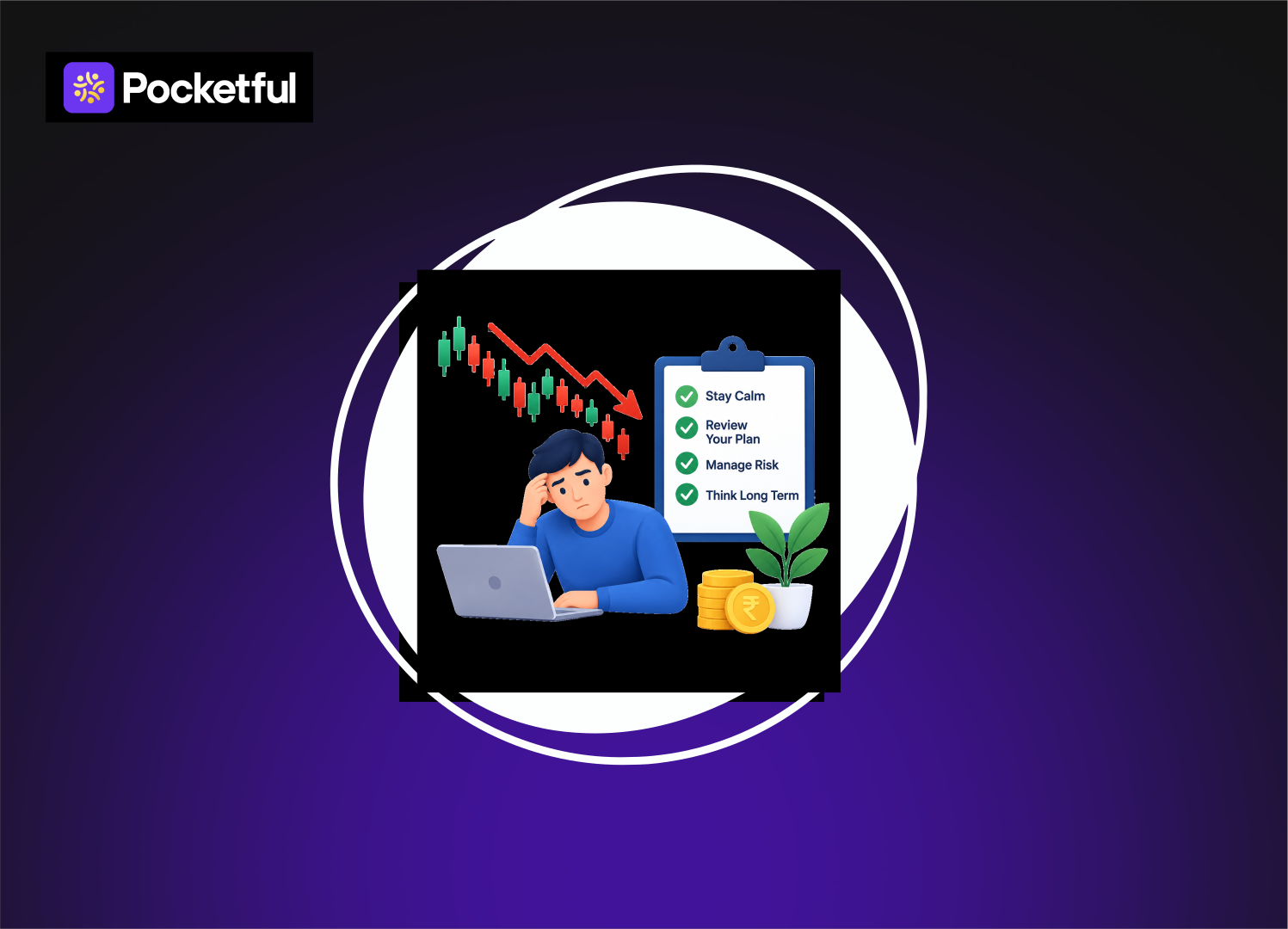
Incurring losses in the stock market is common, but the real challenge arises when one is unsure of
the next move whether to sell, hold, or engage in new trades to recover the funds. A wrong decision can exacerbate the loss. In this blog, we will explore how to handle stock market losses, calculate them, and make informed decisions regarding your next steps in equity, intraday, futures, and options trading.
What Should You Check First After a Stock Market Loss?
If you lose money in stocks, first see how much you lost and why it happened. Don’t rush to sell in panic or start a new trade right away check your actual loss first, and then plan your next move.
Calculate Your Actual Loss
Suppose you bought 40 shares of a company at Rs. 500 per share. After some time, the share price fell to Rs. 400. Your loss would be calculated as follows
| Particulars | Calculation | Amount |
|---|---|---|
| Purchase price per share | – | Rs. 500 |
| Current price per share | – | Rs. 400 |
| Number of shares | – | 40 |
| Total purchase value | Rs. 500 × 40 | Rs. 20,000 |
| Current market value | Rs. 400 × 40 | Rs. 16,000 |
| Unrealised loss | Rs. 20,000 − Rs. 16,000 | Rs. 4,000 |
| Loss percentage | Rs. 4,000 ÷ Rs. 20,000 × 100 | 20% |
This means the current value of your investment has decreased by Rs. 4,000. Since you have not yet sold the shares, this is an unrealised loss. The actual profit or loss will be calculated based on the selling price and applicable charges once the shares are sold.
Identify Why the Loss Occurred
Understanding the exact reason for the loss is equally important. Sometimes the entire market falls, while at other times, a specific company’s share price drops due to weak financial results. In intraday trading, a wrong entry, or taking excessive risks in futures and options, can also lead to losses.
How to Deal with Losses in Equity Investments
If you incur a loss on a stock, first assess how the company’s business is performing. Decisions to either sell or buy more shares based solely on a price drop should not be made without proper analysis.
1. Check how the business is actually doing
Go check the company’s latest quarterly numbers, how much debt they’re sitting on, and their actual profits. If the business is taking a hit month after month, ask yourself if holding on is just foolish hope or a smart move.
2. Hold or sell the stock?
Suppose you bought 50 shares at ₹400, and the price is now ₹320. Before deciding, determine whether there has been a fundamental shift in the company’s business or if the price drop is merely due to a general market downturn.
3. Calculate before ‘averaging’
If you bought 20 shares at ₹500 and another 20 shares at ₹400, your total investment would be ₹18,000, and your average purchase price would be ₹450. While this lowers your average cost, it also ties up more of your capital in that specific company.
4. Don’t put everything into one stock
If most of your portfolio is tied up in just one company, a sudden price drop will hurt your whole investment pretty bad. Spreading your money out over multiple stocks and sectors simply protects you from taking a huge loss if one single company fails.
5. Always keep your goal in mind
If you need cash in the near future, sitting around hoping a fallen stock jumps back up is just too risky. But if you are in this for the long run, make your moves based on how strong the company actually is and what your own financial targets are.
How to Handle Losses in Intraday Trading
If you incur a loss in intraday trading, the first step is to analyze why the trade went wrong. Immediately entering another trade solely to recover losses often leads to even greater losses. Keep the following points in mind:
1. Calculate the potential loss before entering a trade.
For instance, suppose you bought 100 shares at ₹250 and set a stop-loss at ₹245.
| Description | Amount |
|---|---|
| Purchase price | ₹250 |
| Stop-loss | ₹250 |
| Risk per share | ₹5 |
| Number of shares | 100 |
| Potential loss | ₹500 |
2. Figure out why the trade blew up
Once you’re out of a trade, take a second to see what actually happened. Did you enter way too fast, or did the trend just flip out of nowhere? Doing this plain sanity check tells you if your setup was flawed or if the market was just being completely unpredictable.
3. Do not rush to recover losses
Taking a ₹500 hit on your first trade doesn’t mean you must force another trade right away to get that ₹500 back. Only take a new setup when your system actually gives a clear signal.
4. Set a daily loss limit
For example, if your max limit is ₹1,000 for the day, close your screens as soon as you hit that number. It stops you from falling into the trap of revenge trading after every loss.
5. Do not frequently alter your stop-loss
When the price gets close to your stop-loss, shifting it further away just to stay in the trade only balloons your risk. Always stick to the boundaries you set before taking the entry.
6. Do not overlook trading costs
Brokerage and extra fees eat into your total returns. Always calculate your final P&L after adding up all charges instead of just looking at the stock’s gross profit or loss.
Read Also: What should you do if your stock portfolio is stuck in losses?
How to Manage Losses in Futures Trading
Futures losses can blow up your capital in seconds because even a tiny price wiggle impacts the entire contract size. Because of that brutal leverage, you need to calculate your absolute worst-case damage before you even think about placing the trade.
1. Calculate the loss based on the contract
Suppose you bought a futures contract at ₹1,000 with a quantity of 50. If the price drops to ₹980, the loss would be calculated as follows
| Description | Amount |
|---|---|
| Entry price | ₹1,000 |
| Exit price | ₹980 |
| Decline per unit | ₹20 |
| Contract Quantity | 50 |
| Total loss | ₹20 × 50 = ₹1,000 |
2. Don’t size up when you’re down
If your current futures position is losing money, rethink your risk before adding more contracts to the same trade. Buying extra contracts just multiplies your potential losses if things keep dropping. Never make a move based purely on hope that the market will magically turn around for you.
3. Understand the need for additional margin
If losses on a position increase, the broker may demand additional margin. If funds are unavailable, the position could be closed out. Therefore, before entering a trade, ensure you have sufficient funds to cover potential losses.
4. Check the contract status before expiry
Review your position and your next course of action as the futures contract approaches expiry. If the original reason for the trade is no longer valid, make a decision based on your established rules rather than holding onto the position in the hope of avoiding a loss.
5. Do not increase position size when facing losses
If your current futures trade is already bleeding money, stop and think before dumping more contracts in that same direction. Throwing more size at a losing trade just multiplies your potential damage. Never make a move purely on blind hope that the market is about to magically turn around for you.
How to Deal with Losses in Options Trading
In options trading, you can sometimes lose money even when the market moves exactly the way you expected. That happens because option prices don’t just rely on the stock or index direction, time decay and market volatility play a huge role too. Because of this, you need to keep a close eye on these factors whenever a trade goes south.
1. Understand the risk associated with the premium before buying an option.
Suppose you bought a call option with a quantity of 50 at a premium of ₹100. Later, the premium dropped to ₹60, and you sold the position.
| Description | Amount |
|---|---|
| Purchase premium | ₹100 |
| Sales premium | ₹60 |
| Loss per unit | ₹40 |
| Quantity | 50 |
| Total loss | ₹2,000 |
2. Think twice before holding till expiry
As expiry gets close, option premiums bleed time value insanely fast. If the move isn’t going your way, sitting around and praying for a sudden last-second miracle spike is a guaranteed way to lose cash.
3. Watch out for volatility crushed premiums
You’ll often see the index go up, yet your call option drops. That’s usually implied volatility getting crushed or time decay eating away your price. Never trade options looking only at Nifty or Bank Nifty charts there’s more going on under the hood.
4. Get real about option selling risks
When you sell an option, the premium you collect is all the profit you’ll ever get, but your loss potential is massive. Selling naked call options, for example, can blow up your account if the market rockets up. Always calculate margin needs and maximum downside before taking the trade.
5. Stop averaging down a dying option
When a premium keeps sinking, buying more lots just to lower your entry average is pure suicide. Stop and ask if your initial setup is even valid anymore. If the trade’s broken, take the exit and walk away.
6. Simple Setup Checklist to Protect Your Capital
Most traders get wiped out not by black swan events, but by ignoring basic rules. Running through a quick checklist before clicking buy/sell saves serious money.
7. Write your rules down
If you keep changing setups every single day, you’ll never figure out why you’re losing. Write down clear entry triggers and know exactly when you’re staying on the sidelines.
8. Don’t jump on headline news
Good news doesn’t mean the stock’s automatically going up half the time the market already priced it in days ago. Look at how far the stock already moved before you chase it.
9. Double check your screen before Market Close
If you’re doing intraday, make sure you don’t leave an accidental open position when the bell rings. Delivery and overnight positions have totally different rules, so always verify your order type.
Read Also: Best Stop Loss Strategies for Day Trading
Conclusion
Taking a loss in stocks sucks, but panic-trading right after will only dig you a deeper hole. If you own normal shares, just check if the business itself is still solid. If you’re doing intraday or F&O, never ignore how fast those can wipe out cash. Jumping into new trades just to win back what you lost almost always ends badly. Treat every bad trade as a harsh lesson and just don’t repeat the same error next time.
Frequently Asked Questions (FAQs)
01
What should I do right after losing money in stocks?
First, figure out why you took the hit. Only then decide if holding or selling makes sense.
02
Should I sell everything when the market drops?
Not right away. Look at how the actual company is doing and check your own goals first.
03
How can I get back my stock market losses?
Stop rushing. Lower your risk and make calm, calculated moves instead of fast trades.
04
How do I handle losses while intraday trading?
Set your risk limit before opening any trade, and stop overtrading just to get your cash back.
05
Can I lose more cash than I put into options trading?
If you’re buying options, your max loss is just the premium. But if you’re selling options, the downside can be huge.
Disclaimer

The information shared in this content is intended solely for educational and informational purposes and should not be considered financial, investment, or trading advice. Any references to stocks, mutual funds, or market instruments are purely for informational purposes and do not constitute recommendations. Investments in financial markets are subject to market risks, and past performance is not indicative of future returns. Readers are advised to conduct independent research, review official documents carefully, and consult a qualified financial advisor before making any investment or trading decisions.
Article History