



| Type | Description | Contributor | Date |
|---|---|---|---|
 | Post created | Pocketful Team | Jul-17-26 |
What Is SWP in Mutual Funds?
Published on : 19th July 2026
|Updated on : 17th July 2026



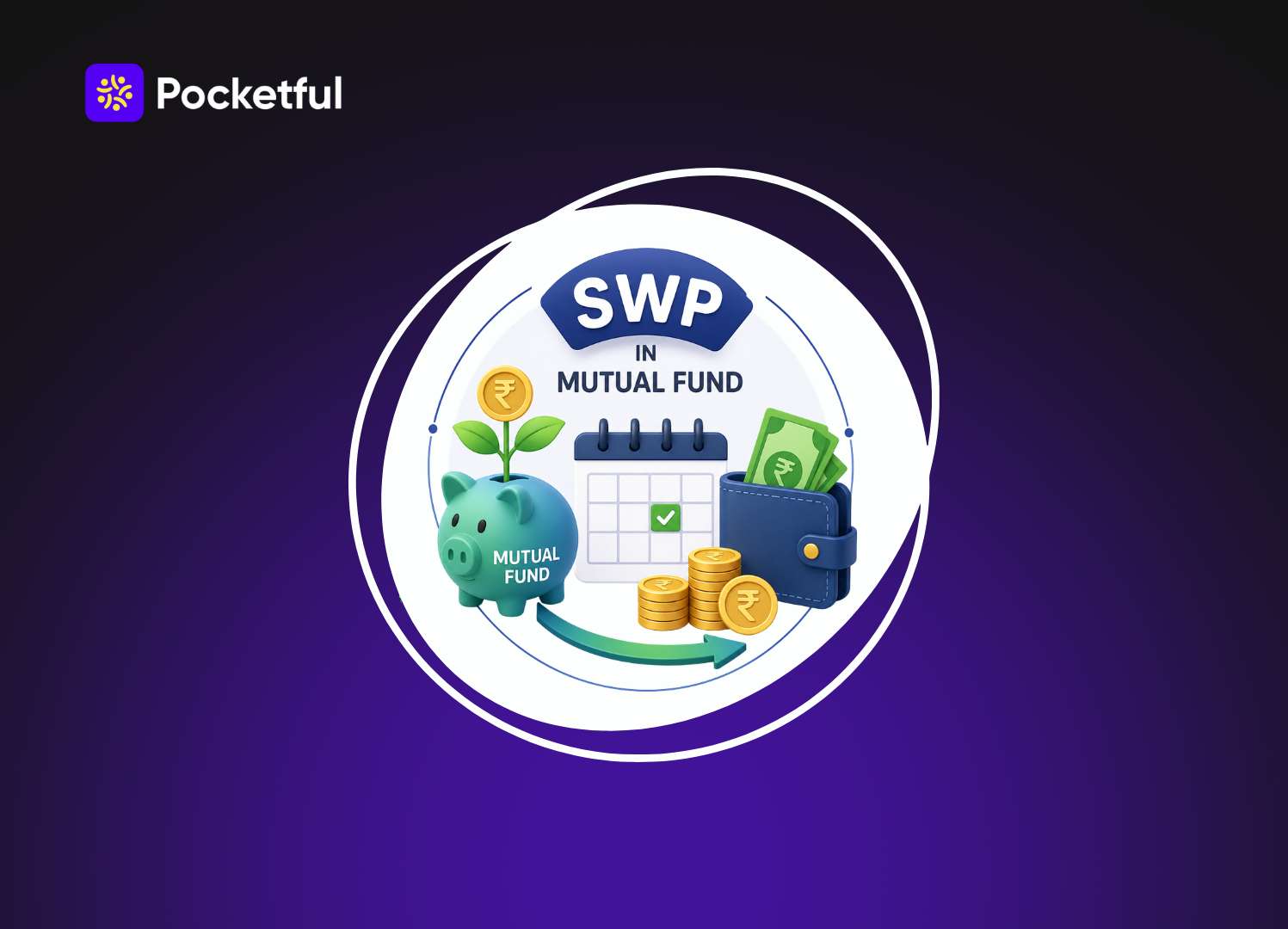
Most investors are familiar with SIP, and this is one which is a key part of the portfolio as well. This is where you invest a fixed amount every month into a mutual fund. SWP works the other way around.
Instead of putting money in regularly, you take money out regularly. But the best part is that the rest of your investment continues to stay invested and grow. For anyone nearing retirement, looking for a steady monthly income, or simply wanting a disciplined way to withdraw from their mutual fund portfolio, understanding SWP is essential.
This guide covers the SWP full form, how a systematic withdrawal plan works, its types, tax treatment, and how you can set one up.
SWP Full Form and Meaning
SWP full form is Systematic Withdrawal Plan. It is a facility offered by mutual funds where you can withdraw from the fund. It allows an investor to withdraw a fixed or variable amount. This is from their investment at regular intervals, which they did in the past.
The remaining units stay invested in the fund. This is where the fund will continue to earn returns based on market performance. In simple terms, an SWP plan converts your mutual fund investment into a source of regular income, without requiring you to sell your entire holding at once.
What Is SWP in Mutual Fund, Explained Simply
SWP investment is essentially the reverse of a SIP:
- It is the process where money moves out of the fund instead of into it.
- You choose the amount and frequency of withdrawal.
- Each withdrawal is processed by redeeming a certain number of units based on the fund’s current NAV.
- The remaining units continue to remain invested and are exposed to market movement.
- You can modify, pause, or stop an SWP mutual fund plan at almost any time.
How Does an SWP Plan Work
When you start an SWP, you are not withdrawing a lump sum from your fund. Instead, the fund house sells a portion of your units. The process is as follows:
1. You Set a Fixed Withdrawal Amount
You decide how much money you want to withdraw and how often. You can choose monthly, quarterly, or any other available frequency. This is based on your financial needs.
2. Units Are Redeemed on Every Withdrawal Date
Instead of withdrawing your entire investment, the mutual fund redeems only the required number of units to match your chosen withdrawal amount. The redeemed amount is then credited directly to your registered bank account.
The number of units redeemed depends on the fund’s Net Asset Value (NAV) on the withdrawal date. If the NAV is higher, fewer units are sold. If the NAV is lower, more units need to be redeemed to generate the same withdrawal amount.
4. Your Remaining Investment Continues to Stay Invested
After each withdrawal, the remaining units continue to be invested in the mutual fund. This allows the balance of your investment to keep participating in market movements and potential long-term growth.
Example of How an SWP Works
Suppose you invest ₹10,00,000 in a mutual fund and set up a monthly SWP of ₹10,000. Every month, the fund redeems units worth ₹10,000. These will be transferred to your account.
Now, here are two things to know:
- Say, the fund delivers returns above your withdrawal rate. Then the remaining investment can continue to grow.
- Another is when the returns are lower, the corpus will gradually decline. This will make it important to choose a sustainable withdrawal amount.
Read Also: SWP vs FD: Which is Better?
Types of SWP in Mutual Funds
- Fixed Withdrawal SWP: You withdraw a fixed amount at every interval, regardless of how the fund performs.
- Appreciation Only SWP: You withdraw only the gains generated by the fund, leaving your original investment untouched.
- Flexible SWP: You can change the withdrawal amount periodically based on your financial needs.
- Capital Plus Growth SWP: A mix where both a portion of capital and gains are withdrawn together over time.
Choosing the right type depends on whether your priority is preserving your original capital or generating a specific level of regular income.
SWP vs SIP vs Lump Sum Withdrawal
| Feature | SWP | SIP | Lump Sum Withdrawal |
|---|---|---|---|
| Purpose | Regular income from investment | Regular investment into a fund | One-time exit from a fund |
| Cash Flow | Money moves out at intervals | Money moves in at intervals | Entire amount withdrawn at once |
| Ideal For | Retirees, income seekers | Long-term wealth building | Immediate lump sum need |
| Market Timing Risk | Reduced through staggered exits | Reduced through staggered entries | Fully exposed to a single day’s NAV |
| Tax Impact | Spread across multiple transactions | Not applicable on investment | Concentrated in a single year |
An SWP essentially applies the same rupee cost averaging logic as a SIP, but in reverse, since withdrawals are staggered across different NAV levels rather than exiting the entire investment at one price point.
Benefits of a Systematic Withdrawal Plan
SWP is a great plan when you execute it in the proper manner. The key benefits are as follows:
- Provides a predictable and regular income stream without disturbing the entire investment.
- Reduces the risk of withdrawing your full corpus at a market low, since withdrawals are spread out.
- Offers more flexibility than fixed deposits, since you can change or stop withdrawals anytime.
- Keeps the remaining investment working in the market, which can help the corpus last longer.
- Can be more tax efficient than a lump sum withdrawal, since gains are realised gradually rather than all at once.
Taxation on SWP in Mutual Funds
Each SWP withdrawal is treated as a redemption of mutual fund units. So, you must know the taxation aspects as well as below:
1. For equity mutual funds
Gains on units held for more than one year are treated as long-term capital gains. But the units held for a shorter period attract short-term capital gains tax.
2. For debt mutual funds
Gains are taxed as per the investor’s income tax slab, regardless of the holding period, under current tax rules.
- Only the gain portion of each withdrawal is taxed, not the entire withdrawal amount, since part of every instalment is a return of your original capital.
- Since withdrawals happen periodically, the tax liability also gets spread across financial years instead of being concentrated in one go.
Because tax rules can change and vary based on individual circumstances, it is a good idea to check the latest provisions or consult a tax advisor before planning large withdrawals through SWP. Keeping a record of the purchase date and NAV for each tranche of units can also make it easier to calculate the correct tax liability at the time of filing returns.
Who Should Consider an SWP Investment
SWP is not for all, and this is the thing that you should understand. The key people who should consider the same are as follows:
- Retirees looking for a steady monthly income from their accumulated mutual fund corpus.
- Investors who want to supplement their salary or business income without a full-time job.
- Anyone transitioning out of a large lump sum, such as from a maturity payout or bonus, into a regular income stream.
- Investors who want to keep a portion of their money invested in the market while still meeting regular expenses.
How to Start an SWP with Pocketful
Setting up an SWP is a straightforward process when you invest through a platform like Pocketful.
- Open a free demat and trading account with Pocketful. This is a complete paperless KYC process.
- Choose a mutual fund based on your risk appetite and investment goal. This can be equity, debt, or hybrid.
- Invest a lump sum or build a corpus over time through SIP. You would need to do this before starting your withdrawal plan.
- Select the SWP option. Now, set your preferred withdrawal amount and frequency, monthly, quarterly, or annually.
- Track your remaining investment value and withdrawals directly from your Pocketful account dashboard.
Since the entire process is managed digitally, you can start, pause, or modify your SWP mutual fund plan whenever your financial needs change.
Read Also: Best SWP for Monthly Income in India
Things to Keep in Mind Before Starting an SWP
- Ensure your withdrawal rate does not consistently exceed the fund’s average returns.
- Review your SWP periodically, especially after major market movements, to check if the withdrawal amount still makes sense.
- Factor in exit loads, if any, that may apply to units redeemed within a short period from purchase.
- Keep your overall asset allocation in mind and based on that work on your plan.
Conclusion
SWP is a practical way to turn your mutual fund investment into a source of regular income. This is all possible while keeping the rest of your money invested and working in the market.
Whether you are planning for retirement or simply want a steady monthly payout, an SWP plan offers flexibility that a lump sum withdrawal cannot match. Open a free demat account with Pocketful today and start building or withdrawing from your mutual fund investments with ease.
| S.NO. | Check Out These Interesting Posts You Might Enjoy! |
|---|---|
| 1 | Mutual Fund vs PMS: Which is Better? |
| 2 | What is Solution Oriented Mutual Funds? |
| 3 | Hybrid Mutual Funds – Definition, Types and Taxation |
| 4 | What is an Open-Ended Mutual Fund & How to Invest in it? |
| 5 | Mutual Fund vs ETF. Are They Same Or Different? |
Frequently Asked Questions (FAQs)
01
What is the SWP full form in mutual funds?
SWP full form is Systematic Withdrawal Plan. It allows investors to withdraw a fixed or flexible amount from their mutual fund investment at regular intervals.
02
How is SWP different from SIP?
SIP involves investing a fixed amount into a mutual fund regularly, while SWP involves withdrawing a fixed or flexible amount from an existing investment regularly. They work in opposite directions.
03
Is SWP a good option for retirement income?
Yes, SWP is commonly used by retirees to generate a predictable monthly income from their mutual fund corpus, while the remaining investment continues to stay invested and grow.
04
Does SWP guarantee returns?
No, SWP does not guarantee returns. The performance of the underlying mutual fund still depends on market conditions, and if withdrawals exceed returns over time, the total corpus can be reduced.
05
Can I stop or change my SWP anytime?
Yes, most mutual funds allow investors to stop, pause, or modify the withdrawal amount and frequency of an SWP at any time without any long-term lock-in.
Disclaimer

The information shared in this content is intended solely for educational and informational purposes and should not be considered financial, investment, or trading advice. Any references to stocks, mutual funds, or market instruments are purely for informational purposes and do not constitute recommendations. Investments in financial markets are subject to market risks, and past performance is not indicative of future returns. Readers are advised to conduct independent research, review official documents carefully, and consult a qualified financial advisor before making any investment or trading decisions.
Article History