



| Type | Description | Contributor | Date |
|---|---|---|---|
 | Post created | Pocketful Team | Jul-10-26 |
Read Next
- Is ₹2000 Note Still Valid in India in 2026?
- Best Stock Market YouTube Channels in India for Beginners
- SEBI Action on Jane Street: Impact on Indian Markets
- What is Personal Finance?
- Military Wealth Management: Strategies for Growing and Preserving Your Assets
- India’s Republic Day 2025: Honoring the Nation’s Defense Achievements
- 10 Essential Financial Planning Tips for Military Members
- How Do You Apply for PAN 2.0 Online and Get It on Your Email ID?
- LTP in Stock Market: Meaning, Full Form, Strategy and Calculation
- 15 Best Stock Market Movies & Web Series to Watch
- Why Do We Pay Taxes to the Government?
- What is Profit After Tax & How to Calculate It?
- Budget 2024: Explainer On Changes In SIP Taxation
- Budget 2024: F&O Trading Gets More Expensive?
- Budget 2024-25 Tax Slabs & Middle Class Benefits
- Semiconductor Industry in India
- What is National Company Law Tribunal?
- What is Capital Gains Tax in India?
- KYC Regulations Update: Comprehensive Guide
- National Pension System (NPS): Should You Invest?
How to Calculate In Hand Salary from CTC
Published on : 10th July 2026
|Updated on : 14th July 2026



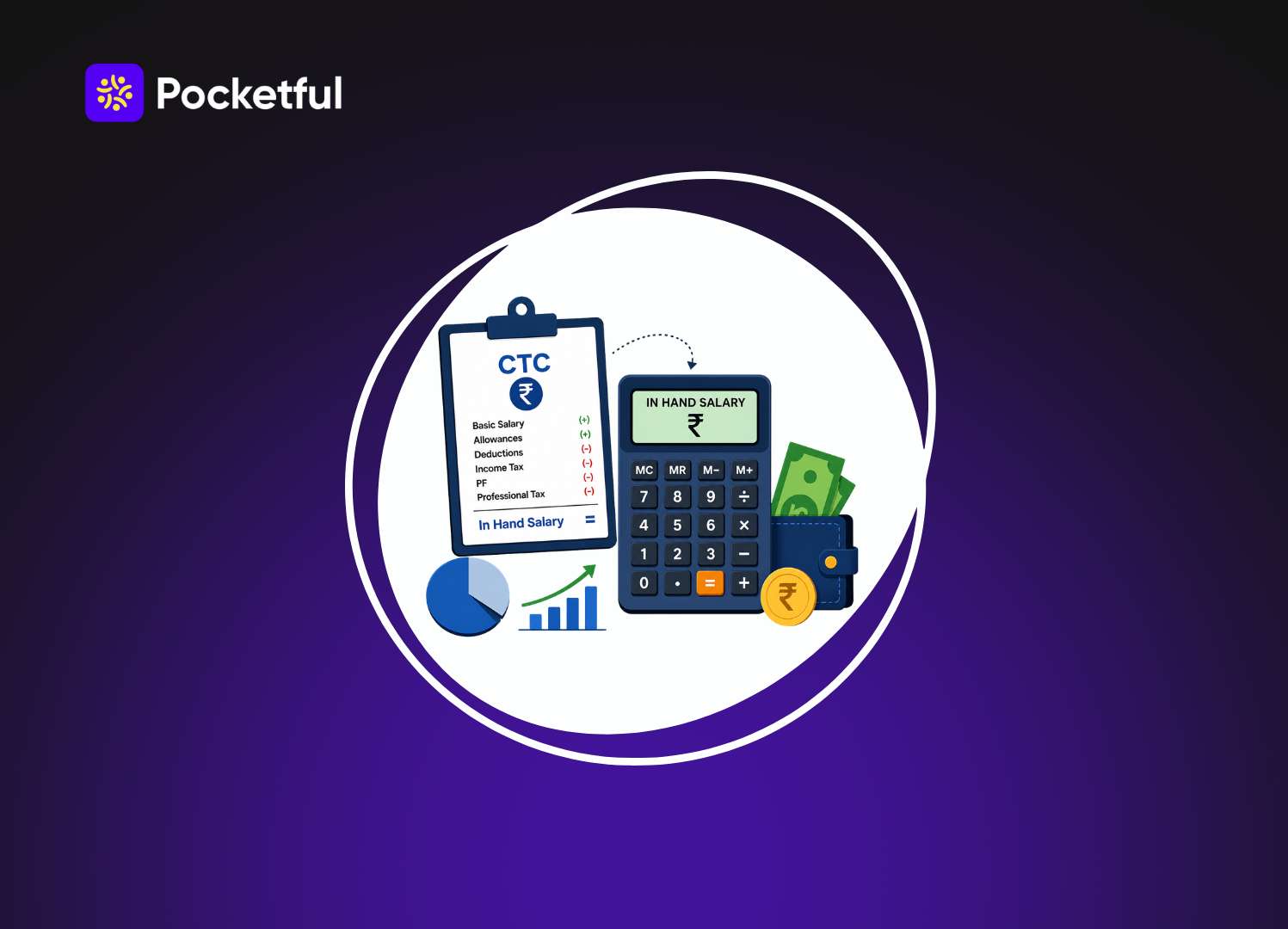
If you believe that the CTC is the exact amount credited to your bank account as salary each month, that is not entirely accurate. This is a common source of confusion for many people when accepting a job offer. In this article, we will explain in simple terms what “in-hand salary” is, how it is calculated from the CTC, and how to estimate in-hand figures for packages such as 2.4 LPA in hand salary ,2.7 ctc in hand salary , 3.8 ctc in hand salary , and 6.4 lpa in hand salary . We will also look at the key deductions that affect your actual monthly salary.
What is CTC?
CTC (Cost to Company) represents the total annual amount a company spends on an employee. It encompasses not only your monthly salary but also various other benefits and contributions provided by the company. Consequently, the CTC stated in the offer letter often differs from the “in-hand” salary credited to your bank account.
The purpose of the CTC is to reflect the total expenditure incurred by the company on the employee. That is why, before accepting a job offer, it is essential to understand not just the CTC figure but the complete salary breakup.
Components Included in CTC
| Salary Component | Included in CTC | Paid Every Month |
|---|---|---|
| Basic Salary | Yes | Yes |
| House Rent Allowance (HRA) | Yes | Yes |
| Special Allowance | Yes | Yes |
| Employer’s EPF Contribution | Yes | |
| Bonus / Performance Incentive | Usually | Depends on company policy |
| Gratuity (if applicable) | Usually | No |
| Medical or Group Insurance | May be included | No |
Note: The CTC structure varies across companies. Some companies include bonuses, gratuity, insurance, or other benefits in the CTC, while others do not. Therefore, it is always advisable to carefully review the salary breakup provided in the offer letter.
What is In Hand Salary?
“In-hand salary” refers to the amount credited to your bank account every month after all necessary deductions. It is also known as “take-home salary.” While the CTC mentioned in an offer letter represents your total annual salary, the in-hand salary is the actual amount you receive each month to spend or save.
This amount is determined by deducting Employee EPF, Professional Tax (where applicable), Income Tax (TDS), and other applicable deductions from your gross salary. Consequently, two employees with the same CTC may have different in-hand salaries because their salary structures, tax regimes, and deductions can vary.
CTC vs Gross Salary vs In Hand Salary
| Salary Term | Meaning |
|---|---|
| CTC (Cost to Company) | The total annual expenditure incurred by the company on an employee, which may include salary and other benefits. |
| Gross Salary | The total salary received before deductions, which includes Basic Pay, HRA, allowances, etc. |
| In Hand Salary (Take-Home Salary) | The actual salary credited to the bank account every month after all necessary deductions. |
Why is Your In Hand Salary Lower Than Your CTC?
When you receive a job offer, the CTC (Cost to Company) often makes the salary appear higher than it actually is. However, the monthly “in-hand” salary is lower. This is because the CTC includes components that are not directly deposited into your bank account, and certain mandatory deductions are also made from the salary.
- Employee Provident Fund (EPF): If your company falls under the purview of the EPF scheme, the employee’s contribution is deducted from the monthly salary. Since this money is set aside for your retirement savings, it is not included in your take-home salary.
- Professional Tax: Professional Tax is applicable in certain states. The amount is determined by state regulations and is deducted from the salary in regions where it is enforced.
- Income Tax (TDS): If your income is taxable, the company may deduct TDS (Tax Deducted at Source) in accordance with applicable tax rules. This deduction varies from employee to employee.
- ESIC (If Applicable): ESIC applies only to eligible employees. If you meet the eligibility criteria, an ESIC contribution may also be deducted from your salary.
- Other Company Deductions: Some companies make deductions based on their specific facilities or policies such as for health insurance, meal cards, transport facilities, or the recovery of salary advances.
Note: Every employee’s salary structure is different. Therefore, even with the same CTC, two individuals may have different in-hand salaries.
Read Also: Breakdown of CTC: A Detailed Analysis
How to Calculate In Hand Salary from CTC
To calculate your in-hand salary from your CTC, it is important to first understand that every company has a different salary structure; therefore, no single fixed amount applies to everyone. However, using a simple formula, you can estimate your monthly take-home salary.
Formula to Calculate In Hand Salary
In Hand Salary = Gross Monthly Salary − Employee EPF − Professional Tax − Income Tax (TDS) − Other Applicable Deductions
Example: 6.4 LPA CTC
Suppose an employee’s CTC is ₹6.4 LPA. Based on the company’s salary structure, their monthly salary could be as follows.
| Particular | Amount (Approx.) |
|---|---|
| Monthly Gross Salary | ₹53,333 |
| Employee EPF | ₹2,400 |
| Professional Tax | ₹200 |
| Other Deductions | ₹500 |
| Estimated In Hand Salary | ₹50,200 |
Calculation: ₹53,333 − ₹2,400 − ₹200 − ₹500 = ₹50,233 (Approx. ₹50,200 per month)
Estimated In Hand Salary for Popular CTC Packages
If you are evaluating a job offer, the estimate below can help you understand your monthly take-home salary. Please note that this is only an estimated range; your actual in-hand salary may vary based on the company’s salary structure, allowances, applicable taxes, EPF, and other deductions.
| Annual CTC | Estimated Monthly In Hand Salary |
|---|---|
| 2.4 LPA in hand salary | ₹17,000 – ₹18,500 |
| 2.7 CTC in hand salary | ₹19,000 – ₹20,500 |
| 3.8 CTC in hand salary | ₹27,000 – ₹30,000 |
| 6.4 LPA in hand salary | ₹45,000 – ₹50,000 |
How to Read Your Salary Structure Before Accepting a Job Offer
Do not make a decision based solely on the CTC when accepting a job offer. Carefully reviewing the salary structure will help you understand the actual monthly “in-hand” salary and the terms of payment.
- Check the Basic Salary: Basic salary is a crucial component of the overall salary structure. Since many allowances and statutory contributions are determined based on it, you should definitely check this figure.
- Review Fixed and Variable Pay: Check what portion of the CTC consists of fixed salary and what amount will be paid as variable pay or a performance bonus. Variable pay is not always guaranteed.
- Verify Deductions: Carefully review the deductions listed in the offer letter, such as EPF, Professional Tax (where applicable), and other payroll deductions. This will give you a better idea of your monthly take-home salary.
- Understand Bonuses and Benefits: If the CTC includes bonuses, gratuity, health insurance, or other employee benefits, understand when and under what conditions they will be paid.
- Compare the Monthly Take-Home Salary: Two different companies might offer the same CTC, yet the monthly in-hand salary could differ. Therefore, when comparing offers, pay attention to the estimated monthly take-home salary and the salary breakup, alongside the annual CTC.
Tips to Maximize Your In Hand Salary
Increasing your CTC isn’t the only way to boost your earnings; you can also improve your “in-hand” salary through proper planning and by understanding the salary structure.
- Choose the Right Tax Regime: If your income is taxable, compare the Old and New Tax Regimes and select the option that results in a lower tax liability for you.
- Negotiate the Salary Structure: During salary discussions, don’t focus solely on the CTC; discuss fixed pay, allowances, and your monthly take-home salary as well. A well-structured salary package can be more beneficial in the long run.
- Review Your Salary Breakup Carefully: Examine the salary breakup closely before accepting an offer. This helps you understand which components are included in your monthly salary and which payments will be made separately.
- Make Use of Eligible Tax Benefits: If you opt for the Old Tax Regime, you can reduce your tax liability by effectively utilizing available tax deductions and exemptions. This can have a positive impact on your net salary.
- Compare Job Offers Beyond CTC: If you have multiple job offers, do not compare them based on CTC alone. It is wiser to make a decision by considering the monthly in-hand salary, benefits, and overall compensation package.
Read Also: Gross Pay vs Net Pay: What’s the Difference?
Conclusion
If you are preparing for a new job or considering an offer, do not make your decision based solely on the CTC. It takes just a few minutes to understand the salary breakup, but doing so gives you an accurate idea of your monthly in-hand salary. Hopefully, this guide will help you better understand CTC and choose the right job offer.
Frequently Asked Questions (FAQs)
01
What is In-Hand Salary?
The actual salary credited to the bank account after all necessary deductions.
02
Is CTC the same as In-Hand Salary?
No, CTC and In-Hand Salary are different.
03
How is In-Hand Salary calculated?
By subtracting applicable deductions from Gross Salary.
04
Why is my In-Hand Salary lower than my CTC?
Because CTC includes many components that are not received every month.
05
Can two people with the same CTC have different In-Hand Salaries?
Yes, this can happen if the salary structure and deductions are different.
Disclaimer

The information shared in this content is intended solely for educational and informational purposes and should not be considered financial, investment, or trading advice. Any references to stocks, mutual funds, or market instruments are purely for informational purposes and do not constitute recommendations. Investments in financial markets are subject to market risks, and past performance is not indicative of future returns. Readers are advised to conduct independent research, review official documents carefully, and consult a qualified financial advisor before making any investment or trading decisions.
Article History