



| Type | Description | Contributor | Date |
|---|---|---|---|
 | Post created | Pocketful Team | Apr-06-26 |
Read Next
- What is Commodity Swap?
- Compounding Strategy in Commodity Trading
- Commodity Channel Index – CCI Meaning, Formula & Strategy
- How to Invest Long Term in Commodities
- Hard vs Soft Commodities: Key Differences
- What is Indian Commodity Exchange (ICEX)?
- Top 10 Precious Metals to Invest in India
- Gold Import Duty Hike in India – Reasons & Impact
- Silver Hallmark India Purity: How to Check, Meaning & Investment Guide (2026)
- How to Buy Silver Coins & Bars in India
- Silver Price Last 10 Years in India
- Gold to Silver Ratio in India: Meaning, Formula & Investment Strategy (2026)
- Is Silver a Good Investment in 2026? Benefits & Risks
- What is Kasu Gold?
- Which City Has the Highest Gold Price in India?
- Which City Has the Lowest Gold Price in India?
- AI in Commodity Trading: Benefits, Risks & Future Trends
- MCX vs NCDEX: Key Differences
- MCX Copper Trading Guide 2026: Price Factors & Strategies
- What is Commodity Margin?
How to Hedge with Commodity Trading: A Practical Guide
Published on : 8th April 2026
|Updated on : 8th April 2026



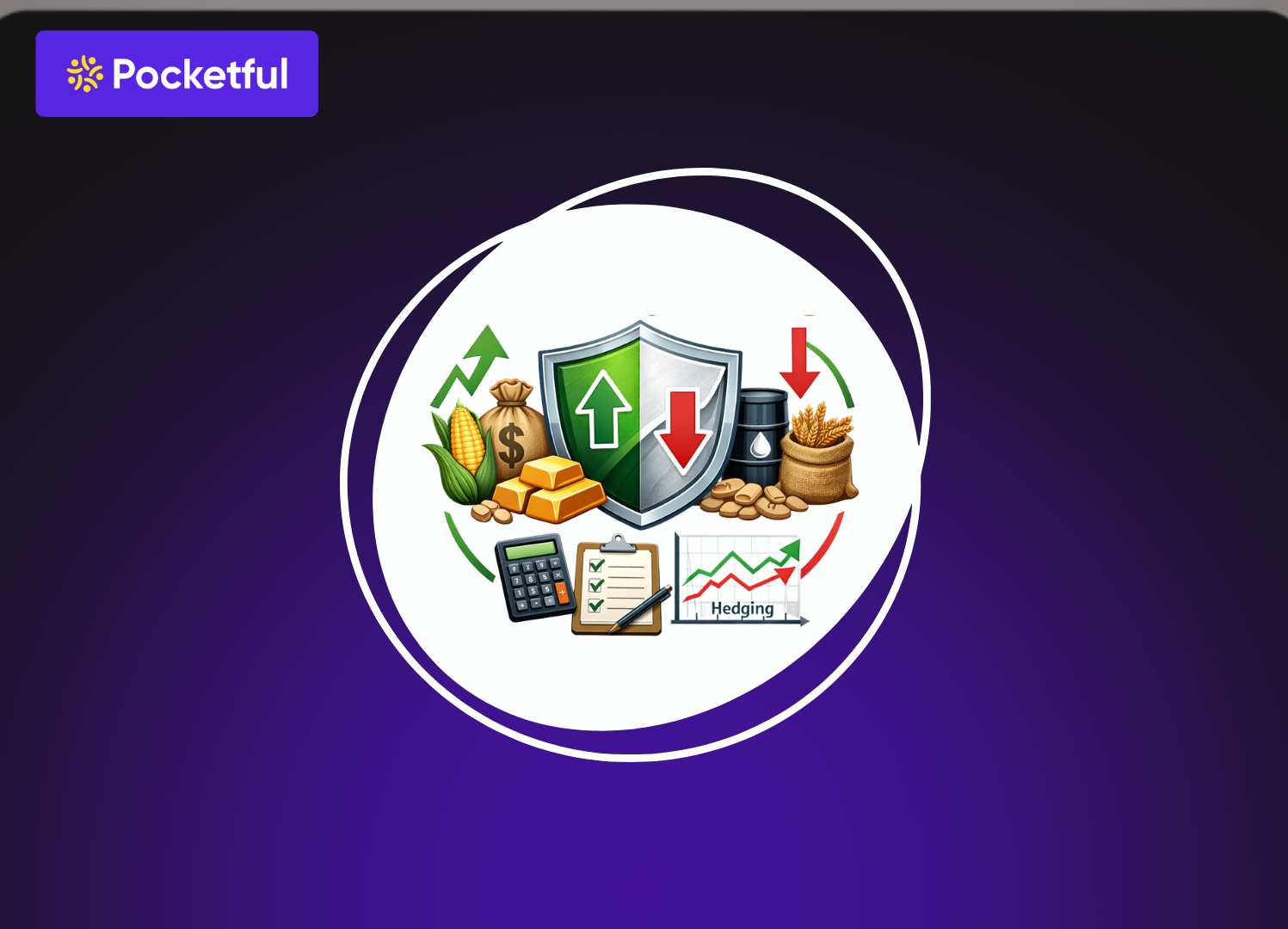
Commodity trading is the buying and selling of commodities on the commodity exchanges, where raw materials like oil, wheat, gold & metals etc. are traded. And you might have noticed that there are daily price movements in commodities like petrol or gold. But some sudden jumps can be a big deal for businesses and the general public. To lower down their risk and stay safe some traders use a commodity hedging strategy. This can act as a safety net or an insurance policy for your investments.
To simply understand this let us learn it from a simple example, let’s say you own a bakery and you use a lot of wheat in your products. If the price of wheat rises next month it could directly hamper your profits. But what if you can lock in today’s price for next month. By doing this you can protect yourself from the risk of rising prices. This could be very beneficial during a volatile market and you can plan your future without getting affected by sudden price rise.
Understanding the Basics of Hedging
Hedging is not the same as speculation; rather, it differs from it. In speculation the investor bids on a specific commodity and hopes that the price moves in your desired direction so that quick profits can be generated. A hedger on the other hand just wants to avoid the fluctuating future prices in the future by locking the price on today’s rate and stay secure for the future price fluctuations.
Hedging reduces risk by letting you take an opposite position in the market. If you own physical gold and you are worried the price will fall, you can sell a gold contract in the market. If the price falls, the money you lose on your actual gold is balanced by the profit you make in the market. In India, people commonly hedge items like gold, crude oil, and agricultural products like cotton or spices.
Types of Hedging Strategies
1. Long Hedge (The Buyer’s Shield)
It is most preferred by the entities that require commodities (raw material) in future, such as a wire company requiring copper. In long hedging you need to opt for a “long” position (buy) in a futures contract based on the current price.
By long hedging you buy the commodity on today’s price and if the commodity price rises, the profit you make on your futures contract can sideline the higher price that you have to pay when physically buying the commodity. In this the raw material price is locked.
2. Short Hedge (The Seller’s Safety Net)
This is most suitable for producers who are producing these raw materials like farmers or mining companies. Here the raw material is currently held in the inventory and is not ready for the final sale yet. Here you “short” (sell) a futures contract for the amount of goods you plan to produce.
If the price of the commodity crashes even before your product enters the market, the gain generated from closing out your short futures position compensates for the falling commodity price.
3. Cross Hedging
This is used when you want to trade in a commodity that has lower liquidity (like jet fuel or certain types of timber). In these cases traders go for cross hedging. In this hedging is done using a different but highly similar commodity. For example, since jet fuel prices move in close direct relation with crude oil or heating oil, an airline might cross hedge or trade those contracts instead.
Here you need to keep a watch that both commodities are correlated and moving in a similar manner. If they do not move in correlation the hedge can fail.
4. Calendar Spreads
This is also known as intra-market spread and it is a detailed strategy that functions on the basis of supply and demand of the commodity. Here future contracts are bought and sold for the same commodity but with different delivery months (like buy copper in June, sell copper in July).
Here you are not putting your bet on whether the price of copper rises or falls. Rather you are betting on the difference in price that the commodity experiences in between those two months.
5. Arbitrage
This is a practice where temporary price inefficiencies are exploited between varied locations or forms of the same product. If gold is trading at $2,000 in London but $2,005 in New York, an arbitrageur buys in London and sells in New York simultaneously.
This practice reduces the risk to the minimal level and you earn a risk less profit (excluding the cost of transaction). Numerically it forces the global markets to bring back the price of the commodity to equilibrium.
6. Protective Put
In this practice you get the most flexibility as unlike futures contracts which direct you to a certain price, an option on the other hand gives you a choice. In this investors buy a “Put” option for the commodity they own, which gives the investor the right to sell at a specific “strike price”.
If prices crash, you exercise your option and sell at the higher strike price. If prices skyrocket, you simply let the option expire (losing only the “premium” you paid for it) and sell your physical goods at the new, higher market price.
Read Also: Risks in Commodity Trading and How to Manage Them
Advantages of Commodity Hedging
- Risk Reduction: Here you eliminate the fear factor. You know your future costs or income today, which prevents huge financial shocks.
- Portfolio Diversification: Commodities are inverse in relation to the stock market, meaning they move in opposite directions of the stock market. When the stock market falls commodities like gold and oil generally rise keeping the portfolio balanced.
- Steady Cash Flow: It makes sure that your venture has a predictable cash flow. And you won’t run out of cash suddenly even if the fuel or raw materials become expensive.
- Inflation Protection: With the rising inflation and cost of living, raw material cost also rises. Hedging helps the investors to maintain your purchasing power over time.
- Better Budgeting: By knowing your future expenses you can plan for expansion and stock purchase without any worry.
How Commodity Hedging Works (Step-by-Step)
- Identify your risk: Figure out how much you might lose if prices change. For example, if you have 100 grams of gold, that is your “exposure.”
- Choose the right commodity: Match your real world item with a market contract. If you need jet fuel, you might use crude oil because their prices move together.
- Select your tool: Choose Futures for a solid price lock or Options for a flexible safety net. Experts generally suggest not to risk more than 2% of your capital on one trade.
- Execute the trade: Use a trading app to place your order on an exchange. Remember that MCX stays open late (until 11:30 PM) so you can react to global news.
- Monitor and adjust: One shall always check their “Margin” daily. If prices move the wrong direction, the exchange might ask for extra cash (a margin call) to keep your trade alive.
Key Instruments Used in Commodity Hedging
There are a few main tools you can use to before starting the hedging practice:
- Futures Contracts: These are promises that are made to buy or sell the product at a fixed price later. Also these products/commodities are standardized meaning quality and quantity are set by the exchange, making them safe for traders on MCX or NCDEX.
- Options Contracts: These give you the “right” but not the “duty” to buy or sell. You pay a small fee called a “premium.” If the market moves in the opposite direction, you may let the option expire and only the small fee is charged.
- Forward Contracts: These are private, customized deals between two people or companies. They aren’t traded on an exchange, so they carry more risk if the other person doesn’t follow through.
- Commodity ETFs and Mutual Funds: These let you invest in commodities like gold or silver just like buying shares of a company. You don’t need to worry about storage, purity, or lockers because it is all handled digitally in your account.
Read Also: What is Hedging?
Risks and Limitations of Hedging
- Basis Risk: This is the risk that the exchange price and your local mandi price don’t move exactly together for the raw materials. Formula – Basis = Spot Price – Futures Price.
- Leverage Risk: Exchanges let you control a large amount of goods with a small “margin” (5% to 15%). While this can lead to big profits, even a small 1% price move can wipe out your margin money.
- Cost of Hedging: You have to pay brokerage fees, taxes, and premiums for options. Sometimes these costs can be more than the protection is worth.
- Regulatory Risk: The government can suddenly ban exports or change storage limits for crops like wheat or pulses, causing prices to jump unexpectedly.
- Liquidity Risk: For some items, there may not be enough buyers or sellers on a given day. This could make it hard to exit your trade at a fair price.
Who Should Use Commodity Hedging
Many different groups of people find hedging useful in their daily work. Farmers and producers are the most common users. A farmer who is growing rice is always worried that prices might crash by the time the crop is ready. But by using the hedging practice the farmer can fix the selling price priorly and stay safe.
The import and export segment also requires hedging as it can be used to deal with the global prices and currency variations. For example, a company importing oil has to pay in dollars, so they hedge to avoid losses if the rupee becomes weak. Manufacturers and businesses use it too. A car company needs steel and aluminum, so they hedge to keep their raw material costs stable. Even retail traders and investors use it to protect their stock portfolios by buying gold when the markets feel risky.
Read Also: How to Trade in the Commodity Market?
Conclusion
Commodity hedging is a great technique to bring neutrality to the volatile global markets. It is not about making quick profits rather keeping yourself safe from the sudden price changes of commodities in the world. By knowing the functioning of commodities exchanges like MCX investors like you can protect your investments and make the right financial moves without losing your money. Remember you should always do a thorough research, make a solid plan and start investing small amounts to understand the market.
For more market news and insights, download Pocketful – offering users zero brokerage on delivery trades and an easy to use platform designed for both beginners and experienced investors.
Frequently Asked Questions (FAQs)
01
Is hedging the same as insurance?
Yes, it is very similar where you use hedging to avoid a big loss from price changes, similar to the premium paid for health insurance to avoid a big hospital bill.
02
Can college students start commodity trading?
Yes, but always start with small amounts through Commodity ETFs or mutual funds. It is a good way to learn how global markets work without risking too much capital.
03
Do I have to buy the actual oil or gold?
No. Most retail traders in India use “cash settlement.” This means you only settle the profit or loss in your account. You don’t have to worry about storing heavy barrels or bags.
04
What is the difference between MCX and NCDEX?
MCX is mainly for metals and energy like gold and oil, which follow global trends. Whereas NCDEX is mostly for agricultural products like spices and pulses, which follow Indian weather patterns.
05
How much money do I need to start?
To trade futures, you only need to pay a “margin,” which is usually 5% to 15% of the total value. For smaller investments, you can start with ETFs for the price of just one unit.
Disclaimer

The information shared in this content is intended solely for educational and informational purposes and should not be considered financial, investment, or trading advice. Any references to stocks, mutual funds, or market instruments are purely for informational purposes and do not constitute recommendations. Investments in financial markets are subject to market risks, and past performance is not indicative of future returns. Readers are advised to conduct independent research, review official documents carefully, and consult a qualified financial advisor before making any investment or trading decisions.
Article History