| Type | Description | Contributor | Date |
|---|---|---|---|
 | Post created | Pocketful Team | Mar-23-26 |
Read Next
- What is Gamma in Options Trading?
- Nifty Weekly Options Strategy for Beginners
- Pre-Open Market Session in India: Timings, Meaning & How It Works
- What Is Proprietary Trading?
- What Is Short Delivery in Share Market?
- What Is the Turtle Trading Strategy?
- What Is CFD Trading?
- What are the Upper Circuit and Lower Circuit in the Stock Market?
- What Is Colour Trading?
- How to Buy MCX Gold in India 2026?
- What Is Leverage in the Stock Market?
- Common Trading Mistakes Beginners Make (And How to Avoid Them)
- How to Pledge ETFs for Margin in India
- What Is Expiry Day Trading?
- Best ETF Platforms for Trading and Investment in India 2026
- What Is Strike Price in Options Trading?
- What is Speculative Trading?
- What is Revenge Trading?
- What Is Time Decay in Options?
- What are Candlestick Patterns? 38 Candlestick Patterns Every Trader Must Know
Long Vol vs Short Vol in Options Trading
Written by : Pocketful Team
|Updated by : Pocketful Team
Published on : 27th March 2026
|Updated on : 27th March 2026



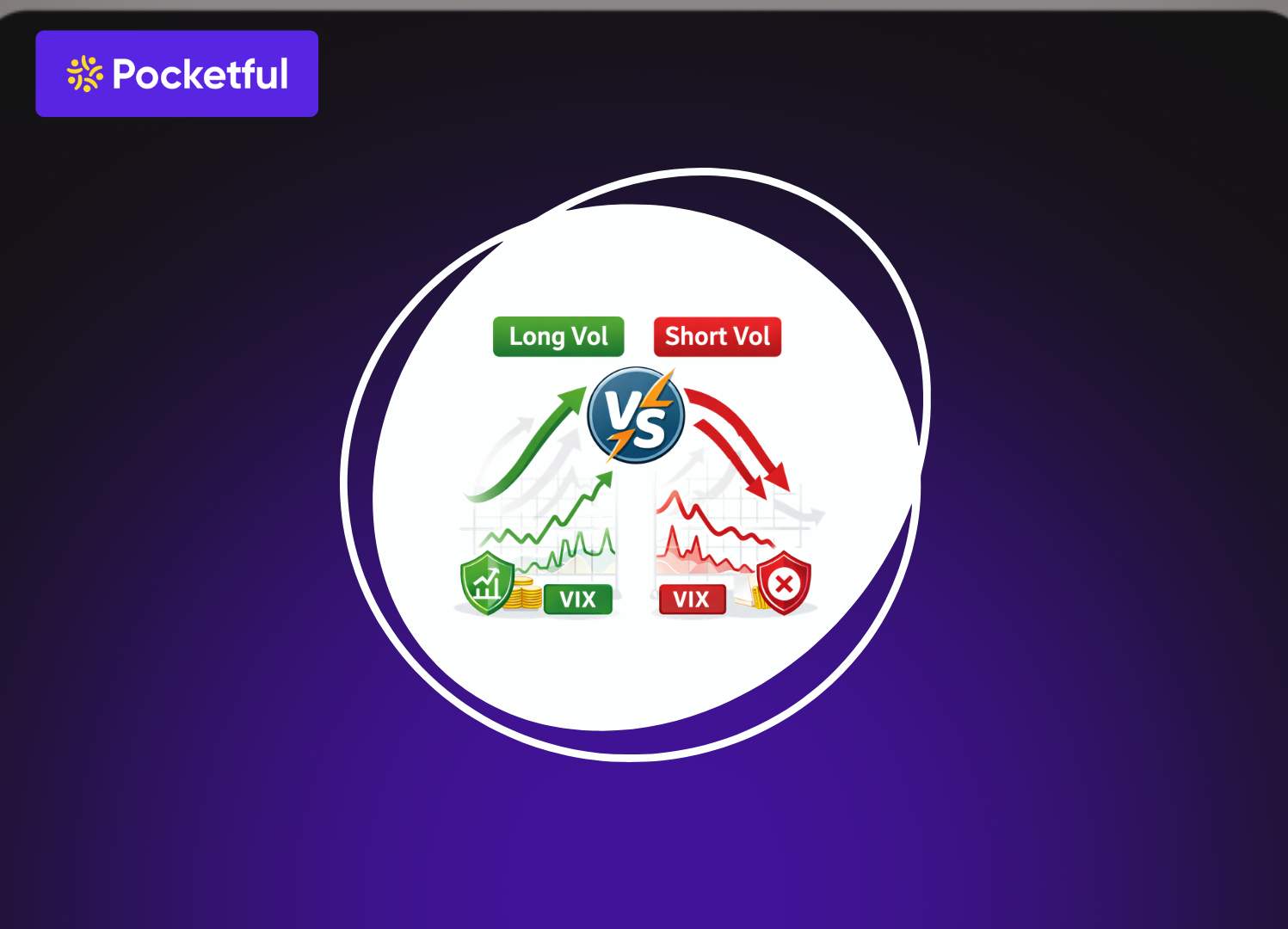
If you have spent even a little time in options trading, you have probably heard traders say things like “I’m short vol here” or “This is a long volatility trade.” But what does that truly signify? Volatility isn’t about price fluctuations – it’s tied to anticipations. Market participants utilize it to assess possible price variations, handle downside exposure, and spot chances. Regardless of whether the market is stable or quite erratic, grasping volatility can grant you a substantial advantage in executing wiser, more calculated trades.
It sounds confusing. Let us break this down for you in today’s blog.
What is Vol
In options trading, ‘Vol’ is the short form of volatility.
Volatility, in simple terms, means how much and how fast the price of an asset moves.
Types of Volatility
- Historical Volatility: HV looks at the past price movements and tells you how volatile the stock has been.
- Implied Volatility: This is what traders usually mean by ‘Vol’ in options. It reflects the market’s expectation of future price movement.
Now that we understand the two types of volatility, the next step is to see how traders use this concept when trading in real-time.
In options, volatility is not just about observing; it is about actively taking a position that benefits either from rising volatility (long vol) or falling volatility (short vol).
What Does “Long Volatility” Mean?
A long volatility (long vol) position means you benefit when volatility increases.
How does it work?
When volatility rises, option premiums increase. So if you buy options (calls and puts), their value increases not only because of price movement but also because of rising implied volatility.
Example
A stock is about to announce earnings. Nobody knows in which direction it will move, but everyone expects a big move.
You buy a long straddle, i.e., simultaneous buying of a call and a put option for the same underlying asset, with the same strike price and expiry date.
If the stock makes a sharp move (either side), you profit because volatility expands.
Read Also: Difference Between Options and Futures
What does “Short Volatility” Mean
A short volatility (short vol) position means you benefit when volatility decreases.
How Does it Work?
When volatility drops, option premiums drop. So if you sell options (calls and puts), you profit from this decline.
Example
Let us say that, before an event, implied volatility spikes because traders expect a big move.
But after the event, the uncertainty disappears, even if the stock barely moves. This leads to IV Crush, where option premiums drop sharply. If you were an option seller, you would profit from this drop.
The Role of India VIX
India VIX, or India Volatility Index, is a key market indicator that measures the expected volatility of the NIFTY 50 index over the next 30 days. It is often referred to as the ‘fear index’ because it reflects investor sentiment and market uncertainty.
India VIX is calculated from implied volatility in NIFTY options and reflects expected market volatility.
Traders use it in the following way,
- High VIX is considered good for short vol strategies
- Low VIX is considered good for long vol strategies.
How Strategies are formed out of view on Volatility
Once you understand volatility, you stop “choosing strategies randomly” and start building them based on what you expect the market to do.
If you feel the market is underestimating movement, maybe due to an event, breakout, or uncertainty, you naturally move towards long volatility strategies because you want to benefit if the possible movement turns out to be bigger.
This thinking leads you to strategies like:
- Straddles and Strangles
- Calendar spreads
Now consider the opposite situation.
If you feel the market is overestimating movement, you lean towards short volatility strategies.
This leads to strategies like:
- Short Straddles or Strangles
- Iron Condors
- Covered Calls
Read Also: What is Short-Term Trading Vs Long-Term Trading Strategies?
Table of Difference: Long Vol vs. Short Vol
| S. No | Aspect | Long Volatility (Long Vol) | Short Volatility (Short Vol) |
|---|---|---|---|
| 1 | Idea | You are betting that the market will make a big move soon without caring about direction, just movement. | You are betting that the market will be stable or move less than expected. |
| 2 | Approach | This usually involves buying options (calls, puts, straddles). You pay a premium, hoping it expands. | This involves selling options. You collect premium upfront and hope it shrinks over time. |
| 3 | Volatility Behaviour | You want volatility to increase. | You want volatility to decrease. |
| 4 | How You Make Money | You profit when the stock/index makes a sharp move or when option premiums rise due to increasing IV. | You profit when the market stays range-bound, and option premiums slowly decay due to falling IV. |
| 5 | Role of Time | Time works against you. Every passing day reduces the value of your options. | Time works in your favour. You earn from the natural decay of option premiums. |
| 6 | Risk Profile | Your loss is limited to the premium paid, but profits need a strong move. | Your profit is limited to the premium collected, but losses can be large if the market moves sharply. |
Conclusion
Options trading is not just about predicting whether the market will go up or down. It is more about understanding how much the market is expected to move, and whether that expectation is right or wrong.
If you believe the market is underestimating movement, you naturally lean towards long vol strategies, where you benefit from big swings. On the other hand, if you feel the market is overreacting, short vol strategies tend to work better, allowing you to benefit from stability and time decay.
There’s no “better” side here. Both approaches work.
Stay ahead with real-time market insights & latest news. Download Pocketful – Zero brokerage on delivery, no AMC, and a seamless, easy-to-use platform.
Frequently Asked Questions (FAQs)
01
Which is safer: Long vol or short vol?
In long vol, loss is limited to the premium paid, while short vol can have a greater risk.
02
When should I use long vol strategies?
You should use long vol strategies during events, breakouts, or uncertain situations where big moves are likely.
03
Can I combine long vol and short vol strategies?
Yes, many traders switch between them depending on the market conditions or even combine them in advanced ways.
04
What is the biggest mistake beginners make?
Ignoring volatility completely and focusing on only the direction, which eventually often leads to unexpected losses.
05
What is IV crush?
A sudden drop in implied volatility leads to a fall in option prices.
Disclaimer

The securities, funds, and strategies discussed in this blog are provided for informational purposes only. They do not represent endorsements or recommendations. Investors should conduct their own research and seek professional advice before making any investment decisions.
Article History


 Facebook
 Twitter
 Instagram
 LinkedIn
 Youtube