| Type | Description | Contributor | Date |
|---|---|---|---|
 | Post created | Pocketful Team | Aug-09-24 |
 | Change content | Nisha | Jan-15-26 |
Read Next
- Why Are Steel Share Prices Increasing in India?
- Top Nifty Metal ETFs in India 2026
- Best Gold Investment Schemes in India 2026
- How to Build a Portfolio With Exchange-traded Funds (ETFs)
- How to Invest in US Stocks from India
- Platinum Price Forecast in India (2026–2030)
- Why Is the Gold Price Going Down?
- Top 10 BESS Stocks in India (2026)
- Why is the Silver Price Going Down?
- Best Construction Stocks in India
- Why Gold Prices Hit ₹1,80,000 – Key Reasons
- List of Best Sensex ETFs in India
- Best Commodities to Trade in India
- Best Cyclical Stocks in India 2026
- How to Check the Purity of 20-Carat Gold: Easy Methods & Tips
- Why Are Silver Prices Rising in India?
- Difference Between Hallmark Gold, KDM Gold and BIS 916
- Why Are Gold Prices Rising in India?
- 1 Tola Gold in India: How Many Grams, Price & Investment Insights
- 22K vs 24K Gold: Which Is Better for Jewellery & Investment?
Best Banking Stocks in India 2026
Written by : Pocketful Team
|Updated by : Pocketful Team
Published on : 14th January 2026
|Updated on : 15th January 2026




Today, every street corner has an ATM and digital payment systems are seamlessly woven into everyday transactions. Not only do banks provide a safe space to store your money, but they also offer a wide range of services to help you grow your wealth. From savings accounts and fixed deposits to loans and investment opportunities, they are the cornerstone of the Indian Financial system.
But with so many banking stocks available to invest in, how should an investor sort out the leading players in the banking industry? In this blog, we will discuss the best Indian banking stocks based on market capitalization and 1-year returns.
Overview of the Banking Sector in India
India’s banking sector is crucial for the economy and plays a vital role in financial inclusion and economic growth. The industry has experienced substantial transformation throughout the years. India has a large banking network that includes several types of banks, such as the public sector, private sector, and foreign banks. It is one of the world’s largest banking markets, serving a massive population. According to RBI, total deposits with banks as of September,2025 are approximately $ 2,655 billion. Public sector banks have always held a significant share of the banking industry, although private sector banks have gained prominence in recent years.
The Indian banking sector is classified into:
- Scheduled Banks: These banks are included in the Second Schedule of the Reserve Bank of India Act, 1934. They are further categorized into Public Sector Banks, Private Sector Banks, Foreign Banks, Regional Rural Banks, and Co-operative Banks.
- Non-Scheduled Banks: These banks are not included in the Second Schedule of the RBI Act and operate under different regulations than the scheduled banks.
Best Banking Stocks Based on Market Capitalization
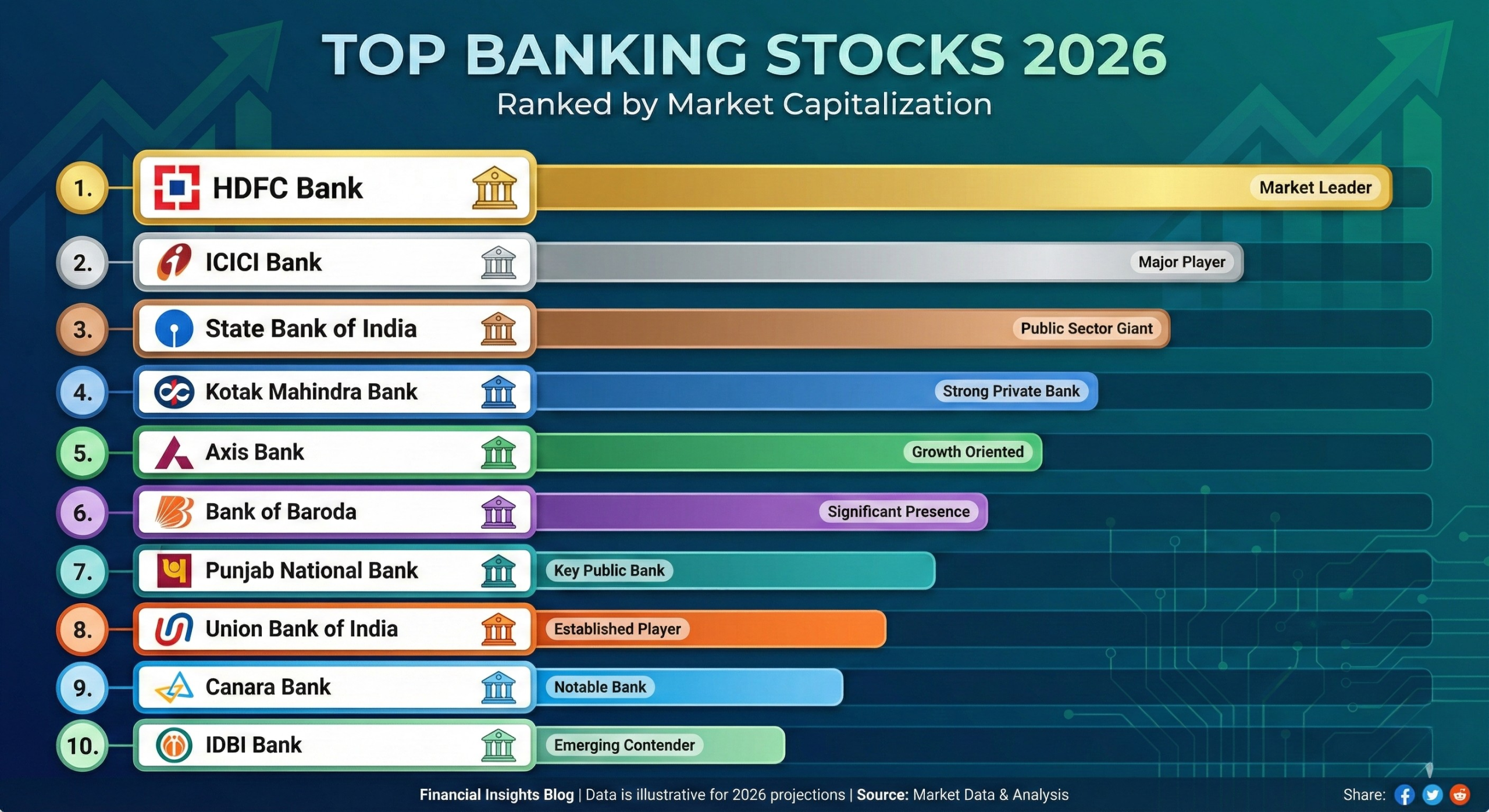
The top banking stocks in 2026 are:
| S.No. | Banking Stocks |
|---|---|
| 1 | HDFC Bank |
| 2 | ICICI Bank |
| 3 | State Bank of India |
| 4 | Kotak Mahindra Bank |
| 5 | Axis Bank |
| 6 | Bank of Baroda |
| 7 | Punjab National Bank |
| 8 | Union Bank of India |
| 9 | Canara Bank |
| 10 | IDBI Bank |
The top banking stocks have been listed in descending order based on their market capitalization in the table below:
| Bank | Market Cap(in INR crore) | CMP (in INR) | 52-Week High | 52-Week Low |
|---|---|---|---|---|
| HDFC Bank Ltd. | 14,24,612 | 925.45 | 1,020 | 813 |
| ICICI Bank Ltd. | 10,14,287 | 1,418 | 1,500 | 1,186 |
| State Bank of India | 9,49,184 | 1,028 | 1,030 | 680 |
| Kotak Mahindra Bank Ltd. | 4,18,705 | 421 | 460 | 345 |
| Axis Bank | 4,03,244 | 1,299 | 1,308 | 933 |
| Bank of Baroda | 1,59,123 | 307 | 312 | 191 |
| Punjab National Bank | 1,47,914 | 128 | 129 | 85 |
| Canara Bank | 1,39,643 | 154 | 158 | 78 |
| Union Bank Of India | 1,37,023 | 179 | 180 | 102 |
| IDBI Bank | 1,12,739 | 105 | 118 | 66 |
Read Also: Government Bank Stocks/Share in India
Best Banking Stocks Based on Market Capitalisation – An Overview
The best banking stocks in India are given below, along with a brief overview:
1. HDFC Bank
HDFC Bank was among the first financial institutions in India to receive an ‘in principle’ approval from the Reserve Bank of India in 1994. The HDFC bank started its operations as a scheduled commercial bank in January 1995. The bank’s business philosophy is based on five core values: Operational Excellence, Customer Focus, Product Leadership, People, and Sustainability.
HDFC Ltd. or Housing Development Finance Corporation Ltd. was merged with HDFC Bank in 2022 in India’s largest-ever M&A deal. The bank provides a wide range of financial products and services, such as retail banking, wholesale banking, loans, credit cards, savings accounts, current accounts, investment products, etc.
2. ICICI Bank
ICICI Bank stands for Industrial Credit and Investment Corporation of India and is regarded as India’s second-largest private sector bank. The World Bank, Indian public-sector banks, and public-sector insurance companies initiated the establishment of ICICI through a joint venture with other businesses in 1955 as a part of their initiative to accelerate the economy’s industrial growth by providing them with long and medium-term financing. ICICI became the first Indian company and Asian bank other than Japanese Banks to be listed on the New York Stock Exchange (NYSE). In October 2001, the directors of ICICI and ICICI Bank approved the merger of its subsidiary businesses named ICICI Personal Financial Services Limited and ICICI Capital Services Limited with ICICI Bank.
3. State Bank of India (SBI)
SBI is India’s largest public sector bank, with a 23% market share. SBI is headquartered in Mumbai and holds a rich heritage of over 200 years.
The roots of SBI trace back to 1806 when the Bank of Calcutta was established, the first joint stock bank in British India. Bank of Calcutta was later renamed as Bank of Bengal. Three separate presidency banks, Bank of Bengal, Bank of Bombay, and Bank of Madras, emerged across British India during this period, which were later merged to form the Imperial Bank of India in 1921.
In 1955, the Reserve Bank of India acquired a controlling stake in the Imperial Bank of India and renamed it the State Bank of India. SBI later acquired various state-associated banks and commercial banks.
SBI has played an important role in bringing banking services to rural areas. Core values of the Bank – Service, Transparency, Ethics, Politeness and Sustainability.
4. Kotak Mahindra Bank
Kotak Mahindra Bank is a leading Indian banking and financial services company headquartered in Mumbai. It offers a wide range of banking products and financial services for corporate and retail customers. It is India’s third-largest private sector bank by market capitalization.
Kotak Mahindra Financial Services was founded in 1985 by Uday Kotak. In 1986, Anand Mahindra and his father, Harish Mahindra, invested in the company, which was subsequently renamed Kotak Mahindra Bank. The company was initially engaged in bill discounting and lease and hire-purchase activities. In 2003, Kotak Mahindra Bank became India’s first non-banking finance company to convert into a commercial bank.
5. Axis Bank
Axis Bank was initially established as UTI Bank by a joint venture between the Life Insurance Corporation of India, the Government of India, and other business houses. UTI Bank’s operations started in 1994 when the first branch in Ahmedabad was opened. In 2007, UTI Bank was renamed “Axis Bank”. It soon became a well-established and recognized bank in the Indian Banking sector. This was a turning point in the history of Axis Bank because it became an aggressive player with a focus on branch expansion and innovation. Additionally, Axis Bank consistently made an effort to diversify its product portfolio. The bank now offers a variety of financial products, including credit cards, savings accounts, current accounts, brokerage facilities, and retail banking.
6. Bank of Baroda
Established in 1908, Bank of Baroda stands as a premier public sector bank in India, boasting a solid presence both domestically and overseas. Nationalized in 1969, the institution has since held an important function in the progress of India’s banking and finance sectors. Bank of Baroda adheres to a client-focused operational outlook centered on reliance, creativity, and widespread expansion. After integrating with Dena Bank and Vijaya Bank in 2019, the bank notably grew in size and scope. It provides a full suite of financial offerings and provisions, encompassing personal banking, business banking, financing for small and medium enterprises (MSME), treasury activities, credit facilities, savings options, electronic banking, and global banking support.
7. Punjab National Bank
Established in 1894, Punjab National Bank stands as one of India’s most historical public sector financial institutions. Following its nationalization in 1969, the institution boasts a considerable heritage of serving varied client bases nationwide. Punjab National Bank expanded its operational reach significantly post-amalgamation with Oriental Bank of Commerce and United Bank of India in 2020. The core tenets of the bank’s business approach involve promoting financial inclusion, practicing sound credit allocation, and embracing digital advancement. PNB provides a broad spectrum of financial offerings and services, including personal and business banking, credit for small and medium enterprises (MSMEs), farm financing, savings instruments, international trade support, and modern digital finance options.
8. Canara Bank
Established in 1906, Canara Bank has developed into a leading and highly reputable Indian public sector financial institution, boasting a history exceeding one hundred years. Its takeover by the government in 1969 signified a key moment, prompting the bank to actively work on broadening access to conventional banking and offering credit to less-served populations. The 2020 amalgamation with Syndicate Bank enhanced its footprint and network nationally.
Presently, Canara Bank operates guided by a distinct dedication to its clientele. It prioritizes streamlined procedures, robust digital platforms, and continuous enhancement of its asset health. The institution provides a broad array of monetary goods and supports, encompassing everything from personal banking and business lending to financing for small and medium enterprises, savings plans, credit facilities, treasury activities, and global banking services.
9. Union Bank of India
Established in 1919, Union Bank of India transitioned into a state-owned public sector bank following its nationalization in 1969. The institution broadened its presence considerably after integrating with Andhra Bank and Corporation Bank in 2020. Union Bank’s core operating belief centers on fostering environmentally sound expansion, ensuring client contentment, and employing careful handling of potential risks. It delivers a full suite of financial and banking provisions such as personal banking, business credit facilities, financing for small and medium enterprises, agricultural credit, savings schemes, electronic banking, and global banking services, serving various clients from individuals to corporations and institutions throughout India.
10. IDBI Bank
Established in 1964 as the Industrial Development Bank of India, IDBI Bank transitioned into a commercial bank in 2004. A controlling interest in the bank is jointly held by the Government of India and the Life Insurance Corporation of India. IDBI Bank’s operating ethos centers on revitalization, soundness, and a focus on client needs. The institution has bolstered its financial position over time via enhanced asset quality and procedural enhancements. Its extensive array of banking offerings encompasses retail services, corporate finance, loans for MSMEs, deposit services, digital platforms, and government-related business.
Read Also: Small Finance Bank Share List in India
Best Banking Stocks Based on 1-Year Return
| S.No. | Bank | 1-Year Return |
|---|---|---|
| 1 | AU Small Finance Bank | 70% |
| 2 | Indian Bank | 67.31% |
| 3 | Canara Bank | 63.45% |
| 4 | State Bank Of India | 36.54% |
| 5 | IDFC First Bank | 34% |
Best Banking Stocks Based on 1-Year Return – An Overview
The best banking stocks according to 1-year return are given below, along with a brief overview:
1. AU Small Finance Bank
AU Small Finance financial institution, based in 1996 and converted right into a small finance financial institution in 2017, operates with ~1,000 branches across India. The bank has a growing retail and msme-focused mortgage ebook and serves numerous million customers. Its commercial enterprise model is centred on secured lending, granular deposits, and enhancing casa, making it one of the more potent players among small finance banks.
2. Indian Bank
Founded in 1907, Indian Bank is a state-owned public sector financial institution boasting nearly 5,700 outlets across the country. Following its 2020 amalgamation with Allahabad Bank, the institution’s combined operations now exceed ₹10 lakh crore, underpinned by consistent expansion in deposits and enhancement of asset quality. Indian Bank maintains a broad presence encompassing retail, MSME, corporate, and global banking areas.
3. Canara Bank
Founded in 1906, Canara Bank is recognized as a premier public sector bank in India, operating around 9,700 branches across local and global locations. The organization manages total operations exceeding ₹20 lakh crore and holds a significant presence in consumer credit, small and medium-sized businesses, and commercial lending. In recent times, its financial health has been strengthened through continuous improvements in asset quality and capital adequacy.
4. State Bank of India
Founded in 1955, the State Bank of India is recognized as India’s foremost bank, featuring upwards of 23,000 outlets and over 60,000 cash dispensers. With combined operations exceeding ₹85 lakh crore, SBI holds a dominant place in the country’s financial system. Its significance spanning deposits, advances, and digital transactions confirms SBI’s status as a core component of India’s monetary scene.
5. IDFC First Bank
Emerging in 2018 from the combination of IDFC Bank and Capital First, IDFC First Bank maintains roughly 900 locations nationwide. The institution boasts total business surpassing ₹4 lakh crore, largely fueled by consumer credit and enhanced deposit gathering. Its commitment to client-focused offerings, service driven by technology, and growth in the retail sector underpins its sustained expansion plan.
Key Performance Indicators (KPIs)
| Bank | Net Interest Margin (%) | CASA (%) | Capital Adequacy Ratios (%) | P/E (x) | P/B (x) |
|---|---|---|---|---|---|
| HDFC Bank Ltd. | 3.47 | 34.74 | 19.55 | 9.85 | 2.68 |
| ICICI Bank | 3.68 | 41.53 | 16.55 | 18.62 | 3.10 |
| State Bank of India | 2.59 | 38.76 | 14.25 | 8.88 | 1.50 |
| Kotak Mahindra Bank Ltd. | 4.25 | 42.98 | 23.30 | 3.90 | 2.74 |
| Axis Bank Ltd. | 3.40 | 40.75 | 17.07 | 12.15 | 1.82 |
| Bank of Baroda | 2.66 | 37.71 | 17.19 | 5.70 | 0.81 |
| Punjab National Bank | 2.33 | 36.51 | 17.05 | 5.85 | 0.89 |
| Union Bank Of India | 2.49 | 32.47 | 18.02 | 5.34 | 0.89 |
| Canara Bank | 2.24 | 28.46 | 16.33 | 4.60 | 0.82 |
| IDBI Bank | 3.55 | 46.56 | 25.05 | 10.94 | 1.63 |
Read Also: Best Growth Stocks in India
Benefits of Investing in Banking Stocks
The benefits of investing in banking stocks are:
- Dividend Income – Banks often pay regular dividends to shareholders. This offers a stable income stream, which makes it particularly appealing to long-term investors.
- Hedge against Inflation – Bank stocks have been seen as protection against inflation. When inflation increases, banks can raise interest rates on loans and make more profit.
- Diversification – Adding banking stocks to your portfolio helps you reduce overall portfolio risk.
Factors to Consider Before Investing in Banking Stocks
An investor must consider the following factors before investing in banking stocks:
- Financial Performance – Analyze important financial ratios such as net interest margin, CASA, etc.
- Valuation – Investors should compare the bank’s valuation to its peers and judge its intrinsic value.
- Interest Rate – Rising interest rates generally benefit banks’ net interest margins, while falling rates can reduce profitability.
- Inflation – High inflation can erode the buying power and increase loan defaults, impacting the bank’s profitability.
Future of the Banking Industry
The banking industry is undergoing significant changes due to technological advancements and the evolving regulatory landscape. Banks use data analytics and artificial intelligence to offer customized financial products and services. These technological advancements have the potential to enhance fraud detection and prevention mechanisms, ultimately creating a more secure financial environment. More AI-powered chatbots and virtual assistants are being used for customer support and process automation. The RBI’s IFTAS cloud platform is also expected to strengthen the banking sector by enhancing the security, integrity and privacy of financial data.
Conclusion
To summarize, investors must thoroughly analyze banking stocks to ensure profitability. While these investments can give you lucrative returns, it is important to have a careful and well-thought-out investment plan. A thorough analysis of market trends and fundamental research can help investors make better decisions. It is advised to consult a financial advisor before investing.
Frequently Asked Questions (FAQs)
01
Is it good to invest in banking stocks in India?
While the future of the Indian banking sector is promising, the short-term performance is affected by the regulations and other market variables. Hence, it is important to consult a financial advisor before investing.
02
How can I identify good banking stocks?
Investors can analyze the financial performance, past returns, growth prospects and industry trends to identify banking stocks for investment purposes.
03
Should I invest in public or private sector banks?
Both the private and public sector banks offer good investment opportunities. Public sector banks may be more stable, while private sector banks offer high growth potential.
04
How much should I invest in banking stocks?
Diversification is important to reduce portfolio risk, and investors should allocate a suitable amount to banking stocks depending on the investor’s risk tolerance and investment goals.
05
What are the risks involved when investing in banking stocks?
Economic downturns, NPAs, interest rate fluctuations, and regulatory changes are major risks that an investor should be aware of before investing in banking stocks.
Disclaimer

The securities, funds, and strategies discussed in this blog are provided for informational purposes only. They do not represent endorsements or recommendations. Investors should conduct their own research and seek professional advice before making any investment decisions.
Article History


 Facebook
 Twitter
 Instagram
 LinkedIn
 Youtube