| Type | Description | Contributor | Date |
|---|---|---|---|
 | Post created | Pocketful Team | Apr-01-26 |
Read Next
- What are International ETFs?
- Top 10 Unlisted Companies in India
- What Is Demerger in the Share Market?
- What Is a 3x Bull ETF?
- ETF vs FOF: Key Differences
- VPF vs PPF: Which Is Better for Tax Saving?
- Impact of Iran War on Indian Shipping Sector and Shipping Stocks
- Madhusudan Kela Portfolio: Top Stocks and Holdings (2026)
- Top Sectors to Watch During Geopolitical Tensions in India
- Best Oil and Gas Stocks to Watch as Global Oil Prices Surge
- Top Induction Stove Stocks in India
- Iran-US War Impact on Indian Stock Market: Stocks That May Rise or Fall
- Best Stocks to Buy During War: Iran–US Tensions & Market Impact
- Top Capital Goods Stocks in India 2026
- What is Inverse ETF?
- What Is Nifty ETF?
- Best Edible Oil Stocks in India 2026
- Top Electronics Stocks in India 2026
- How to Invest in Copper in India?
- Best Cybersecurity Stocks in India 2026
Gold Measurement Units in India: Gram, Pavan, Tola Explained
Written by : Pocketful Team
|Updated by : Pocketful Team
Published on : 1st April 2026
|Updated on : 1st April 2026



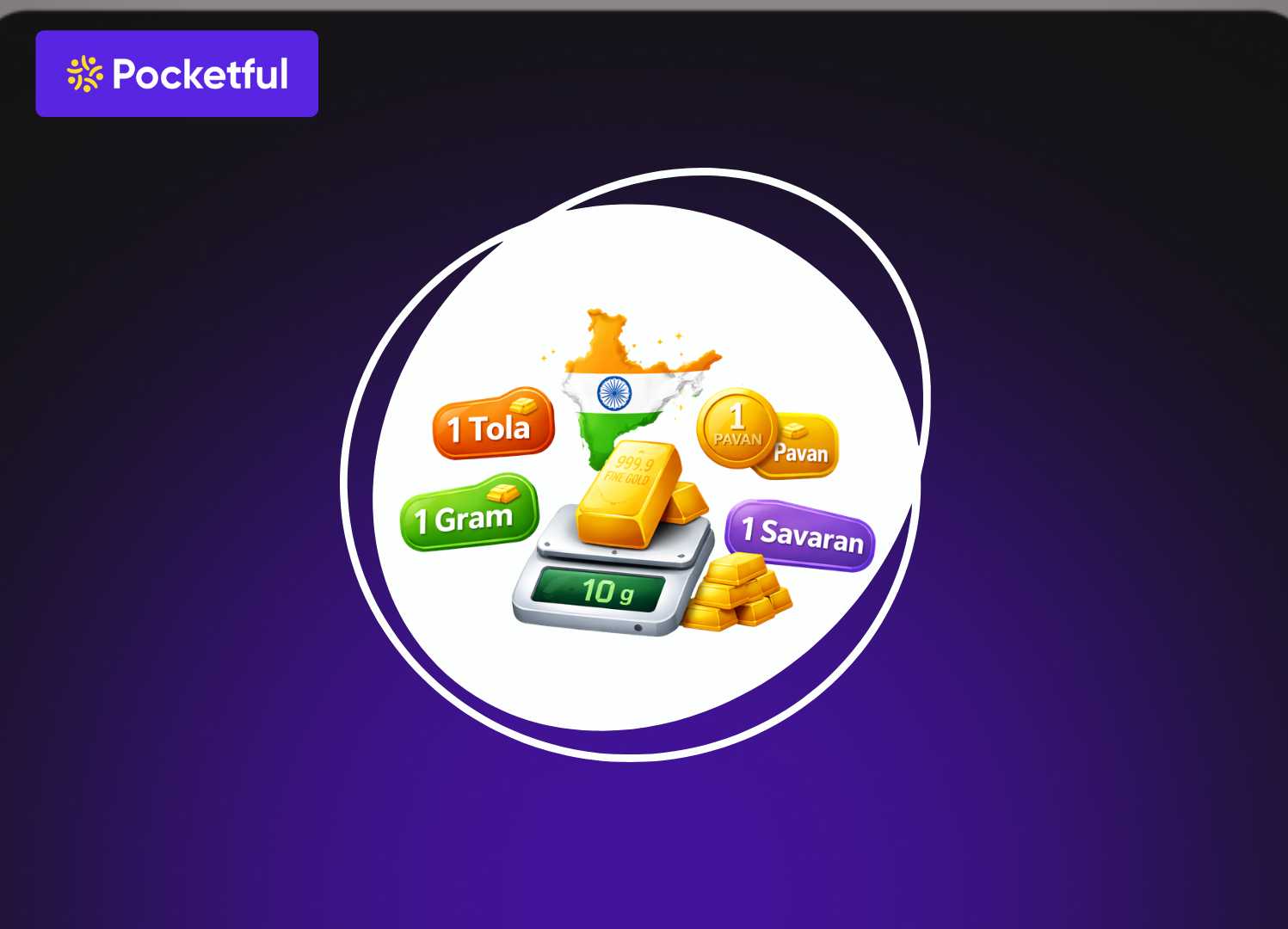
In India, purchasing gold is not merely a tradition; it is also a significant financial decision. In 2026, gold prices are typically quoted on a per-gram basis; however, various units such as pavan and tola are utilized across different states, which can lead to confusion. Even a minor calculation error can result in a discrepancy of thousands of rupees. In this guide, we will explain all the major gold measurement units in simple language, enabling you to make accurate and informed decisions.
Overview of Gold Measurement Units in India
In India, two types of gold measurement units are still used today: modern (gram, kilogram) and traditional (tola, pavan, ratti, masha). In 2026, gold prices are predominantly determined on a per-gram basis; however, many jewelers continue to quote prices in regional units particularly in South and North India.
| Category | Units Included | Usage Area |
|---|---|---|
| Modern Units | Gram, Kilogram | Standard across India |
| Traditional Units | Tola, Pavan, Ratti, Masha | Regional and Cultural Uses |
Gram: The Standard Gold Measurement Unit in India
In today’s times, the gram is the most widely used and standard unit for measuring gold. Today, in almost all cities, the price of gold is determined on a per-gram basis whether you are purchasing jewelry, buying digital gold, or making an investment.
Why is Gram the best?
| Reason | Benefit |
|---|---|
| Standard system | Same all over India |
| Easy calculation | The price is easy to understand. |
| Transparency | There is clarity in billing. |
Where is it used?
- Jewellery buying
- Digital gold platforms
- Gold ETFs and coins
Example (Based on Current Rates)
Assume Gold Price (24K, 10 grams) = ₹1,51,695
| Quantity | Calculation | Total Price |
|---|---|---|
| 1 gram | 1,51,695 ÷ 10 | ₹15,169.5 |
| 10 gram | Direct price | ₹1,51,695 |
| 20 gram | 15,169.5 × 20 | ₹3,03,390 |
Tola: The Traditional Gold Weight Measurement Unit
The Tola is an old and traditional unit of gold weight measurement in India, which is still used in many places today. 1 Tola equals 11.66 grams.
Where is it used?
| Usage Area | Example |
|---|---|
| North India | Jewellery buying and trading |
| Rural Areas | Gold saving and transactions |
| Family Assets | Valuation of old jewellery |
Example (Based on Current Rates)
Assume Gold Price (10 grams) = ₹1,51,695
| Unit | Calculation | Price (Approx) |
|---|---|---|
| 1 Gram | 1,51,695 ÷ 10 | ₹15,169.5 |
| 1 Tola | 11.66 × 15,169.5 | ₹1,76,850 (approximately) |
Read Also: What is 1 Pavan of Gold in Grams and How is It Calculated?
Pavan (Sovereign): South India’s Popular Gold Unit
The Pavan (or Sovereign) is the most widely used unit of gold measurement in South India.
1 Pavan equals 8 grams.
Where is it used?
| Region | Usage |
|---|---|
| Tamil Nadu | Jewellery buying |
| Kerala | Wedding gold measurement |
| Karnataka | Traditional gold purchase |
Why is Pavan so popular?
- Jewelry designs are often crafted based on the ‘pavan’ weight unit.
- During weddings and marriages, the quantity of gold is typically specified in terms of ‘pavan’.
- This makes it easier for local buyers to understand.
Example (Based on Current Rates)
| Unit | Calculation | Price (Approx) |
|---|---|---|
| 1 Gram | 1,51,695 ÷ 10 | ₹15,169.5 |
| 1 Pavan | 8 × 15,169.5 | ₹1,21,356 (approximately) |
| 10 Pavan | 80 × 15,169.5 | ₹12,13,560 |
Other Regional Gold Measurement Units in India
In India, apart from grams, tolas, and pavans, some older units of gold measurement were also used.
Traditional Units Table
| Unit | Equivalent in Grams | Details / Usage |
|---|---|---|
| Ratti | 0.1215 gram | For gemstones and gold in ancient times |
| Masha | 0.97 gram | 1 Masha = 8 Ratti |
| Chhatank | 58 gram | Now rarely used; a historical unit. |
Conversion Table: Gold Measurement Units Simplified
| Unit | Equivalent in Grams |
|---|---|
| 1 Gram | 1 gram |
| 1 Tola | 11.66 grams |
| 1 Pavan | 8 grams |
| 1 Masha | 0.97 grams |
| 1 Ratti | 0.1215 grams |
Modern Shift: Digital Gold and Standardization
- The Use of Grams on Digital Platforms : Today, digital gold platforms operate entirely on a gram-based system. This makes it easier for buyers to understand the exact quantity and price, thereby eliminating any confusion regarding measurements.
- Gold ETFs and Sovereign Gold Bonds : Gold ETFs and Sovereign Gold Bonds (SGBs) are also denominated in grams. In this context, the investment process is completely transparent, and pricing remains directly linked to market rates.
Read Also: 1 Tola Gold in India: How Many Grams, Price & Investment Insights
Common Mistakes Buyers Make
- Confusion Regarding Pavan and Gram : Many people assume that 1 Pavan equals 10 grams, whereas the correct value is actually 8 grams. This minor error often leads to a misunderstanding of the actual price at the time of purchase.
- Failing to Ask Which Unit the Jeweler Is Using : Some shopkeepers quote prices in terms of Pavans or Tolas, even though the standard market price for gold is based on grams. If the unit of measurement is not clearly established, it becomes difficult to determine the final cost.
- Comparing Prices Without Conversion : Due to the use of different units across various shops, a price may appear deceptively low or high. For an accurate comparison, it is essential to convert all quoted values into grams.
- Relying Solely on Verbal Price Quotes : Often, prices are quoted verbally, without a clear breakdown of the associated charges. Always insist on a written bill or a detailed price breakdown to ensure complete transparency.
How to Choose the Right Gold Measurement Unit While Buying
- For Investment : If you are purchasing gold for investment purposes, always buy it in grams. This is the clearest and most standardized unit, making it easy to understand the gold price and facilitating easy resale in the future.
- Jewelry Buying : In South India, jewelry prices are often quoted in ‘Pavans.’ While there is nothing inherently wrong with this, it is essential to convert the weight into grams to accurately determine the final price.
- Traditional Buying : In certain regions, gold is still purchased using the ‘Tola’ as a unit of measurement. In such instances, rather than simply accepting the quoted price directly, verify it by converting the weight into grams to ensure you are getting the correct value.
- The Golden Rule : The final billing should always be calculated in grams. This is the most transparent and reliable method, ensuring that you avoid overpaying.
Read Also: How to Check the Purity of 20-Carat Gold: Easy Methods & Tips
Conclusion
When purchasing gold, it is crucial to understand the various units such as pavan, tola, and gram as these directly influence the final price. If you convert everything into grams for comparison, you can easily identify the correct price and make better decisions without any confusion. Invest smarter, not costlier – Download Pocketful for Zero Brokerage, Zero AMC, Zero Account Opening, and easy Mutual Fund investing.
Frequently Asked Questions (FAQs)
01
What gold units are actually used in India today?
Nowadays, the gram is the most widely used unit, although the pavan and tola remain in circulation in many regions.
02
How much gold does 1 Pavan represent, exactly?
1 pavan is exactly equivalent to 8 grams; there should be no confusion regarding this.
03
Do jewelers calculate prices in tolas or grams?
In reality, prices are always based on the gram; it is simply that some shopkeepers prefer to quote prices in terms of tolas.
04
Why do people still use the tola or pavan?
This practice persists today primarily due to old habits and regional traditions.
05
What is the safest way to check the price of gold?
Always ask for the price per gram and verify it by performing the calculation yourself.
Disclaimer

The securities, funds, and strategies discussed in this blog are provided for informational purposes only. They do not represent endorsements or recommendations. Investors should conduct their own research and seek professional advice before making any investment decisions.
Article History


 Facebook
 Twitter
 Instagram
 LinkedIn
 Youtube