



| Type | Description | Contributor | Date |
|---|---|---|---|
 | Post created | Pocketful Team | May-15-26 |
Read Next
- What is IOC in the Share Market?
- Cyclical vs Defensive Stocks: Key Differences
- CPSE ETF: What Is It, Benefits, Risks & How to Invest
- Long Term vs Short Term Investment: Which One Fits Your Goals?
- How to Invest in Stock Market for Beginners: A Step-by-Step Guide
- Ethical Investing: Meaning, Types, Benefits & Risks
- NYSE vs NASDAQ: Key Differences
- PB Fintech Lower Circuit: Why Is the Stock Falling?
- Why Did the Stock Market Fall Today? Sensex, Nifty, Crude Oil, US Bond Yields & IRDAI Explained
- Parabolic Move in Stocks: Meaning, Causes & Risks
- Federal Reserve Interest Rate: Impact on India & Markets
- What Is ASM in Share Market?
- Tracking Stock: Meaning, Examples, Pros & Cons
- What is the Magic Formula Investing?
- How does Inflation affect your Investment Portfolio?
- What Is Graded Surveillance Measure (GSM)? Stages & Rules
- Outstanding Shares vs Floating Shares: Key Differences
- Top 10 Largest Economies in the World 2026
- Electronic Gold Receipts (EGR): Benefits, Tax & How It Works
- High-Priced vs Low-Priced Stocks: Key Differences
How to Buy Silver ETF in India
Published on : 15th May 2026
|Updated on : 15th May 2026



Let us talk about silver. We Indians love our precious metals for many reasons. We buy them for festivals, weddings, and as a safety net for tough times. You probably have some silver coins or jewelry safely locked away right now.
However, buying physical silver comes with its own set of problems. You have to pay extra making charges and GST whenever you buy it. Then you have to worry about the safety of the metal and perhaps pay for a bank locker. This is where a modern solution steps into the picture.
Enter the silver ETF. A silver ETF solves all these storage and purity problems in one simple go. You might be wondering what exactly this financial product is. Do not worry, we will break it down for you.
Understanding of Silver ETF with Example
To truly understand how this works, let us look at the background process. When you buy a unit of a silver ETF, an Asset Management Company takes your money and buys physical silver. This is not just any silver, but high-purity physical silver with 99.9 percent purity.
companies store the purest form of silver in secure vaults. These vaults are managed by professional custodians who are registered with the government regulator, SEBI. Because the fund owns this physical silver, the price of your digital units moves up and down exactly like the real price of silver in the market.
Let us make this clearer with a practical example. Mr A invested Rs.1,00,000 in silver for the next 3 years. If you buy physical silver bars, you have to find a safe place to hide them. But if you invest that Rs.1,00,000 in an ETF, your money starts growing digitally as the market price of silver goes up.
These funds charge a very tiny fee called an expense ratio to manage the secure vaults. This fee is usually between 0.34 percent and 0.50 percent per year. Let us say your silver investment grows by an expected 10 percent every year.
In the first year, your Rs.1,00,000 becomes Rs.1,10,000. The fund takes a tiny 1 percent expense fee from this, which is Rs.1,100. So, your true value at the end of year one is Rs.1,08,900. By the end of the third year, through the magic of compounding, your final amount would reach approximately Rs.1,29,147.
This is a very clean and transparent way to grow your money. You do not have to negotiate with a jeweler when you want to sell. You just click a button on your app. Below is a simple table showing some popular silver funds available in India and their expense ratios.
| Fund Name | Launch Date | Expense Ratio (%) | 1-Year Return (%) |
|---|---|---|---|
| Nippon India Silver ETF | 05 Feb 2022 | 0.56 | 141.49 |
| ICICI Prudential Silver ETF | 21 Jan 2022 | 0.40 | 142.31 |
| HDFC Silver ETF | 02 Sep 2022 | 0.50 | 141.02 |
| Axis Silver ETF | 05 Sep 2022 | 0.40 | 141.89 |
| Zerodha Silver ETF | 20 Mar 2025 | 0.34 | 141.40 |
Read Also: Best Silver ETFs in India
Step by Step Guide to Buy Silver ETF in Pocketful
Now that we know how good these funds are, you might be asking how to actually buy them. Buying a silver ETF is as simple as buying a regular stock. You just need a Demat account and a good broker.
We highly recommend using Pocketful for this journey. Pocketful is considered to be a very user-friendly trading platform built especially for modern Indian investors. The best part about Pocketful is that they charge zero account opening fees and zero annual maintenance charges for life.
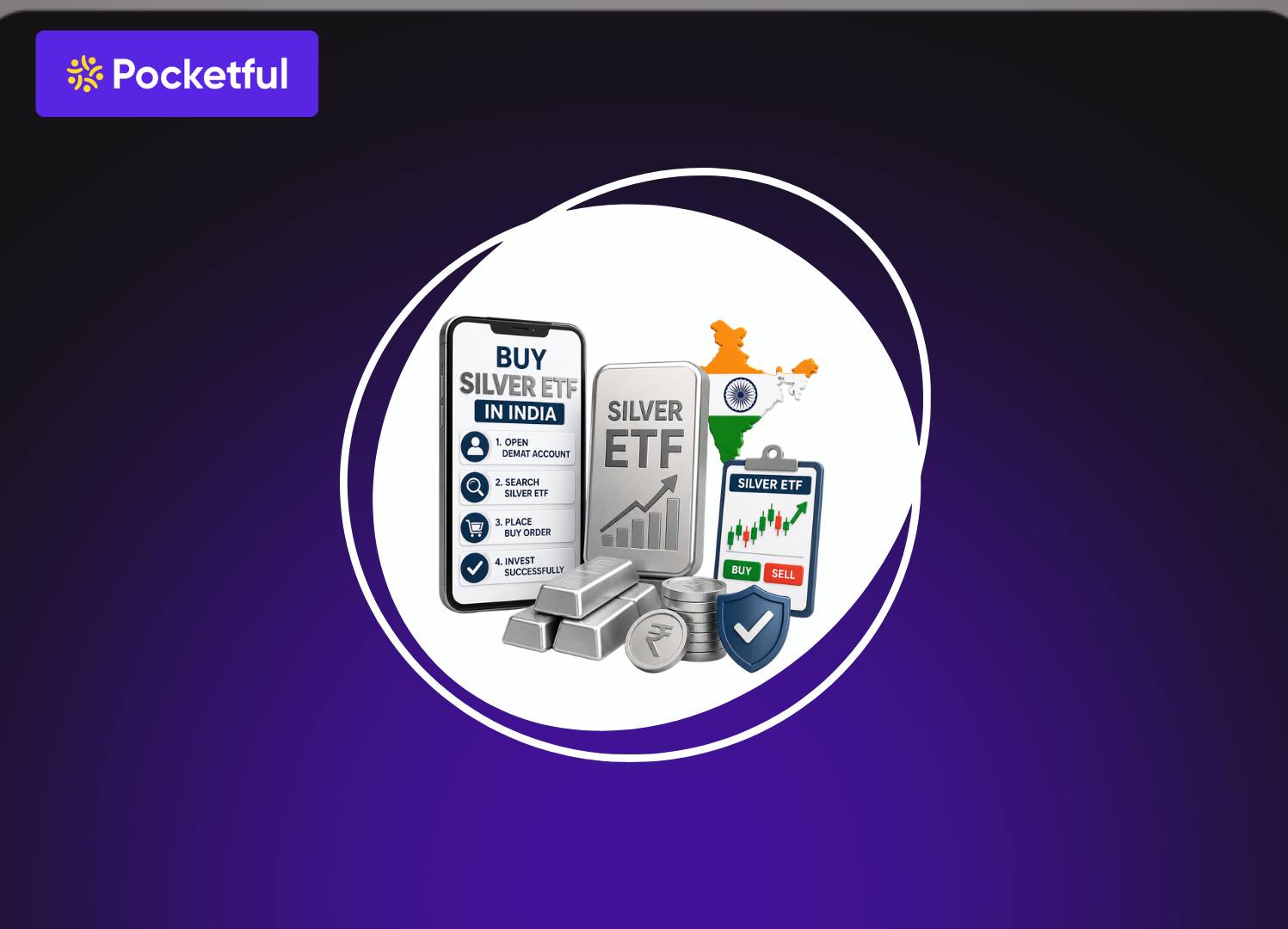
- Step 1- Open a Demat Account. First and the most basic step is to create free account on pocketful by downloading the app.upload your basic KYC documents like PAN card and Aadhaar card.
- Step 2-Login to the Platform. After verification of account, open the Pocketful app or website and log in by using credentials.
- Step 3- Search for the ETF. Type the name or the symbol of the silver fund you want to select at the search bar such as “SILVERBEES” or “HDFCSILVER”.
- Step 4- Place the Order. See the current price of the fund on the interface. Just enter how many units you want and hit that “BUY” button
- Step 5- Check your delivery And you are done! After the standard processing time, your digital silver units will safely show up right in your Pocketful Demat account.
Pocketful also gives you some advanced features if you want to be a smart investor. For example, they offer a Good Till Triggered order feature. This means you can set a target price today, and the app will automatically buy the silver for you whenever the price drops to your target level.
Taxation of Silver ETFs in India
Silver is taxed just like bank FDs or debt funds. Here are simple things that you should know about taxation of silver ETFs in India:
- Long-term benefits: Since April 1, 2023, the benefit of “indexation” (adjusting for inflation) has been removed for Silver ETFs.
- Taxed as per Slab Rate: Regardless of whether you sell after two months or ten years, your profits are added to your total income. You pay tax based on whatever income tax bracket (slab) you fall into.
- Simple Calculation: If you earn Rs.50,000 in profit from your Silver ETF and you are in the 20% tax bracket, you simply pay 20% on that profit (plus cess).
Who Should Invest in Silver ETFs?
Silver is used both as an investment and as a raw material for industries. Know when and where you should invest:
- No Physical Possession: If you want silver exposure but don’t want the headache of finding a locker or worrying about the purity of physical bars and coins.
- Portfolio Diversification: If your portfolio is heavy on stocks and gold, silver adds a different layer because it often moves differently than the stock market.
- Green Energy Sector: Silver is used heavily in solar panels, EVs, and electronics. If you believe the “green energy” boom is here to stay, silver is a smart way to bet on that industrial demand.
- Indexation: If you’re worried about the rupee losing its purchasing power over time, silver historically acts as a solid shield to protect your wealth against rising inflation.
Read Also: How to Invest in Silver in India?
Advantages and Disadvantages of Silver ETF
Here are the clear advantages and disadvantages of investing in a silver ETF.
Advantages of Silver ETF
- Purity: Every unit is strictly backed by 99.9 percent pure physical silver, so you never have to worry about fake metal.
- Saving of storage cost : No lock and key or bank locker required in ETF because the fund securely stores the silver for you.
- High Liquidity: No need to go sell your silver to jewelry shop you can sell your investment on a real time basis.
- Cost Effective: It is much cheaper than physical silver because you avoid paying high making charges and GST upon purchase
Disadvantages of Silver ETF
- Market Volatility: silver prices change very sharply based on global industrial demand and news.
- Tracking Error: Sometimes, the performance of your fund might not match the actual market price of silver perfectly due to fund expenses.
- No Physical Touch: In India the physical form of silver is treated as a sign of prosperity. But in Silver ETF you can not hold them physically and not to use them for family weddings or religious rituals etc.
- Demat Account Mandatory: For buying silver ETF you must have a demat account, unlike physical silver you can not buy it from a local jewelry shop.
Read Also: How to Buy Silver Coins & Bars in India
Conclusion
To sum it all up, investing in silver has never been easier or more secure. The future of this precious metal looks very bright. With the whole world shifting towards solar energy and electric vehicles, the industrial demand for silver is only going to increase in the coming years.
A silver ETF provides a brilliant, modern way to capture this potential growth. You get to avoid all the traditional headaches of physical storage, purity checks, and high making charges. It is a clean, transparent, and highly liquid investment that fits right into your smartphone.
Platforms like Pocketful have truly made this journey smooth for regular investors. With zero brokerage charges on delivery and a lifetime free Demat account, your investment costs stay very low.
Frequently Asked Questions (FAQs)
01
What is the meaning of a Silver ETF?
It is a type of mutual fund where you can buy digital units of this fund on the stock market. Every unit is backed by 99.9 percent pure physical silver.
02
What are the main advantages of investing in silver ETF?
Main advantage is assured purity and zero storage headache. You do not have to worry about lock and key or bank lockers.
03
How does Pocketful help users to buy these units?
It is very simple and user friendly. open a free Demat account on the Pocketful, and buy from it by simply searching on tab
04
Can I invest a small amount every month automatically?
Yes, you certainly can. Pocketful allows you to set up a Systematic Investment Plan for your funds. You can fix a small amount to be invested automatically every month,
05
What is the basic tax rule before selling?
If you hold your units for more than 12 months, your profits are considered long-term capital gains. And these long-term profits will be taxed at a flat rate of 12.5 percent. If you sell before 12 months, it is taxed based on your regular income tax slab.
Disclaimer

The information shared in this content is intended solely for educational and informational purposes and should not be considered financial, investment, or trading advice. Any references to stocks, mutual funds, or market instruments are purely for informational purposes and do not constitute recommendations. Investments in financial markets are subject to market risks, and past performance is not indicative of future returns. Readers are advised to conduct independent research, review official documents carefully, and consult a qualified financial advisor before making any investment or trading decisions.
Article History