



| Type | Description | Contributor | Date |
|---|---|---|---|
 | Post created | Pocketful Team | Aug-12-26 |
Read Next
- What is the Public Offering Price (POP)?
- Underpriced IPO: Meaning, Formula, Reasons & Examples
- Pre-IPO vs IPO Investing: Key Differences
- How to Sell IPO Shares on Listing Day or Later
- 10 Common IPO Investing Mistakes to Avoid Before Applying
- What is IPO Lot Size?
- SBI Funds Management IPO Allotment Status: Check Latest GMP, Steps to Verify Status
- SBI Funds Management IPO Day 2 GMP, Subscription & Listing Date
- SBI Funds Management IPO Day 1 Subscription: GMP, Status & Review
- What Is Tax On IPO Profits In India
- What is IPO Lock-In Period?
- How to Bid for an IPO in India (2026)
- How to Check IPO Allotment Status
- CMR Green Technologies IPO Allotment Status: Check Latest GMP, Steps to Verify Status
- What is IPO Valuation?
- What is a Book Running Lead Manager (BRLM) in IPO?
- What Is a Hot IPO?
- Difference Between RII, NII, QIB and Anchor Investor in IPO
- What Are the Different Types of IPO Investors
- Mainboard & SME IPO Eligibility Criteria
What is Basis of Allotment in IPO?
Published on : 12th August 2026
|Updated on : 12th August 2026



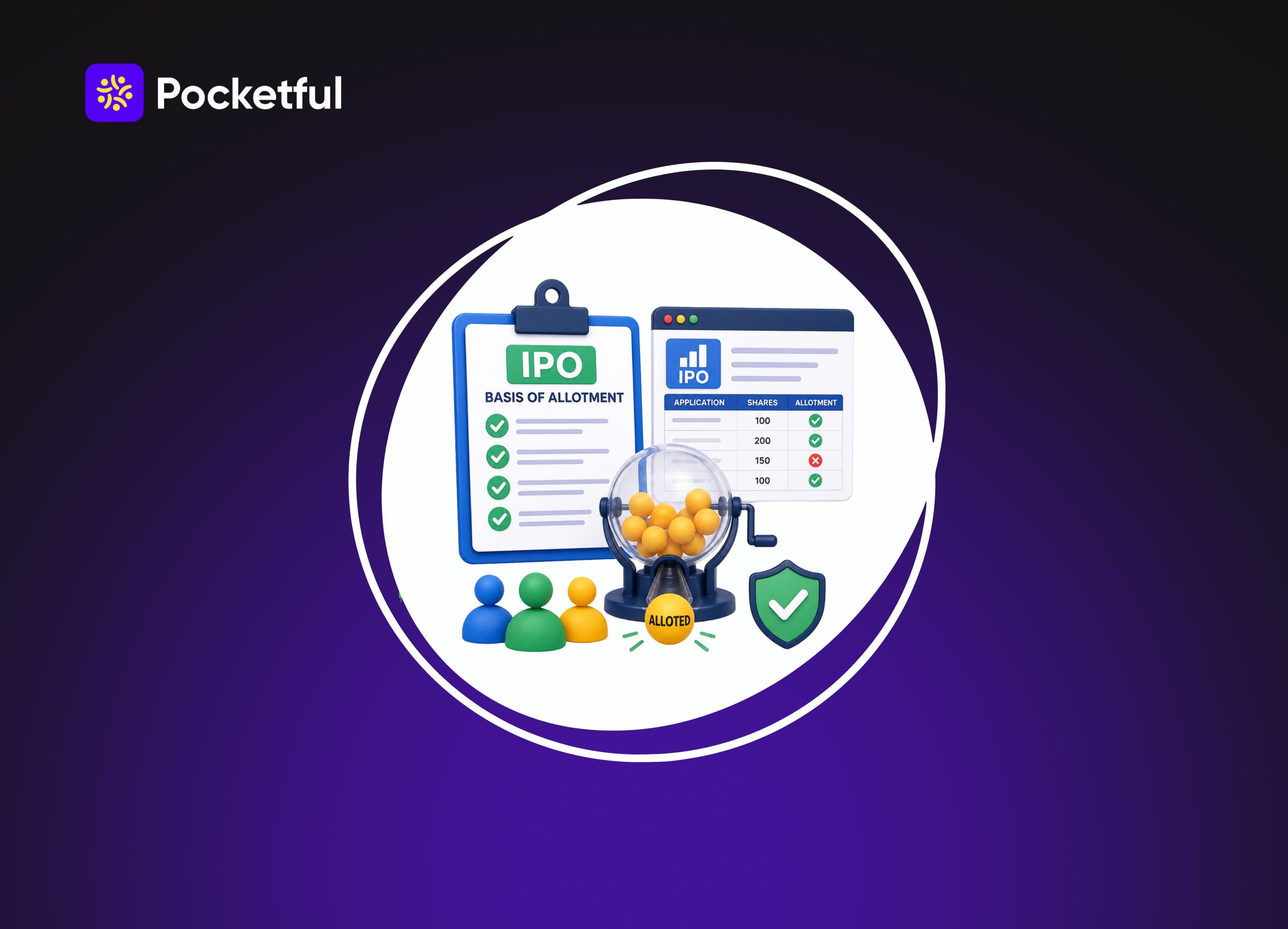
If you’ve ever applied for a hot IPO and then spent the next few days refreshing the registrar’s website every couple of hours, you already know the feeling this article is about. There’s a strange mix of hope and dread that kicks in once the subscription window closes: did you get the shares, or is your money about to bounce back into your account? That outcome comes down to something called the basis of allotment, and it’s worth actually understanding rather than just waiting on.
This piece walks through what the basis of allotment means, who decides it, how the whole IPO allotment process plays out, and how you can actually apply for an IPO on the platform.
What Does Basis of Allotment Mean?
In a nutshell, the basis of allotment (BoA) is the rulebook that decides who gets a piece of the action in an IPO and how many shares they get. And here’s the thing – it’s not a decision made by the company; it’s a very specific, SEBI-regulated process that the registrar to the issue follows to the letter, with the stock exchange (NSE or BSE) giving the final okay.
Now, if not too many people are applying for shares – and they usually aren’t – life is simple: everyone gets what they asked for. But things get really interesting when an IPO takes off, and thousands of people are scrambling to get in on the action. That’s when the company has to have some solid, fullproof system in place to figure out who actually gets the shares. And that’s exactly what the BoA document is all about.
You’ll usually see this document show up a few days after the IPO closes, broken down by the type of investor, showing in detail how the demand stacked up against the available shares and how the shares were eventually divided up.
Why Is the Basis of Allotment Important in an IPO?
For one, it’s what keeps the process honest. When a retail portion gets oversubscribed 30 or 40 times, there’s always a lingering worry that bigger applicants somehow get an edge. Because the allotment is computerised and overseen by the exchange, that worry mostly goes away.
It also gives investors an idea of their allotment chances. For example, if the retail category is oversubscribed 25 times, the probability of receiving shares is relatively low.
There’s a money angle too. Until the allotment is out, your funds sit blocked through ASBA or a UPI mandate. The BoA is what tells you whether that money turns into shares or gets released back to you, which matters if you were planning to redeploy it elsewhere.
And sometimes, it’s simply diagnostic. If your application got rejected, it’s not always about oversubscription; a mismatched PAN or an incorrect DP ID can knock you out too. Checking the allotment status (and understanding why you didn’t make the cut) can save you from repeating the same mistake next time.
Who Actually Decides the Basis of Allotment?
Not the company that’s a common misconception. The job falls to the Registrar to the Issue, a SEBI-registered intermediary (names like Link Intime, KFin Technologies, and Bigshare Services come up often), working alongside the exchange where the company is listed.
Roughly, this is how it plays out:
The registrar first goes through every application received during the subscription period, checking PAN details, demat account information, and whether payments or UPI mandates actually came through. Anything invalid or duplicated gets filtered out at this stage. Based on the final validated numbers in each category, the registrar then works out the allotment by lottery for retail investors if oversubscribed, and a proportionate split for NII and QIB categories. The exchange reviews this before it’s made official, and only then does the basis of allotment get published.
This two-layer check registrar plus exchange is really what gives the process its credibility. It’s not left to the company’s discretion at any point.
Read Also: What is the IPO Allotment Process?
How the Allotment Process Plays Out
The approach changes depending on whether the issue is oversubscribed and which category you fall under. If the IPO is undersubscribed, nothing tricky here. Every valid applicant gets exactly what they applied for.
If the IPO is oversubscribed, things split by category:
- Retail Individual Investors (RIIs): Since most retail applicants go for a lot or two, a computerised lottery decides who gets in. The idea is to spread allotments across as many people as possible rather than favour those who applied for more so a bigger application doesn’t really improve your odds within the retail cap.
- Non-Institutional Investors (NIIs/HNIs): This is where proportionate allotment kicks in. If the NII segment is oversubscribed 8 times, someone who applied for ₹8 lakh worth of shares would typically end up with around ₹1 lakh worth scaled down in proportion to the oversubscription.
- Qualified Institutional Buyers (QIBs): Same proportionate logic applies here, no lottery involved, since this category is made up of mutual funds, banks, and foreign portfolio investors applying in bulk.
The Math Behind Proportionate Allotment
For categories that follow the proportionate route, the formula the registrar uses is fairly straightforward:
Allotment Ratio = Shares Available in the Category ÷ Total Shares Applied For in that Category
Shares Allotted = Shares Applied For × Allotment Ratio
So if a category has 1 lakh shares reserved and applications come in for 12 lakh shares, the ratio works out to roughly 1:12 each applicant gets about a twelfth of what they applied for, adjusted for minimum lot rules.
How the Allotment Splits Across Investor Types
SEBI sets aside specific portions of every IPO for different kinds of investors:
- Retail Individual Investors: typically get a minimum of 35% of the net offer, for anyone applying up to ₹2 lakh. Bidding at the cut-off price is a smart move here; it keeps your bid valid regardless of where the final price lands within the band.
- Non-Institutional Investors (NII): get a minimum of 15%, further split into smaller NIIs (₹2 lakh to ₹10 lakh) and bigger NIIs (above ₹10 lakh), each with its own slice of the quota.
- Qualified Institutional Buyers (QIB): can get up to 50% of the net offer, with a portion carved out specifically for mutual funds.
Worth knowing: if one category doesn’t get fully subscribed, the leftover shares can be reallocated to categories that are oversubscribed, and occasionally, that ends up benefiting retail applicants.
When Does the Basis of Allotment Come Out?
IPO timelines have tightened up quite a bit over the last few years. Here’s roughly how it plays out now:
- Closing Day (T-Day): Subscription window shuts.
- T+1: Registrar validates applications, rejects the technically invalid ones, and works out the allotment numbers.
- T+2: Basis of allotment is published, and refunds for unsuccessful applicants start moving.
- T+3: Shares land in demat accounts, and the stock usually lists shortly after.
These timelines can shift slightly issue to issue, so it’s worth checking the specific dates for whichever IPO you’ve applied to rather than assuming they’ll always match exactly.
How to Check Your IPO Allotment Status
A few reliable ways to check, rather than sitting around waiting for an email:
- Registrar’s website: All IPO has a registrar attached to it. Visit their portal, choose the IPO name and search with your PAN, application number or DP/Client ID.
- NSE or BSE websites: You can check allotment status in both exchanges; just select the IPO and enter your PAN and application number.
- Your broker’s app: most trading platforms, Pocketful included, let you check your allotment status right within the app, so you don’t have to rely between websites.
Keep your PAN, application number, and DP ID within reach; most portals will ask for at least one of these.
Read Also: How to Check IPO Allotment Status
How to Apply for an IPO Through Pocketful
If you’re applying through Pocketful, the process is designed to be quick and mostly happens within the app itself:
- Log in to your Pocketful account. Make sure your demat and trading account are active, and that your bank account is linked for UPI-based payments.
- Head to the IPO section. You’ll find a list of currently open IPOs along with key details: price band, lot size, issue dates, and category-wise subscription status.
- Select the IPO you want to apply for. Tap on it to view more details, including the company’s financials and the offer structure, before deciding how much you want to bid.
- Enter your bid details. Choose the number of lots, and either select a specific price within the band or go with the cut-off price (usually the safer choice, since it keeps your bid valid no matter where the final price settles).
- Enter your UPI ID. This is the ID linked to your bank account, and it’s what Pocketful uses to raise the mandate request for blocking your application amount.
- Approve the UPI mandate. You’ll get a notification on your UPI app (Google Pay, PhonePe, or whichever app you use); approve it before the deadline. This step trips people up more often than you’d expect, so don’t let it sit unapproved.
- Track your application. Once submitted, you can check your application status and, later, your allotment status directly from the IPO section in the app.
- Check allotment and next steps. Once the basis of allotment is out, Pocketful will show you whether you’ve been allotted shares. If you have, they’ll be credited to your demat account before listing; if not, the blocked amount gets released back automatically.
The whole point of applying through a broker like Pocketful is that it collapses a fairly process bidding, mandate approval, and tracking into a few taps, without you needing to visit the registrar’s site at every step.
Common Reasons Investors Don’t Get an Allotment
Even in a fair system, a lot of applicants walk away empty-handed. Usually it comes down to one of these:
- Heavy oversubscription: the most common reason by far. More applicants than lots simply means the lottery won’t favour everyone.
- Duplicate applications on the same PAN: SEBI allows only one application per PAN. Applying twice, even through different brokers, gets you rejected.
- Incorrect details: a mismatched PAN, DP ID, or bank account can invalidate an otherwise fine application.
- UPI mandate or payment issues: forgetting to approve the mandate in time, or not having sufficient balance blocked, is a surprisingly frequent slip-up.
- Bidding below the cut-off price: if your bid price ends up lower than the final issue price, it won’t be considered valid.
- Same UPI ID across multiple family applications: a lot of people try to apply through several family members’ accounts but use one UPI ID for all of them, which gets flagged.
A Few Ways to Improve Your Odds
Applying for a spot in a super popular retail category is always a bit of a crapshoot, but there are some habits you can get into that might just give you a bit of an edge and make you less likely to get knocked out on a technicality at the very last minute
- Instead of making one big application with all your eligible family members on the same account, try applying through multiple eligible family accounts, each with their own PAN and UPI ID. That way you spread your bets and aren’t putting all your eggs in one basket
- In the retail category, it’s actually better to apply for single lots in different accounts rather than putting in one big application with multiple lots – the way the lottery is set up, it treats each application pretty much equally, so by breaking it down into smaller applications you stand a better chance of getting some through
- Play it safe by sticking to the cut-off price, so you don’t run the risk of your bid being rejected because it’s too high.
- Get your application in early rather than waiting till the last minute so you have time to sort out any payment issues that might come up.
- Double-check – and then double-check again – your PAN, DP ID, and bank details before you hit submit
- If you qualify for one of the shareholder or employee quotas, use that – the odds are always much better in those pools than they are in the general public pool
Wrapping Up
The basis of allotment is not fine print, it is the moment you know whether your IPO application turned into shares or refund. Once you understand how the registrar and exchange work together, how the lottery and proportionate methods differ in various categories and the typical problems with applications, the whole thing seems much less of a black box. The application process with Pocketful takes only a few minutes, and the waiting begins after you click submit.
| S.NO. | Check Out These Interesting Posts You Might Enjoy! |
|---|---|
| 1 | What is IPO Lot Size? |
| 2 | How to Cancel an IPO Application? |
| 3 | What Is a Hot IPO? |
| 4 | What is Face What is the IPO Cycle |
| 5 | What is NII in IPO? |
Frequently Asked Questions (FAQs)
01
What is the deal with allotment in an initial public offering?
The allotment situation in an IPO is decided by the method used to sort out who gets how many shares. The registrar in charge of the IPO gets to decide this, and the stock exchange has to give it the thumbs up to make sure its all fair and square.
02
Who actually puts the allotment plan together?
The allotment plan is put together by the registrar company itself, like KFin Technologies, Link Intime, or Bigshare Services, and then gets a once-over by the relevant stock exchange before they publish it.
03
When do the IPO allotments come out?
As a rule of thumb, the basis of allotment is usually announced a couple of working days after the IPO closes for business. At that point you can go check and see if you got any shares.
04
What happens if I don’t end up getting any shares?
If you don’t get an allotment, then the money that was blocked from your bank just gets released back into your account; no need to do anything else.
05
Does sending in multiple applications for more shares increase my chances of getting an allotment?
Generally for individual investors, sending in multiple applications for more shares won’t improve your chances of getting an allotment in an oversubscribed IPO. What’s more, most retail allotments are decided by an automated lottery system for all eligible individual applications.
Disclaimer

The information shared in this content is intended solely for educational and informational purposes and should not be considered financial, investment, or trading advice. Any references to stocks, mutual funds, or market instruments are purely for informational purposes and do not constitute recommendations. Investments in financial markets are subject to market risks, and past performance is not indicative of future returns. Readers are advised to conduct independent research, review official documents carefully, and consult a qualified financial advisor before making any investment or trading decisions.
Article History