



| Type | Description | Contributor | Date |
|---|---|---|---|
 | Post created | Pocketful Team | Aug-29-26 |
Read Next
- JIO Platforms IPO Day 1: Check Latest GMP, Steps to Verify Status
- Jio Platforms IPO 2026: Price Band, Dates, Financials, Valuation and IPO Review
- How to Invest in IPOs in India: From Application to Allotment
- Moneyview IPO Allotment Status: Check Latest GMP, Steps to Verify Status
- NSE IPO Listing Day: NSE Listing Price, Performance & Key Takeaways
- NSE IPO Day 2: Subscription Status, GMP & Allotment Date
- Hero Motors IPO Allotment Status: Check Latest GMP, Steps to Verify Status
- NSE IPO Day 1 Highlights: Check Latest GMP, Steps to Verify Status
- What is the Public Offering Price (POP)?
- Underpriced IPO: Meaning, Formula, Reasons & Examples
- What is Basis of Allotment in IPO?
- How to Sell IPO Shares on Listing Day or Later
- 10 Common IPO Investing Mistakes to Avoid Before Applying
- What is IPO Lot Size?
- SBI Funds Management IPO Allotment Status: Check Latest GMP, Steps to Verify Status
- SBI Funds Management IPO Day 2 GMP, Subscription & Listing Date
- SBI Funds Management IPO Day 1 Subscription: GMP, Status & Review
- What Is Tax On IPO Profits In India
- What is IPO Lock-In Period?
- How to Bid for an IPO in India 2026 – ASBA & Cut-Off
Pre-IPO vs IPO Investing: Key Differences
Published on : 30th August 2026
|Updated on : 29th August 2026



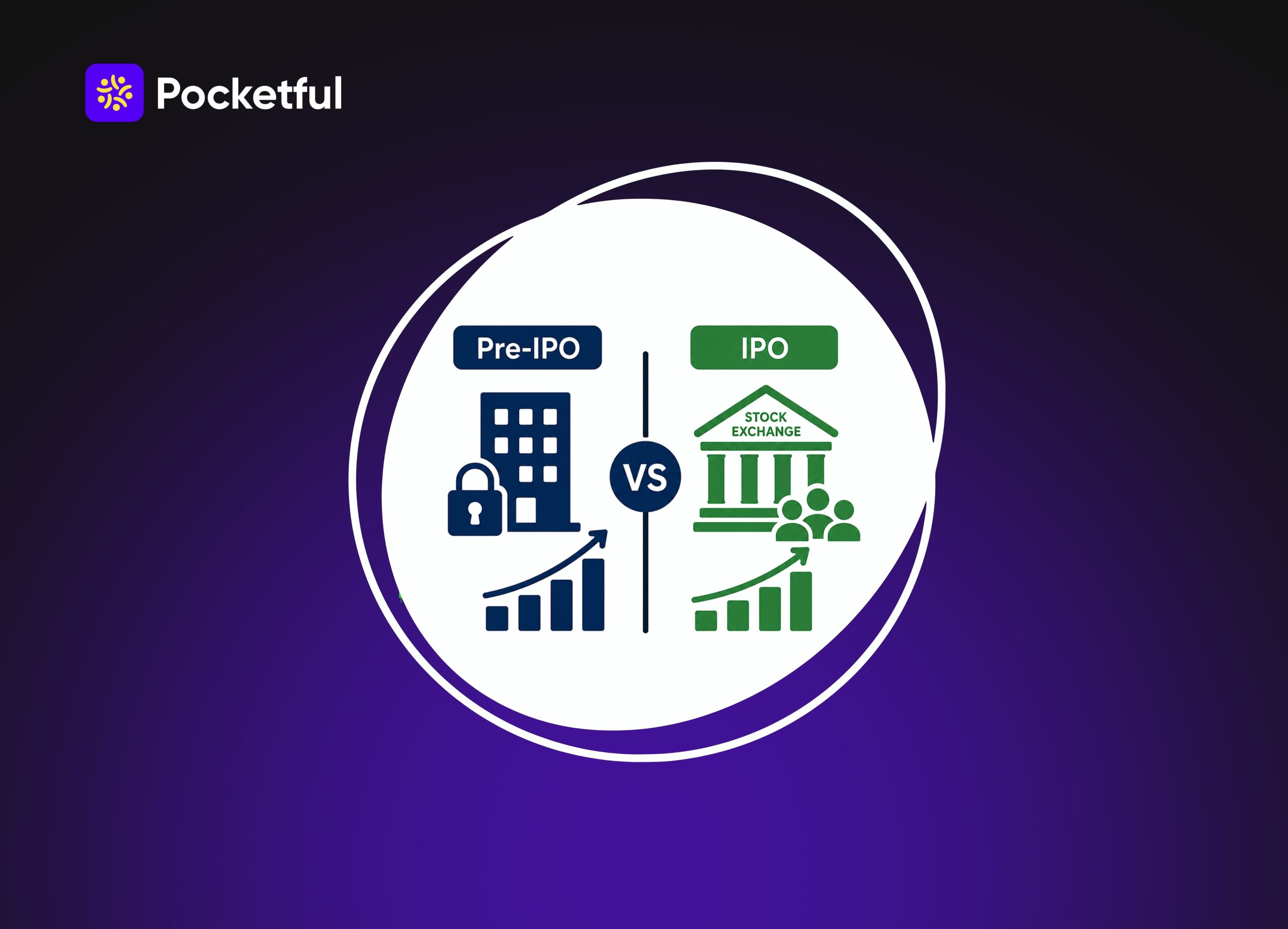
If you have ever invested in an IPO, you have probably come across someone talking about buying shares before they even list.
Pre-IPO investing is gaining a lot of traction these days. At the same time, good old IPO investing has not lost its charm either. Every other day, a fresh IPO opens for subscription, and Indian retail investors continue to apply in huge numbers, hoping for listing gains.
We will break down both concepts in simple and easy language without any jargon.
What is IPO Investing?
An IPO, Initial Public Offering, is the formal route a private company takes to become publicly listed. The company opens a window, usually for about three working days, where investors can apply for shares at a price band.
If the shares are allotted to you, they are credited to your demat account, and once the stock is listed on the NSE or BSE, you can sell whenever you want to.
For most Indian retail investors, this is the more familiar territory. You have likely applied for at least one IPO through your broker, whether through Pocketful or any other platform, using UPI-based ASBA.
How does IPO Investing work?
IPO investing follows a much more defined, SEBI-regulated path.
The company submits a Draft Red Herring Prospectus (DRHP) to SEBI that includes all the details: the company’s financials, its business model, its reasons for going out for capital, and any potential risks.
Once SEBI reviews and approves this, the company submits an updated version, the RHP, including the final price band, the size of the issue, and key dates for bidding and listing.
The IPO then opens for subscription, usually for about three working days. During this window, you can apply through your broker, Pocketful, for instance, using UPI-based ASBA, where your funds get blocked but only debited if you receive an allotment.
Once the subscription period closes, shares are allotted if you are one of the lucky ones; they are credited to your demat account before the listing date. From there, the company starts trading on NSE, BSE, or both, and you can hold or sell at whatever price the market is offering that day.
Pre-IPO Investing – An Overview
It means buying shares of a company that has not been listed on the stock exchange yet. These are called unlisted shares, and they usually come from people who already hold them, like employees with ESOPs, founders, or private equity investors.
Until a few years back, this aspect of IPOs was basically closed off to regular investors. Now, with several platforms dealing specifically in unlisted shares, retail investors can also buy.
However, you should remember that there is no SEBI oversight here in the way there is for listed shares. No investor grievance redressal system built in, no standardised pricing, nothing forcing sellers to disclose information the way a company filing for an IPO has to.
How does Pre-IPO Investing work?
The process is simple once you understand the steps. You select a platform that deals in unlisted shares
Once you have shortlisted a stock you are interested in, you will make an enquiry with the platform, and they will get back to you with the price they are offering and how many shares are available.
Since there is no exchange deciding the price here, it is more of a negotiation than a fixed rate. You agree on a price, make the payment, and the shares are credited to your demat account within a couple of working days.
You hold onto the shares until the company decides to go public, for which there is no fixed timeline
Even after the company finally lists on the NSE or BSE, you are usually not allowed to sell. Most pre-IPO shares come with a lock-in period.
Read Also: What are the Different Types of IPO in India?
The Table of Difference: Pre IPO vs. IPO Investing
| Parameter | Pre-IPO Investing | IPO Investing |
|---|---|---|
| Pricing | Negotiated between buyer and seller; no fixed band, so you could easily overpay without realising it | Fixed price band announced publicly ahead of time; everyone pays within the same range |
| Liquidity | Low: no active exchange, so exit is depends on finding another buyer, which can take time | High: once listed, shares trade freely on NSE/BSE during market hours |
| Regulation | No SEBI oversight; you are relying on your own due diligence and whatever the seller or platform discloses | Heavily regulated by SEBI, companies must disclose financials in their DRHP, risks, and business details before raising money publicly |
| Certainty of listing | No guarantee. The company may delay, downsize, or shelve its IPO plans altogether | The listing date is known and fixed once the subscription window closes |
| Minimum investment | Varies by platform | Generally ranges from ₹15,000 for one retail lot |
Reasons People are attracted to Pre-IPO Investing
- Getting in before the crowd does: There is something appealing about buying into a company before it is even on the exchange. If the pricing works out in your favour and the IPO lists at a premium, you are already on gains before the stock opens for trading on day one.
- Access to businesses you cannot reach otherwise: Mutual funds, index funds, regular stock picks, none of that gets you into a company that is not listed yet. Pre-IPO investing opens up a slice of the market that’s simply unavailable through any conventional route,
- The story behind the company: A lot of pre-IPO buyers are not just chasing returns; they believe in what the business is building. Maybe it is a company they have followed for years, or one operating in a sector they understand well. Getting in early feels like backing that conviction.
Are Pre-IPO & Unlisted Shares the same thing?
No. There is a slight difference in how they are used.
Unlisted shares are the broader term, and it covers any share of a company that is not trading on the NSE or BSE. That includes long-standing private companies that may never go public, government-owned entities that trade in the unlisted space, and, yes, companies that are eventually headed for an IPO.
Pre-IPO, on the other hand, is when you buy pre-IPO shares; you are buying unlisted shares of a company that is expected to list at some point. Maybe it has already filed paperwork with SEBI.
So every pre-IPO share is an unlisted share, but not every unlisted share is a pre-IPO one.
Taxation: Pre IPO vs IPO Investments
For pre-IPO or unlisted stocks, if you sell them within 24 months from the date of purchase, then the gains are treated as income and taxed at your income tax slab rate. After 24 months, it is subject to long-term capital gains tax at 12.5% without indexation.
For IPOs, STCG refers to the capital gains made within a period of 12 months from the listing date and is taxed at 20%, while LTCG refers to capital gains made after 12 months, which is taxed at 12.5% with an exemption of gains up to ₹1.25 lakh per year.
Which one should you choose?
There is no one-size-fits-all answer, and anyone who tells you otherwise is oversimplifying.
Pre-IPO investing is more useful if you already have surplus money that you do not need for a while, you are comfortable with the idea that your capital might be locked in longer than planned, and you have done the research well on the specific company rather than just chasing a name.
IPO investing will make more sense if liquidity is important to you, if you want regulatory disclosures, or if you are working with a smaller amount.
If you’re someone who trades or invests actively and wants to keep an eye on upcoming IPOs, applying through a platform like Pocketful makes the process easy.
Read Also: Why Invest in an IPO and its Benefits?
Conclusion
Neither pre-IPO nor IPO investing is the smarter choice. They are just meant for different kinds of investors with different priorities.
If you like the idea of early access and can tolerate illiquidity and uncertainty, pre-IPO might fascinate you. If you would rather stick to a regulated, transparent process with clear exit options, IPO investing is likely the better fit. Invest in IPOs with Pocketful and enjoy zero brokerage on delivery trades, along with detailed IPO analysis to help you understand the opportunity, assess the risks, and make investment decisions with greater confidence.
| S.NO. | Check Out These Interesting Posts You Might Enjoy! |
|---|---|
| 1 | Anchor Investors in IPOs – Meaning, Role & Benefits |
| 2 | How to Cancel an IPO Application? |
| 3 | Key Difference Between IPO and FPO |
| 4 | What is Face What is the IPO Cycle |
| 5 | What is NII in IPO? |
Frequently Asked Questions (FAQs)
01
Is pre-IPO investing legal in India?
Yes. There is just no SEBI regulation covering the unlisted shares market the way there is for listed stocks.
02
Can I sell pre-IPO shares immediately after the company lists?
Usually not. Most pre-IPO shares come with a lock-in period of around six months post-listing.
03
What happens if a company never files for an IPO?
Your shares stay unlisted indefinitely, and you would need to find a private buyer if you want to exit.
04
Are IPO listing gains guaranteed?
No. Some IPOs list above the issue price, but others list flat or even below it. It depends on market sentiment at the time.
05
Can retail investors access pre-IPO shares now?
Yes, this has changed a lot in recent years. What used to be limited to HNIs and institutions is now accessible to regular investors.
Disclaimer

The information shared in this content is intended solely for educational and informational purposes and should not be considered financial, investment, or trading advice. Any references to stocks, mutual funds, or market instruments are purely for informational purposes and do not constitute recommendations. Investments in financial markets are subject to market risks, and past performance is not indicative of future returns. Readers are advised to conduct independent research, review official documents carefully, and consult a qualified financial advisor before making any investment or trading decisions.
Article History