



| Type | Description | Contributor | Date |
|---|---|---|---|
 | Post created | Pocketful Team | Apr-11-26 |
Read Next
- Is ₹2000 Note Still Valid in India in 2026?
- Best Stock Market YouTube Channels in India for Beginners
- SEBI Action on Jane Street: Impact on Indian Markets
- What is Personal Finance?
- Military Wealth Management: Strategies for Growing and Preserving Your Assets
- India’s Republic Day 2025: Honoring the Nation’s Defense Achievements
- 10 Essential Financial Planning Tips for Military Members
- How Do You Apply for PAN 2.0 Online and Get It on Your Email ID?
- LTP in Stock Market: Meaning, Full Form, Strategy and Calculation
- 15 Best Stock Market Movies & Web Series to Watch
- Why Do We Pay Taxes to the Government?
- What is Profit After Tax & How to Calculate It?
- Budget 2024: Explainer On Changes In SIP Taxation
- Budget 2024: F&O Trading Gets More Expensive?
- Budget 2024-25 Tax Slabs & Middle Class Benefits
- Semiconductor Industry in India
- What is National Company Law Tribunal?
- What is Capital Gains Tax in India?
- KYC Regulations Update: Comprehensive Guide
- National Pension System (NPS): Should You Invest?
Bank Rate vs Repo Rate: Key Differences
Published on : 13th April 2026
|Updated on : 13th April 2026



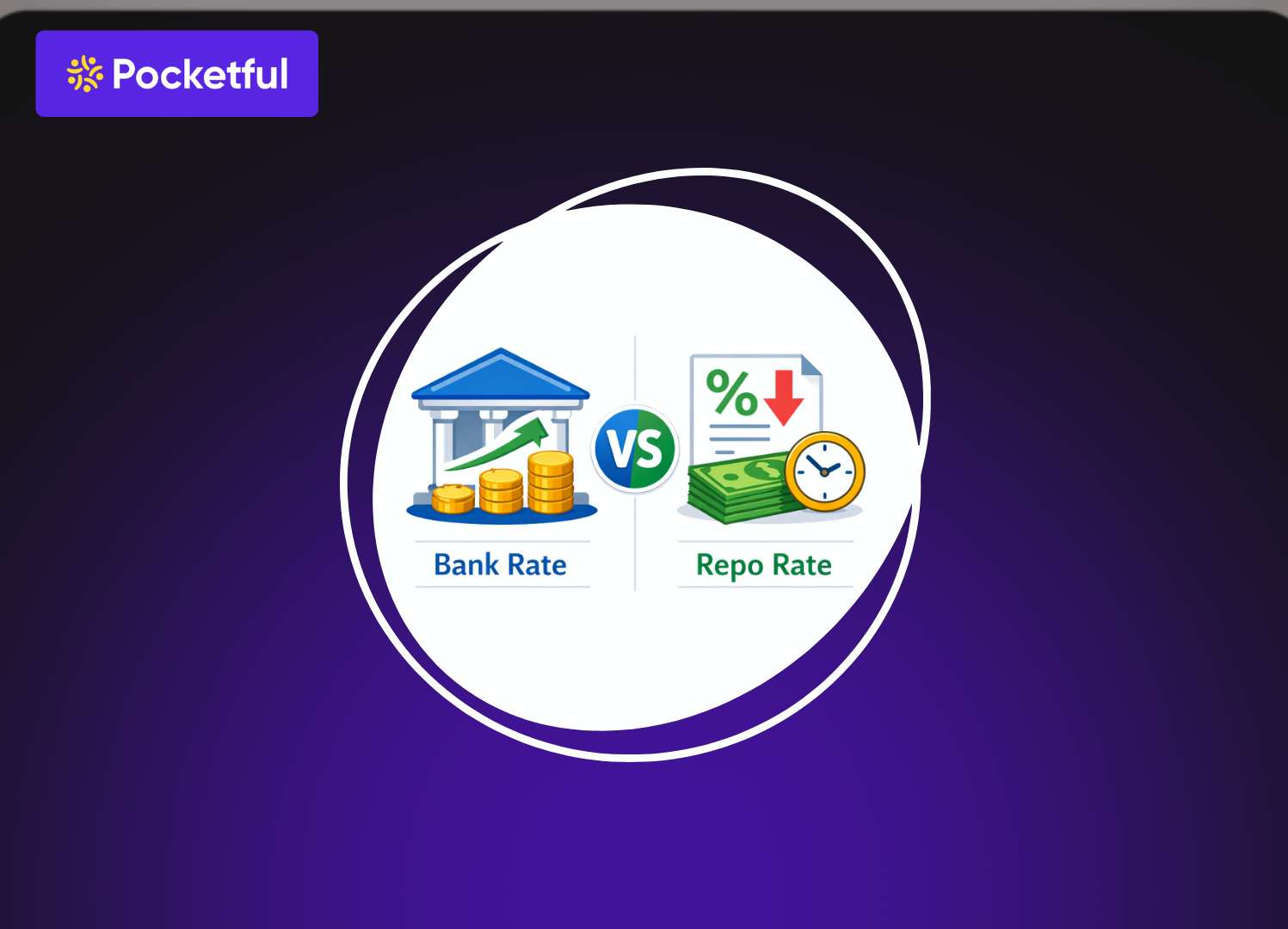
The financial health of a country depends on how its central bank manages the flow of money. In India, the Reserve Bank of India (RBI) is the “Big Boss” that controls this flow using special interest rates. To understand how the economy works, one must look at the bank rate vs repo rate relationship. These two rates help the RBI control how much money is available for people and businesses to spend.
Many people ask, what is bank rate? Simply put, it is the interest rate the RBI charges when it lends money to other banks for a long time.Knowing the difference between ban rate vs repo rate is important for every investor. While both rates involve lending to banks, they serve very different purposes in the market.
Understanding the Basics of Bank Rate and Repo Rate
To understand how the RBI controls the economy, one must look at the basic roles of these two interest rates. The central bank uses these rates to turn the economy up or down. When the RBI wants more people to spend money, it lowers these rates. Similarly when RBI wants people to start spending less, RBI increases these rates to make borrowing expensive.
The repo rate is a short-term lending rate. The word “repo” is a short form for “Repurchase Agreement”. It is a rate in which banks borrow money from the RBI. In this process, a commercial bank needs cash for a few days. It goes to the RBI and sells its government securities.The bank also signs an agreement to buy back these securities at a later date for a slightly higher price. This extra price is the repo rate. Because the bank gives securities as a guarantee, this is a “secured” loan.
The bank rate is different because it is used for long-term borrowing. It is also known as the “discount rate”.When a bank takes a loan at the bank rate, it does not have to provide any securities as a guarantee. This makes it an “unsecured” loan. Because there is no security, the RBI charges a higher interest rate for the bank rate compared to the repo rate.
The bank rate and repo rate: key differences also include how often they change. The repo rate is adjusted very often by the Monetary Policy Committee (MPC) during their meetings every two months. The bank rate changes much less often. It is mostly used as a signal for long-term interest trends in the country.
The Current Economic Situation in 2026
The global economy is facing a lot of stress in April 2026. A conflict in the Middle East has caused oil prices to rise above $100 per barrel. This is a big problem for country like India because we import most of our oil from the Middle East. When crude oil becomes expensive everything gets costly from transport to food.
Because of these risks, the RBI decided to pause any changes to the repo rate in April 2026. Keeping the rate at 5.25% is a “neutral” move.
| Policy Rate | Rate in April 2026 | Purpose |
|---|---|---|
| Repo Rate | 5.25% | Managing short-term cash for banks. |
| Bank Rate | 5.50% | Long-term borrowing and penalty rate. |
Similarity in Repo rate and Bank rate
Both the Repo Rate and the Bank Rate are regulated by the Reserve Bank of India (RBI).
- Liquidity Management: Both rates are used to control the money supply of the economy. By increasing repo rate or bank rate, commercial banks borrow money at a higher rate which ultimately reduces the amount of cash circulating in the market.
- Impact on Interest Rates: When the RBI hikes them, commercial banks usually increase interest rates on home, car, and personal loans, it directly affects your pocket.
- Inflation Targeting: Both rates are utilized to maintain price stability. During periods of high inflation, the RBI uses both rates to curb excess demand.
- Purpose of Lending: The commercial banks are the borrowers and the RBI is the lender In both scenarios. While the duration and collateral requirements differ, the fundamental relationship remains the same.
Read Also: Types of Interest Rates Explained
Bank Rate vs Repo Rate
Even though both rates are set by the RBI, they have different rules and uses. A side-by-side look helps to clarify their roles in the financial system.
| Basis of Difference | Repo Rate | Bank Rate |
|---|---|---|
| Meaning | The rate at which the central bank lends money to commercial banks against collateral(securities) to meet short-term gaps. | The rate at which the central bank lends money to commercial banks without any collateral or discounts their bills of exchange. |
| Purpose | Used to manage short-term liquidity and control the money supply in the economy on a day-to-day basis. | Used to meet the long-term credit needs of banks and serves as a benchmark for penal interest rates. |
| Monetary Policy Tool | A direct and flexible tool; changes in this rate are the primary signal for adjusting inflation and growth. | A qualitative/indirect tool; it acts as a ceiling for other rates and is used to signal the long-term stance of the central bank. |
| Agreement | Requires a buy-back agreement. | No buy-back agreement needed. |
| Loan Duration | Primarily used for short-term financial needs (overnight to 14 days). | Generally used for long-term `financial requirements of commercial banks. |
Factors influencing changes in repo rate and bank rate
The primary factors for changing these rates are as under
- Inflation Control: The RBI raises the Repo Rate when the Consumer price index (CPI) goes above 4%, so RBI lowers the rate this makes borrowing money more expensive, which naturally slows down spending and helps bring inflation back toward that 4%.
- Economic Growth: The central bank cuts rates, encouraging businesses to invest and consumers to spend, to boost the economy
- Global Alignment: If the US Federal Reserve increases interest rates, the RBI also hikes their rates, this keeps the Indian market competitive for foreign investors and prevents the Rupee depreciation.
Benefit and Disadvantage of Repo rate and Bank rate
While the Repo Rate and Bank Rate are both used to control the economy, here are some advantages and disadvantages mentioned below.
Shared Benefits
- Inflation Control: when these rates increase, loans become expensive and people spend less which helps control rising prices.
- Economic Stability: repo rate and bank rate helps to manage the money supply and keep the banking system stable.
Shared Disadvantages
- Increased EMI Burden: When these rates go up banks charge more interest from their customers, this makes home, car, and personal loans more expensive.
- Slower Growth: High interest rates make it costly for businesses to take loans for their expansion, which can slow down economic growth.
Key Differences in Impact
| Aspect | Repo Rate | Bank Rate |
|---|---|---|
| Main Benefit | It gives the bank quick money for a short time frame. This helps them to manage their daily cash needs | It works like a long-term support for the economy, banks dont need to give any collateral against any borrowing. |
| Main Disadvantage | Requires collateral banks must “lock up” government bonds with the RBI to get the money. | Acts like a penalty. If banks don’t maintain proper reserves, borrowing becomes very expensive for them. |
In short, the Repo Rate is your bank’s daily “fuel cost,” while the Bank Rate is more like a “long-term mortgage” or a “fine” for breaking rules.
Read Also: How Interest Rate Changes Affect the Stock Market
Conclusion
When we look at the repo rate and bank rate, it becomes clear how the RBI tries to balance different needs of the economy. The repo rate works more like a quick tool that helps manage day to day cash flow and even affects our monthly EMIs. On the other hand the bank rate is more of a long term tool that helps guide banks and keeps them disciplined.
Right now the situation is not very easy. With global issues and rising oil tensions in the Middle East, the RBI has to be careful, by keeping interest rates steady for now, it is trying to maintain the economy stable.There are several factors which can affect the economy, but a strong banking system gives some confidence for common people, having basic understanding of these rate can really help whether it’s deciding to take a loan or invest money.
In the end, the RBI plays a key role in keeping India’s financial system on track adjusting these rates whenever needed to handle both good times and difficult situations.
For more market news and insights, download Pocketful – offering users zero brokerage on delivery trades and an easy to use platform designed for both beginners and experienced investors.
Frequently Asked Questions (FAQs)
01
Why is the bank rate usually higher than the repo rate?
The bank rate is usually higher because the RBI does not ask for any guarantee or collateral when lending at this rate. Since there is more risk for the RBI, they charge a higher interest rate.
02
How does a repo rate cut affect my home loan?
Most modern home loans are linked to the repo rate. If the RBI cuts the repo rate, your bank usually reduces your interest rate. This means your monthly EMI payment will go down, saving you money.
03
Does the bank rate change as often as the repo rate?
No. The repo rate is the main tool used to control the economy and is usually reviewed after every two months. The bank rate does not change regularly and is mainly used for long term purposes or penalties.
04
What happens to my Fixed Deposits (FDs) when the repo rate rises?
When the repo rate goes up, banks usually increase the interest they rate on FDs. This is good news for people who save money in FDs.
05
Who decides these rates in India?
These rates are decided by the Monetary Policy Committee (MPC) of the Reserve Bank of India. The committee meets six times a year to review the economy and decide whether to change the rates or not.
Disclaimer

The information shared in this content is intended solely for educational and informational purposes and should not be considered financial, investment, or trading advice. Any references to stocks, mutual funds, or market instruments are purely for informational purposes and do not constitute recommendations. Investments in financial markets are subject to market risks, and past performance is not indicative of future returns. Readers are advised to conduct independent research, review official documents carefully, and consult a qualified financial advisor before making any investment or trading decisions.
Article History