



| Type | Description | Contributor | Date |
|---|---|---|---|
 | Post created | Pocketful Team | Jun-30-26 |
Read Next
- Is ₹2000 Note Still Valid in India in 2026?
- Best Stock Market YouTube Channels in India for Beginners
- SEBI Action on Jane Street: Impact on Indian Markets
- What is Personal Finance?
- Military Wealth Management: Strategies for Growing and Preserving Your Assets
- India’s Republic Day 2025: Honoring the Nation’s Defense Achievements
- 10 Essential Financial Planning Tips for Military Members
- How Do You Apply for PAN 2.0 Online and Get It on Your Email ID?
- LTP in Stock Market: Meaning, Full Form, Strategy and Calculation
- 15 Best Stock Market Movies & Web Series to Watch
- Why Do We Pay Taxes to the Government?
- What is Profit After Tax & How to Calculate It?
- Budget 2024: Explainer On Changes In SIP Taxation
- Budget 2024: F&O Trading Gets More Expensive?
- Budget 2024-25 Tax Slabs & Middle Class Benefits
- Semiconductor Industry in India
- What is National Company Law Tribunal?
- What is Capital Gains Tax in India?
- KYC Regulations Update: Comprehensive Guide
- National Pension System (NPS): Should You Invest?
Fixed Salary vs Variable Salary: Key Differences
Published on : 30th June 2026
|Updated on : 30th June 2026



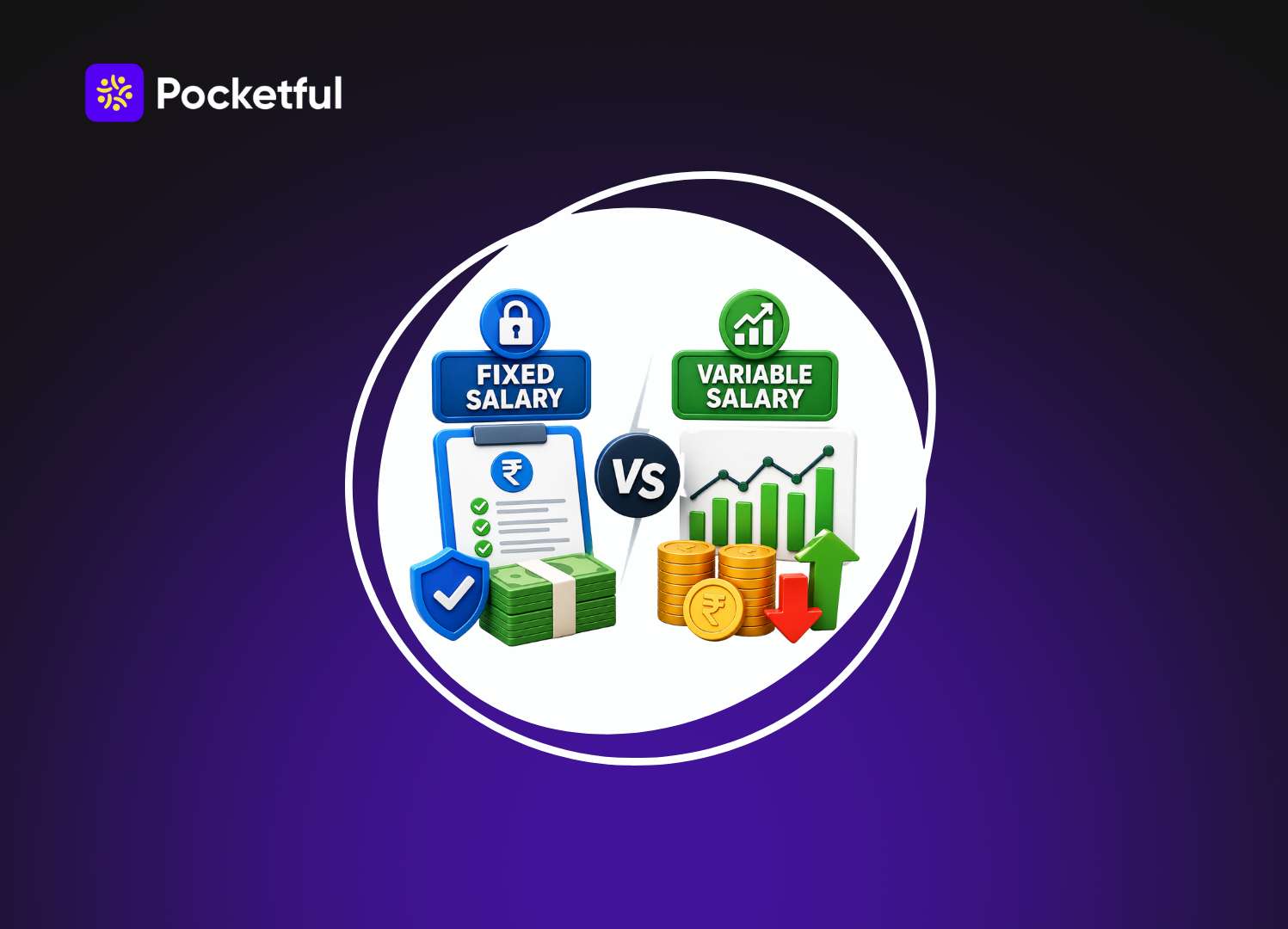
Understanding your compensation package is one of the necessary things that a working professional shall be clear about. It lets the individual manage and plan their hard earned money usage for the upcoming future. Generally professionals only focus on the total of the company. But knowing the exact breakdown helps them see their real take home pay. A standard salary package usually has two main parts. These are the fixed base and the performance linked bonus. This simple overview explains how these components function daily. It shows how they impact daily budgeting and long term financial stability. Let us explore these basic concepts.
What Is Fixed Salary?
Many individuals often wonder about the exact definition when reviewing job offers. It is the stable and guaranteed part of a compensation package. The payout does not depend on an employee’s performance or business profits.
The key features of fixed salary include a steady monthly income. It also acts as the baseline for calculating retirement benefits like the Provident Fund and gratuity. This portion provides a strong sense of financial security.
The components included in fixed salary are:
- Basic Pay: This is the core taxable portion of the package.
- House Rent Allowance (HRA): This allowance helps meet housing rent expenses.
- Special Allowance: This is a flexible part added to balance the overall structure.
- Conveyance Allowance: This covers the cost of travel to and from the workplace.
- Other Fixed Benefits: These include medical allowances and leave travel allowances.
There are clear advantages of a fixed salary for working professionals. It provides income stability for easy budgeting and offers immense financial security. It enables better long term financial planning for major life events like buying a home.
However, there are also noticeable disadvantages of a fixed salary. It does not financially reward extra effort directly. Rising inflation can slowly reduce the real purchasing power of this static pay over time.
What Is a Variable Salary?
This is the extra compensation directly linked to an individual’s or an organization’s performance. It rewards the extra effort that an employee puts into their regular work.
Companies establish clear targets at the start of a financial period. If an employee meets or exceeds these goals, they receive this additional money.
- Common Types of Variable Salary: The components typically include a Performance Bonus given for achieving team targets. They also include Sales Incentives for hitting specific revenue quotas. Other types are Commission Based Pay, Profit Sharing Bonus, and Annual Performance Rewards.
- Advantages of Variable Salary: It directly rewards hard work and outstanding business results. It allows top performers to earn significantly more money than their base pay.
- Disadvantages of Variable Salary: Unpredictable income can cause high mental stress for employees. It can also create unhealthy competition among team members in the workplace.
Difference Between Fixed and Variable Salary
To make smart career decisions, workers need to know what is a fixed and variable salary. Understanding what is fixed salary and variable salary helps in negotiating better job offers. Looking closely at fixed pay and variable pay reveals how they serve different purposes. People often ask what is a fixed salary when comparing two different job offers.
| Feature | Fixed Salary | Variable Salary |
|---|---|---|
| Meaning | Guaranteed pay given regardless of output. | Extra pay is linked to achievements and goals. |
| Payment Frequency | Paid regularly every single month. | Paid quarterly, half yearly, or annually. |
| Performance Dependency | Does not depend on the employee’s performance. | Highly dependent on meeting specific targets. |
| Income Stability | Provides a highly stable and predictable income. | Fluctuates based on results and business profits. |
| Risk Factor | Low risk for the employee. | High risk if performance targets are missed. |
| Motivation Level | Provides baseline security but low extra drive. | Highly motivates workers to push their limits. |
| Financial Planning | Makes it very easy to plan monthly budgets. | Makes it slightly difficult to plan fixed expenses. |
| Employer Cost Management | Increases the fixed financial burden on the company. | Helps companies save costs during bad financial years. |
| Suitability for Different Job Roles | Best for administrative, support, and backend roles. | Best for sales, leadership, and revenue driving roles. |
Read Also: Cash Market vs F&O: Key Differences
Example of Fixed and Variable Salary Calculation
Scenario 1: Employee with 100% Fixed Salary
Imagine an employee has a total package of Rs. 12 Lakhs. In this case, the entire amount is fixed. The employee will confidently receive Rs. 1 Lakh every month before tax deductions. This makes managing household bills very simple.
Scenario 2: Employee with Fixed + Variable Salary
Another employee has a package of Rs. 12 Lakhs, but it is split differently. They have Rs. 10 Lakhs as fixed pay and Rs. 2 Lakhs as variable pay. Their guaranteed monthly income before taxes will be around Rs. 83,333.
Understanding the Actual Take-Home Impact, The second employee will only get the remaining Rs. 2 Lakhs if they hit their performance targets. If they score poorly on their appraisal, their total annual earnings might only be Rs. 10 Lakhs. This creates a significant difference in the actual money taken home.
Why Do Companies Offer Variable Pay?
- Encouraging Employee Performance: When salary is directly linked to the performance it naturally motivates the employees to work harder.
- Aligning Goals with Business: By doing this the goal of the organization and employee goals are aligned in one direction. This ensures that the employee cares about the company’s overall growth, because if the company grows the employee will also grow.
- Cost Optimization for Organizations: It protects companies during tough economic times. If the business is slow performing the employee automatically gets low bonuses.
Fixed Salary vs Variable Salary: Which Is Better?
- For Freshers: A higher fixed component is much better. Employees get financial stability that is required for a stable life.
- For Experienced Professionals: A balance between both is an ideal for the experienced person. The base pay ensures security while bonuses reward their high level expertise.
- For Sales Professionals: A high variable structure is highly beneficial. It offers unlimited earning potential based on the deals they successfully close.
- For Risk-Averse Employees: A completely fixed structure is the safest choice. It completely removes the stress of target based income fluctuations.
- For High Performers: A large variable component is highly attractive. It ensures their extra hard work directly translates into more money in the bank.
Common Misconceptions About Variable Pay
- Variable Pay Is Guaranteed: Many people think they will automatically receive this full amount. In reality, it can be reduced to zero if targets are not met.
- Higher CTC Always Means Higher Take-Home Salary: A large package with a massive variable portion can be very misleading. If the company performs poorly, the actual take home pay will be much lower.
- Variable Pay Is Paid Every Month: Unlike basic pay, this component is rarely paid out monthly. It is usually released after a quarterly or yearly performance review.
- Fixed Salary and CTC Are the Same: Cost to Company includes every cost the employer incurs for the employee. The fixed salary is just one single part of that total cost.
Impact of Fixed and Variable Salary on Financial Planning
- Budgeting Monthly Expenses: Fixed pay dictates the baseline for all household bills. Rent, groceries, and utilities must always be covered by the fixed portion alone.
- Loan Eligibility: Banks primarily look at fixed income when approving home or car loans. A high variable portion might lower the total loan amount an individual can easily borrow.
- Tax Planning: Variable pay is fully taxable in the month it is paid out. This sudden payout can sometimes push an employee into a higher tax slab temporarily.
- Investment Planning: Fixed income ensures regular mutual fund investments can continue smoothly. Variable bonuses are best used for making lump sum investments or clearing off debts early.
Read Also: GIFT Nifty vs Nifty 50: Key Differences
Conclusion
Both compensation structures play a vital role in building a rewarding career. Fixed components offer peace of mind, while performance bonuses provide exciting financial growth. Professionals should carefully evaluate their life stage and financial goals before accepting an offer. Choosing the right balance ensures both job satisfaction and long term wealth creation.
For more market news and insights, download Pocketful – offering users zero brokerage on delivery trades and an easy to use platform designed for both beginners and experienced investors.
Frequently Asked Questions (FAQs)
01
Is variable pay mandatory in India?
Companies can choose whether to include performance bonuses in their employment contracts or not.
02
Is variable salary fully taxable?
Yes, performance bonuses and incentives are fully taxable under Indian law. They are strictly treated as part of the normal salary income.
03
Does variable pay affect my Provident Fund (PF) calculation?
No, it does not affect PF calculations at all. Provident Fund contributions are strictly calculated based on the fixed basic salary.
04
What happens to variable pay if an employee resigns?
Usually, if an employee resigns before the designated payout date, they might lose the unvested bonus. However, earned commissions for fully completed cycles are generally paid out as per the rules.
05
Can an employee negotiate the variable component during hiring?
Yes, this component is highly negotiable during the interview stage. Experienced professionals often negotiate to convert a portion of their bonus into fixed pay.
Disclaimer

The information shared in this content is intended solely for educational and informational purposes and should not be considered financial, investment, or trading advice. Any references to stocks, mutual funds, or market instruments are purely for informational purposes and do not constitute recommendations. Investments in financial markets are subject to market risks, and past performance is not indicative of future returns. Readers are advised to conduct independent research, review official documents carefully, and consult a qualified financial advisor before making any investment or trading decisions.
Article History