



| Type | Description | Contributor | Date |
|---|---|---|---|
 | Post created | Pocketful Team | Aug-11-26 |
Read Next
- Is ₹2000 Note Still Valid in India in 2026?
- Best Stock Market YouTube Channels in India for Beginners
- SEBI Action on Jane Street: Impact on Indian Markets
- What is Personal Finance?
- Military Wealth Management: Strategies for Growing and Preserving Your Assets
- India’s Republic Day 2025: Honoring the Nation’s Defense Achievements
- 10 Essential Financial Planning Tips for Military Members
- How Do You Apply for PAN 2.0 Online and Get It on Your Email ID?
- LTP in Stock Market: Meaning, Full Form, Strategy and Calculation
- 15 Best Stock Market Movies & Web Series to Watch
- Why Do We Pay Taxes to the Government?
- What is Profit After Tax & How to Calculate It?
- Budget 2024: Explainer On Changes In SIP Taxation
- Budget 2024: F&O Trading Gets More Expensive?
- Budget 2024-25: How Will New Tax Slabs Benefit The Middle Class?
- Semiconductor Industry in India
- What is National Company Law Tribunal?
- What is Capital Gains Tax in India?
- KYC Regulations Update: Comprehensive Guide
- National Pension System (NPS): Should You Invest?
Interest Coverage Ratio (ICR): Formula, Meaning, Calculation & Uses
Published on : 10th August 2026
|Updated on : 11th August 2026



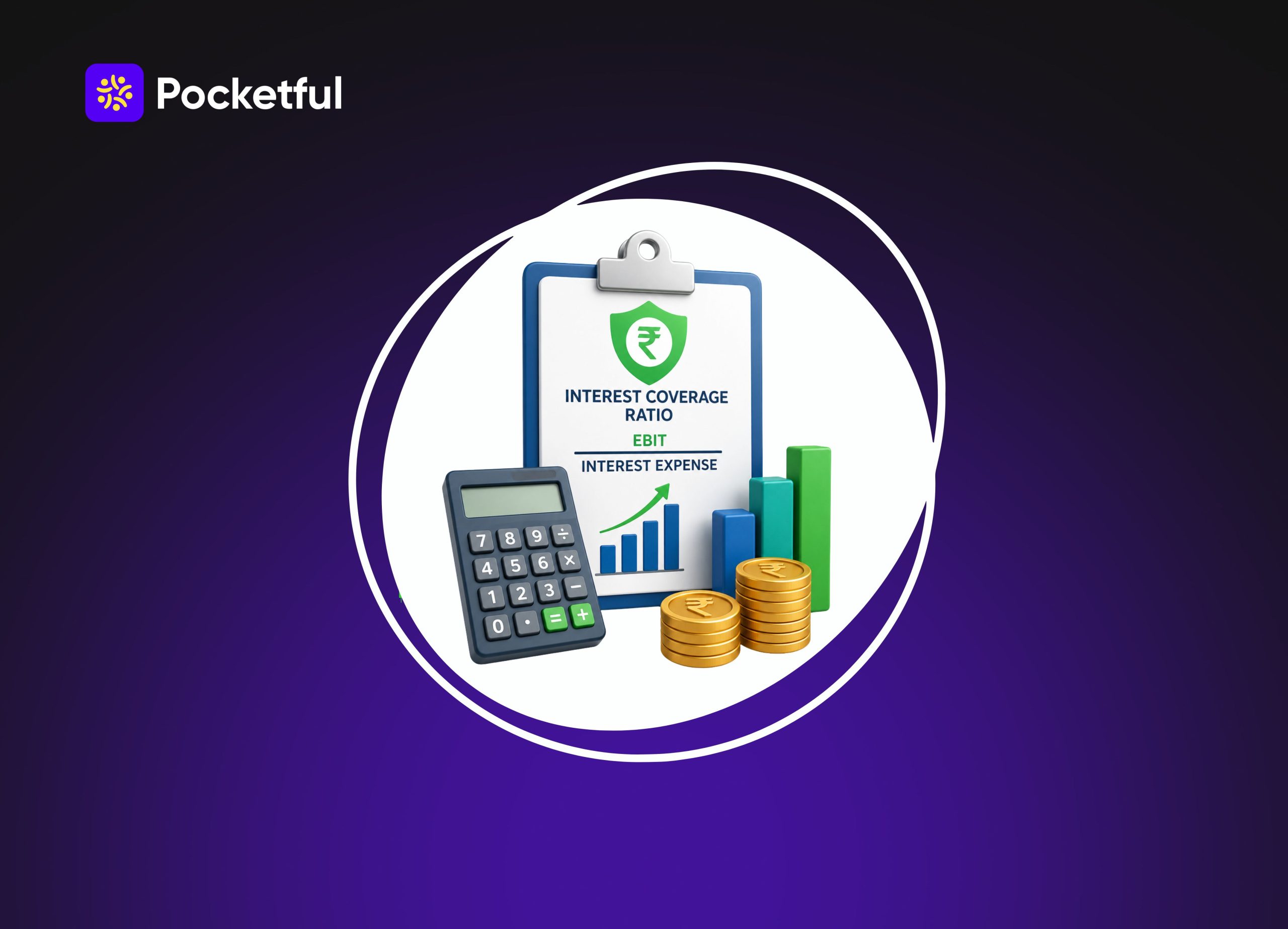
A company’s strong profitability does not always guarantee that it can easily service the interest on its loans. This is where understanding the Interest Coverage Ratio (ICR) becomes essential. In this article, we will explain the meaning of ICR, the ICR formula, and its proper application in simple terms, enabling you to make better financial decisions.
What Is Interest Coverage Ratio?
The Interest Coverage Ratio (ICR) shows how easily a company can pay the interest on its loans using its operating profit (EBIT). People also call it the Times Interest Earned (TIE) ratio. This ratio only looks at a company’s ability to cover interest payments, not how it will pay back the main loan amount.
ICR Means Interest Coverage Ratio
The real point of the Interest Coverage Ratio (ICR) isn’t just about getting a high or low number. It’s about understanding how comfortably a business can handle its interest costs with the money it earns. Because of this, you should always check a company’s ICR by comparing it to other companies in the same industry, its competitors, and its own past records.
| ICR Value | What It Generally Indicates |
|---|---|
| Less than 1 | The company’s operating earnings are insufficient to cover interest payments, which could increase financial risk. |
| 1-2 | Interest payments are being made, but pressure could mount if there is even a slight decline in earnings. |
| 2-3 | Generally, this is considered a balanced position, although it should be evaluated according to the industry. |
| Above 3 | The company possesses a relatively strong capacity to service interest payments, and its financial position can be considered sound. |
Interest Coverage Ratio (ICR) Formula
Interest Coverage Ratio (ICR) = EBIT ÷ Interest Expense
Components used in the formula
| Component | Meaning |
|---|---|
| EBIT (Earnings Before Interest and Taxes) | The company’s operating profit, that is, earnings before interest and taxes. |
| Interest Expense | The total interest paid on bank loans, debentures, bonds, or other borrowings over a period of time. |
How to Calculate ICR
Follow these simple steps to calculate the ICR
- First, determine the company’s EBIT (Operating Profit).
- Look up the interest expense for the same period.
- Now, apply the ICR formula: ICR = EBIT ÷ Interest Expense.
- The resulting figure indicates how many times the company can cover its interest payments using its operating earnings.
Example Interest Coverage Ratio Calculation
Let’s assume a company’s financial figures are as follows
| Particulars | Amount |
|---|---|
| Revenue | ₹600 Crore |
| Operating Expenses | ₹420 Crore |
| EBIT | ₹180 Crore |
| Interest Expense | ₹30 Crore |
Now, let’s apply the icr ratio formula :
Interest Coverage Ratio = EBIT ÷ Interest Expense
= ₹180 Crore ÷ ₹30 Crore
= 6 Times
In this example, the company’s Interest Coverage Ratio is 6. This means the company can cover its annual interest expense six times over using its operating profit. Generally, such an ICR indicates that the pressure on the company to service its interest obligations is relatively low. However, to draw an accurate conclusion, this ratio should always be compared with the ICRs of other companies in the same industry and with the company’s own ICR from previous years.
Read Also: Formulas used to Calculate Profit and Loss in Nifty Options
Where Investors and Lenders Use Interest Coverage Ratio
The Interest Coverage Ratio serves different purposes depending on the context; consequently, investors, banks, and companies utilize it in their own specific ways.
- During Fundamental Analysis: Before investing in a company, it is crucial to assess the strength of its earnings relative to its debt burden. The ICR indicates how easily a company’s operating income covers its interest expenses, thereby helping to gauge investment risk.
- Before Approving Business Loans: Banks want to ensure that any company receiving a loan will be able to make timely interest payments in the future. Therefore, the ICR is a key ratio examined during the review of loan applications.
- Comparing Companies in the Same Sector: When comparing two companies operating in the same sector, the ICR helps evaluate their respective debt management capabilities. This makes it easier to determine which company is making better use of its earnings.
- Monitoring Financial Health Over Time: A single year’s ICR does not tell the whole story. Tracking its fluctuations over several years reveals whether a company’s financial position is strengthening or if the pressure of debt is gradually mounting.
What Considered a Good Interest Coverage Ratio?
There is no single fixed standard for determining a “good” interest coverage ratio for a company. It depends largely on the industry, business model, and debt requirements.
| Industry | Generally Considered a Healthy ICR | Reason |
|---|---|---|
| Manufacturing | 2-4 Times | Loans are often taken for machinery and expansion. |
| Infrastructure | 1.5-3 Times | Debt levels are generally high due to large projects and substantial capital investment. |
| Power & Utilities | 2-3 Times | Debt can persist for a long time despite a stable income. |
| IT & Software | 4 Times or Above | Generally, the ICR remains high due to low debt and better operating margins. |
| FMCG | 3-5 Times | A strong ICR is observed due to regular cash flow and relatively low debt. |
Advantages of Using Interest Coverage Ratio
The biggest advantage of the Interest Coverage Ratio (ICR) is that it simplifies understanding a company’s debt position. When used in the right context, it can provide valuable insights.
- Makes Financial Reports Easier to Understand: Reading a company’s entire financial statement is not easy for everyone. The ICR is a ratio that helps quickly determine the extent of the interest burden on a company relative to its earnings.
- Useful for Tracking Performance Over Time: If a company’s ICR improves year after year, it may indicate rising earnings or better debt management. This makes it easier to gauge the company’s progress.
- Helps Assess the Impact of New Debt: When a company plans to take on a new loan, the ICR helps assess how the additional interest might affect its current earnings. This allows for an estimation of potential future financial strain.
- Supports Risk-Based Investment Decisions: The ICR can be a useful indicator for investors seeking low-risk companies. It reveals the level of interest pressure a company faces and whether its earnings are sufficient to handle that pressure.
- Useful Alongside Other Financial Ratios: While the ICR does not provide a complete picture on its own, analyzing it alongside other ratios such as the Debt-to-Equity Ratio, Current Ratio, and Cash Flow offers a clearer view of the company’s financial health.
Limitations of Interest Coverage Ratio
While the Interest Coverage Ratio is certainly useful, evaluating a company based solely on this single ratio is not appropriate. It has certain limitations that are important to understand.
- Doesn’t Include Principal Repayment: The ICR only indicates the capacity to pay interest; it does not show whether the company will be able to repay the loan’s principal amount on time.
- Ignore Actual Cash Availability: A company may have strong EBIT but lack sufficient cash for immediate payments. In such a scenario, relying solely on the ICR does not lead to an accurate conclusion.
- Affected by Temporary Earnings: If a company records extra profit in a given year from the sale of an asset or other one-time income, the ICR may appear better than the actual situation warrants.
- Industry Comparison Can Be Misleading: Debt requirements and earnings structures vary across industries. Therefore, comparing the ICR of an IT company with that of an infrastructure company does not yield meaningful results.
- Needs Support from Other Financial Ratios: For a comprehensive analysis, one should also consider other financial metrics alongside the ICR such as the Debt-to-Equity Ratio, DSCR, Current Ratio, and cash flow data. Only then can a balanced assessment of the company’s true financial health be made.
Interest Coverage Ratio vs Debt Service Coverage Ratio (DSCR)
| Basis | Interest Coverage Ratio (ICR) | Debt Service Coverage Ratio (DSCR) |
|---|---|---|
| Purpose | It measures the company’s ability to pay interest. | It measures the company’s ability to repay its total debt obligations (interest + principal). |
| Formula | EBIT ÷ Interest Expense | Net Operating Income ÷ Total Debt Service (Interest + Principal Repayment) |
| Focus | It focuses solely on interest payments. | It includes both interest and principal. |
| Used By | Investors, analysts, and lending institutions. | Banks and financial institutions, especially during loan assessment. |
| Best Used When | If you want to know the company’s interest-paying capacity. | To assess the company’s overall debt repayment capacity. |
| Limitation | It does not include principal repayment. | Cash flow and a repayment schedule are required for accurate results. |
Common Mistakes While Calculating ICR
Even a minor error while calculating the ICR can lead to an incorrect conclusion. Therefore, one should avoid these common mistakes.
- Using Different Financial Periods: EBIT and interest expense must pertain to the same financial period to ensure an accurate result.
- Ignoring Financial Statement Notes: Information regarding interest is often found in the notes to the financial statements; these should not be overlooked.
- Comparing Different Industries: Every sector has a unique debt structure; therefore, the ICRs of companies from different industries should not be directly compared.
- Ignoring Interest Expense Trends: If interest expense is consistently rising, looking solely at the current ICR does not provide an accurate picture of the situation.
- Ignoring Business Events: Events such as expansion, acquisitions, or new loans can impact the ICR. Thus, it is essential to understand the underlying reasons behind the ratio.
Read Also: Understanding Futures Pricing Formula
Conclusion
The Interest Coverage Ratio helps you see how easily a business can pay the interest on its loans. Still, you shouldn’t rely only on ICR when making an investment decision. To get a clear picture, you should also look at the company’s earnings, total debt, actual cash flow, and other key financial factors.
Frequently Asked Questions (FAQs)
01
What is a good Interest Coverage Ratio?
Generally, an ICR of 2 or higher is considered good, though the ideal benchmark may vary by industry.
02
Can a company have a negative Interest Coverage Ratio?
Yes. If a company’s EBIT is negative, the Interest Coverage Ratio can also be negative.
03
Is a higher ICR always better?
Not necessarily. A good ICR is a positive sign, but other financial ratios should also be considered before investing.
04
Where can I find the data to calculate ICR?
Information regarding EBIT and interest expense can be found in the company’s Income Statement (Profit & Loss Statement).
05
What does an ICR below 1 mean?
It means that the company’s operating earnings are insufficient to cover its interest expenses.
Disclaimer

The information shared in this content is intended solely for educational and informational purposes and should not be considered financial, investment, or trading advice. Any references to stocks, mutual funds, or market instruments are purely for informational purposes and do not constitute recommendations. Investments in financial markets are subject to market risks, and past performance is not indicative of future returns. Readers are advised to conduct independent research, review official documents carefully, and consult a qualified financial advisor before making any investment or trading decisions.
Article History