



| Type | Description | Contributor | Date |
|---|---|---|---|
 | Post created | Pocketful Team | May-18-26 |
Read Next
- Best Stop Loss Strategies for Day Trading in 2026
- Best ETF Trading Strategies in India
- What is Overnight Trading?
- Why Option Buyers Lose Money in Trading
- Formulas used to Calculate Profit and Loss in Nifty Options
- How to Trade Fake Breakouts Using Options: 5 False Breakout Strategies
- Trade Breakouts with Options Without Overpaying IV
- How to Use MTF in the Stock Market?
- Understanding Bull Put Spread Option Strategy
- NSE Extends F&O Trading Hours by 10 Minutes
- Expiry Day Trading Explained
- High Premium Selling: Risk vs Reward Explained
- Delta Neutral Trading Strategy: What it is & How it works
- Selling Penny Options: Small Gains, Massive Risk
- Hard vs Soft Commodities: Key Differences
- How to Become a Systematic Trader: Beginner’s Guide
- 5-Minute ORB System for Option Scalping
- Weekly vs Monthly Expiry in Options Trading: Key Differences
- Opening Range Breakout (ORB) Strategy
- Understanding the Equity Trade Life Cycle
What is Automated Trading?
Published on : 18th May 2026
|Updated on : 18th May 2026



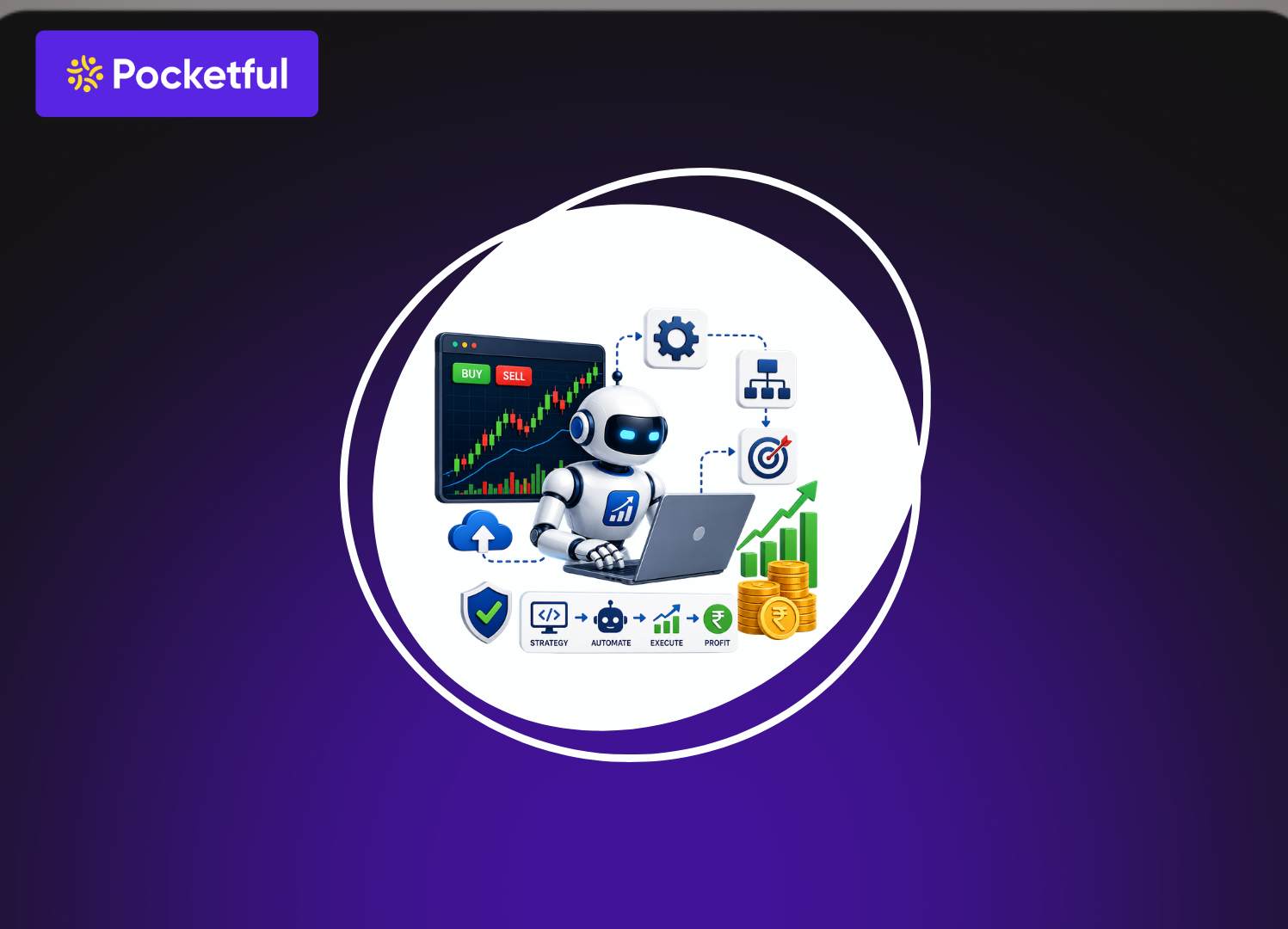
The world of trading is very dynamic; the stock price changes very frequently, and it is not possible for a trader to constantly stare at the chart or track the price. Automated trading offers a solution to this by allowing you to follow a rule-based trading strategy and can execute trades within milliseconds without human intervention.
In today’s blog post, we will give you an overview of automated trading, its advantages, and its types.
What is Automated Trading?
Automated trading, also known as Algo or Algorithmic trading, is a method of trading in which a computer program executes trades based on a predefined set of instructions. The rules are based on various parameters, such as price movement, technical indicators, and volume. No manual interventions are required in it.
Key Features of Automated Trading
The key features of automated trading are as follows:
- Speed Execution: In algorithmic trading, computers can execute trades in milliseconds with minimal delay. The prices changes very frequently and a small delay in execution can significantly impact the profit. And the computer reacts faster than humans it helps traders in executing trade immediately.
- Manual Intervention: There is zero intervention by the trader, which reduces the fear of panic selling or greed, etc. This can help a investor because emotions such as fear, greed, panic, etc. can lead to make poorer decision and automated trading follows pre-defined rules and avoid emotional mistakes.
- Backtesting: One can backtest the strategy by using historical data before executing any strategy in real-time. This can help an investor in understanding how their strategies can perform in different market situations. And if the strategies are not working properly they can modify it.
- Analyse Large Data: The computers used in algorithmic trading can analyse a huge amount of data which is difficult for an individual to analyse. Automated trading setup can track multiple stocks performance, their corporate actions, and analyse them on technical indicators, etc.
How Does Automated Trading Work
The automated trading works in the following manner:
- Establishing Trading Strategy: The first step is to create rules based on which you want to trade. The trading strategies can be based on technical indicators, price movements, etc. A well-defined strategy is a key element in automated trading.
- Converting Strategy into an Algorithm: Once your rules are defined, you need to turn them into a program that a computer can understand, which involves creating an algorithm. This step generally involves changing the strategies into coding language or on the trading platforms that support automation. The key objective of this step is to remove human error.
- Linking with Broker Platform: The next step is to link the algorithm to your broker platform through an API. Through this, your setup can access the real-time market data. APIs act as a bridge between the automated trading software and stock brokers. Without the integration of the API, the strategies and algorithms would not be able to interact with the live market feeds.
- Execution of Trade: When the conditions you define are met by the system, it will automatically execute the trades on your behalf without delay. This acts as a key advantage of automated trading, as it removes the chances of human error and emotional decision-making. It also acts faster than humans in executing trade.
- Optimisation: You can regularly monitor the trades and strategy to optimise them and reduce losses. As the market is dynamic in nature, the strategies need to be changed accordingly. Optimisation helps keep the automated trading system aligned with the changing market conditions.
Read Also: What is AI Trading?
Types of Automated Trading Strategies
There are several types of trading strategies; a few of these strategies are mentioned below:
1. Following Trend
There is a strategy in which the algorithm follows the market trend and continues to trade on it until it lasts. In this strategy, the algorithm finds the direction of the market trend and executes trades accordingly. If the market trend is positive, the algorithm tries to find out the buying opportunities and vice versa.
Example: For example, the price of a stock crosses its 50-day moving average, hence it generates a buy signal, then the system will identify it as an opportunity and execute a buy order.
2. Mean Strategy
Under this strategy, one believes that the stock prices can be overvalued and undervalued, and with time it will eventually return to their average or mean value. According to this strategy, if a stock becomes overvalued and undervalued in the short run based on some events or news, the algorithm identifies it and expects that the prices will return to their mean, actual value or average.
Example: Suppose the actual value of a stock is 1000 INR, and due to some negative sentiments in the market, the stock price corrects significantly and falls to 600 INR. It acts as an opportunity for the algorithm, and it will execute a trade on the assumption that the stock price will eventually reach 1000 INR to its actual value.
3. Arbitrage Strategy
This strategy focuses on taking advantage of the price differences of a particular security in different markets. As the prices are not always identical in every market, it is difficult for an individual investor to identify such an opportunity. Hence, the automated trading setup can identify such an opportunity and execute a trade immediately.
Example: Let’s say a stock name ABC Limited is trading at INR 1000 in NSE and INR 990 in BSE. Hence, it creates an arbitrage opportunity for the algorithmic setup, and the system will execute a trade and purchase the share at INR 990 in BSE and immediately sold them on the NSE at INR 1000.
4. Scalping Strategy
In a scalping trading strategy, the algorithm focuses on making small profits from different trades. This strategy executes multiple trades during the day. This is a short-term trading strategy in which the system does not wait for large price movements and focuses on capturing the small changes in stock prices. This strategy is generally used by the algorithm traders, as humans cannot act as fast as computers can.
Example: A stock name XYZ Limited priced at INR 1000 is moving within a range of 1% several times during the day. In this situation, the system purchased them at INR 1000 and sold them within the 1% price range several times during the day.
Advantages of Automated Trading
The key advantages of automated trading are as follows:
- No Emotions: Emotions such as fear, greed, and panic, etc. can lead to losses. Automated trading systems can remove this completely, and one is required to trade only the pre-defined strategies.
- Speed: Timing is crucial when trading in the financial market. The automated trading systems can react to market changes very quickly and execute trades in milliseconds.
- Continuous Monitoring: Regular monitoring is required in trading, which is practically not possible for an individual. Hence, an automated trading system can track the market movement continuously.
- Consistency: Every trade through the automated trading system follows the same defined rules and strategies and maintains long-term discipline.
Risk of Automated Trading
The risks of automated trading systems are as follows:
- Technical Issues: In case of any technical issue, such as internet connection, server downtime, power failure, software glitch, etc. can lead to misleading trades and unexpected losses.
- Incorrect Strategy: The strategy defined for the automated trading can be wrong sometimes. Poor entry exit rules and unrealistic assumptions can lead to significant losses.
- Complexity in Initial Setup: Setting up the automated trading can be a complex process, as it requires building correct strategies, understanding of platforms to implement the API, etc.
- Unexpected Events: There are certain automated trading setup which are not designed for specific events such as economic crises, geopolitical tensions, policy changes, etc. Unable to analyse these events can lead to significant loss.
Read Also: What is Algo Trading?
Who should use Automated Trading?
Generally, it is considered that automated trading is only for big institutions and tech experts, but an individual can also use it very conveniently without any hassle. It helps beginners in removing emotional bias from trading and saves time. Automated or algorithmic trading can analyse a large amount of data and execute trades faster and more efficiently. Traders who prefer a systematic approach to trading can consider automated trading and can benefit from it. One can easily use automated trading using the Pocketful web application, as it also offers free API integration of your trading strategies.
Conclusion
On a concluding note, automated or algorithmic trading is gaining popularity over time. Through automated trading, traders can execute well-defined strategies with more accuracy within time. It is not possible to track the market regularly, but using an automated trading system, the stress of regular monitoring can be reduced. However, one should remember that trades based only on automated systems do not always guarantee profits; there are various risks involved in them, such as system failure, low internet connectivity, etc. In the end, it is advisable to take help from an automated trading system, but do not solely depend on it and always consult your investment advisor before making any investment.
Frequently Asked Questions (FAQs)
01
Do I need to learn coding to start automated trading?
No, you are not required to learn coding to start algorithmic or automated trading. There are various tools that offers rule based system to start automated trading.
02
How can I define the rule for the trading system for the trading platform?
You are simply required to integrate the API into the system of your broker with whom you have your trading and demat account.
03
Do automated trading offers guaranteed returns?
No, automated trading does not offer guaranteed returns. There are chances that the strategies defined under it can fail due to various reasons, such as technical glitches, etc.
04
Is automated trading expensive?
No, automated trading is not very expensive. However, there are certain platform which can charge based on the trading tools and data feeds involved in it.
05
What does backtesting refer to in automated trading?
Backtesting is a process in which one can test their strategies in real market conditions and past data to analyse how their strategies would have performed in the past.
Disclaimer

The information shared in this content is intended solely for educational and informational purposes and should not be considered financial, investment, or trading advice. Any references to stocks, mutual funds, or market instruments are purely for informational purposes and do not constitute recommendations. Investments in financial markets are subject to market risks, and past performance is not indicative of future returns. Readers are advised to conduct independent research, review official documents carefully, and consult a qualified financial advisor before making any investment or trading decisions.
Article History
