



| Type | Description | Contributor | Date |
|---|---|---|---|
 | Post created | Pocketful Team | Jul-10-26 |
Read Next
- Terminal Value: Meaning, Formula & How to Calculate
- SEBI Rules for Authorised Person Registration
- Can an Authorised Person Trade for Himself? Rules Explained
- How to Calculate Stock Volatility in Excel?
- What are Passive ETFs?
- What is Equity ETFs?
- Stock PE vs Industry PE: Key Differences
- Anil Ambani Net Worth Investments & Portfolio : Per Day, Per Hour, Per Minute & Per Second Income
- Best Gold Penny Stocks in India 2026
- Rule of 72 in the Stock Market: A Simple Guide
- What Is Factor Investing? Types, Benefits & Strategies
- SIF vs AIF: Key Differences, Benefits & Which is Better?
- Vedanta vs Adani Group: Market Cap, Revenue & Net Worth
- Gautam Adani Net Worth (2026: Per Day, Per Hour, Per Minute & Per Second Income
- Best IVF Stocks in India
- Monsoon Impact on Stock Market in India Explained
- AI Advisor vs Human Advisor: Which One Should You Choose?
- Takeover vs Buyback: Key Differences
- What is the Nifty IT Index?
- Top 10 Richest Companies in the World
How To Apply Buyback of Shares?
Published on : 10th July 2026
|Updated on : 10th July 2026



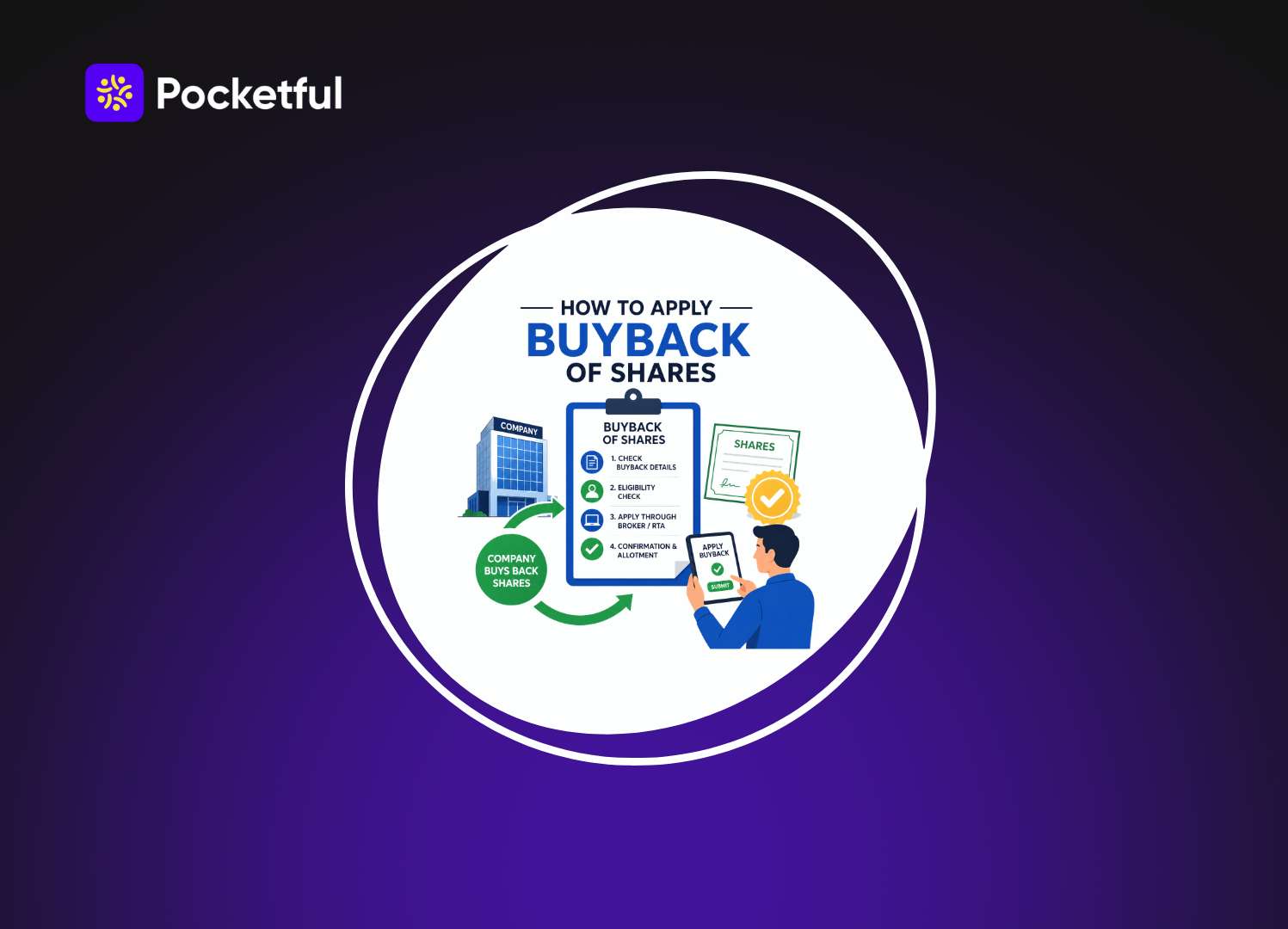
The stock market offers many exciting events for investors. People often ask, exactly what is buy back of shares and how does it work? To put it simply, a company uses its extra cash to purchase its own stock from the public. Understanding the buy back of shares meaning is a great way to boost portfolio returns.
But what is buy back of shares with example? Imagine a business has one hundred shares available in the open market. It decides to purchase ten shares back. This leaves only ninety shares in the market. This action reduces the total supply of shares. This article will explain the buyback of shares meaning in simple terms. It will also explore the buy back of equity shares and show a clear guide on How To Apply Buyback of Shares.
What is Buyback of share
A share repurchase happens when a company decides to buy its own shares back from current investors. The company usually offers a price that is higher than the current market rate. This higher price is known as a premium.
When a company comes in cash surplus The board of directors must decide what to do with this money. They can invest it in new projects, or they can reward the shareholders. Purchasing shares is a very popular method to give value back to the investors. When the company buys the shares, it absorbs that part of the ownership. The total number of shares in the market decreases permanently.
Types of Buyback of share
Companies can use different methods to repurchase their shares. Understanding these types helps investors know how the entire process works. The regulatory body SEBI monitors these methods closely to ensure fairness.
The table below explains the primary types of share repurchases used by companies in the market.
| Method | Description | Current Status in India |
|---|---|---|
| Fixed Price Tender Offer | The company announces a fixed price to buy the shares. This price is usually much higher than the market rate. Shareholders choose to submit their shares within a specific time period. | This is the most common and active method currently permitted for new repurchases. |
| Open Market Offer | The company buys shares directly from the stock exchange over a longer period. It buys them at the current market price like a normal trader. | SEBI has phased out this method from April 2025 onwards. It is no longer allowed. |
| Dutch Auction Tender Offer | The company provides a price range instead of a single fixed price. Shareholders then bid the specific price at which they are willing to sell. | This is a valid method, but it is less common than the fixed price tender offer. |
How to apply for buyback of share
Applying for a share repurchase is a very simple and straightforward process. Investors just need to follow a few basic steps carefully.
Step 1: Check the Record Date
The record date is a strict cut off date set by the company. Investors must hold the shares in their demat account on this exact date to be eligible. India follows a T plus 1 settlement cycle in the stock market. This means buyers must purchase the shares at least one trading day before the record date to get them in time.
Step 2: Log into the Trading Platform
Investors need to access their brokerage account to begin the application. Modern platforms offer a clean and simple interface for this exact purpose.
Step 3: Locate the Specific Offer
Look for the Corporate Actions or Offer for Sale tab in the trading application. Select the specific company that is offering the repurchase. The platform will show all the important details. This includes the offer price, the start date, and the closing date.
Step 4: Enter the Share Quantity
Investors can enter number of shares they want to sell back to the company. They can also offer all their eligible shares or just a small part of them.
Step 5: Authorize the Transaction
This is securely done using a CDSL TPIN and a simple OTP verification sent to the mobile phone. Alternatively, investors who have activated DDPI can sell shares without entering a TPIN and OTP for every transaction. A small fee of twenty to fifty rupees plus GST is usually charged by the broker for processing this order.
Step 6: Wait for Settlement and Payment
The company will not accept all shares if the offer receives too many applications. They use an acceptance ratio to decide exactly how many shares to buy from each person. The accepted shares are debited from the demat account, and the money is sent directly to the linked bank account. Unaccepted shares are simply returned to the investor’s demat account.
Special rules exist for retail investors. Fifteen percent of the total offer size is strictly reserved for small shareholders. A small shareholder is defined as someone whose total holding in the company is worth up to two lakh rupees on the record date.
Reasons for Buyback of shares
Companies do not repurchase shares without a solid business plan. There are strong financial and strategic reasons behind this big decision. When a company acts on these reasons, it usually sends a positive message to the stock market.
- Returning Excess Cash: A mature company might have too much cash and no new projects. Returning this idle cash to shareholders is a smart way to manage the balance sheet and prevents the company from hoarding money without generating returns.
- Improving Financial Ratios: When the total number of outstanding shares decreases, the Earnings Per Share automatically goes up. This makes the company look more profitable and attractive to new investors.
- Signaling Confidence: Management might feel that the stock market is currently undervaluing their company. A repurchase shows the public that the leaders truly believe in the future of the business.
- Increasing Promoter Holding: Promoters can easily increase their percentage of ownership without spending their own money. When public shares are canceled, the promoters naturally own a bigger piece of the company.
- Consolidating Ownership: Having too many small shareholders increases administrative costs for the company. Buying back shares helps reduce these costs and makes decision making faster.
Read Also: What Is Leverage in the Stock Market?
Impact of Buyback
A share repurchase has a direct impact on both the company and the retail investors. Here are the three main impacts:
- Instant Financial Reward: The most immediate impact is the financial reward for those who participate in the offer. When investors sell their shares at a premium, they make a direct and secure profit.
- Higher Market Valuation: Even if an investor chooses not to sell, they still benefit from the event. The total number of shares drops, which usually pushes the market price of the remaining shares higher due to lower supply. When a company announces this event, the stock price usually jumps immediately, acting as a safety net for the stock price during the offer period.
- Favorable Taxation Changes: The Indian government has updated the tax rules for these profits. Starting from April 2026, profits are correctly taxed as Capital Gains. Long term gains for listed equity shares held over twelve months are taxed at 12.5 percent, and short term capital gains are taxed at 20 percent. This new rule is generally much better for retail investors because capital gains tax is usually much lower than the highest income tax slab rates. Using an advanced platform like Pocketful makes tracking these complex tax rules very easy.
Conclusion
A share repurchase is an excellent corporate event that greatly rewards investors. It gives people a chance to sell their holdings at a premium or enjoy better stock valuations over time. Participating in these offers is extremely easy with reliable digital investing platforms like Pocketful.
Investors simply need to track the record dates, apply before the deadline, and understand the acceptance ratio. Overall, these corporate actions are healthy signs of a strong business. By staying informed and making calculated decisions, anyone can successfully navigate these events and grow their financial portfolio effectively.
Frequently Asked Questions (FAQs)
01
What is a record date?
It is the specific cut off date set by the company. Investors must hold the shares in their demat account on this date to participate.
02
Can shares be sold after applying?
No. Once shares are offered for the repurchase, they are temporarily blocked and cannot be sold in the market.
03
What is an acceptance ratio?
It is the exact percentage of shares a company agrees to buy. If an offer is oversubscribed, the company will not buy all tendered shares.
04
Are these profits taxable?
Yes. From April 2026, profits from a share repurchase are taxed as capital gains. Short term and long term rates apply based on holding periods.
05
Is participation mandatory?
No, it is completely optional. Shareholders can choose to ignore the offer and keep their shares safely in their account.
Disclaimer

The information shared in this content is intended solely for educational and informational purposes and should not be considered financial, investment, or trading advice. Any references to stocks, mutual funds, or market instruments are purely for informational purposes and do not constitute recommendations. Investments in financial markets are subject to market risks, and past performance is not indicative of future returns. Readers are advised to conduct independent research, review official documents carefully, and consult a qualified financial advisor before making any investment or trading decisions.
Article History
