


| Type | Description | Contributor | Date |
|---|---|---|---|
 | Post created | Pocketful Team | Oct-19-26 |
Read Next
- Nifty CPSE Index: Meaning, Stocks & Weightage
- Short Selling vs Put Options: Key Differences
- Trendline Trading: Types, Strategies & How to Draw
- What Is Freak Trade in the Stock Market?
- What Is Active Trading? Types, Strategies & Risks
- USD INR Trading: Lot Size, Strategies & How to Trade
- What Is a Trading Halt in the Stock Market?
- Binary Options Trading: How to Trade?
- What is Carbon Credit Trading Scheme? Types & Example
- How to Reactivate a Trading Account Online: Step-by-Step Guide
- Equity Curve in Trading: Meaning, Analysis & Examples
- How to Place an Order During CAS Window
- What is the Impact Cost in Trading?
- Stock Market Crash in India: History & Causes
- Fundamental Trading: A Beginner’s Guide
- What is MetaTrader 4 (MT4)?
- Types of Financial Instruments available for Trading in the Capital Market
- Importance Of Algo Trading In Futures And Options For Traders
- Convexity in Options Trading: Meaning, Benefits & Risks
- Best AI Trading Tools in India 2026: Top 5 Tools
Spin-Off vs Split-Off: Key Differences, Examples & Tax in India
Published on : 20th October 2026
|Updated on : 19th October 2026



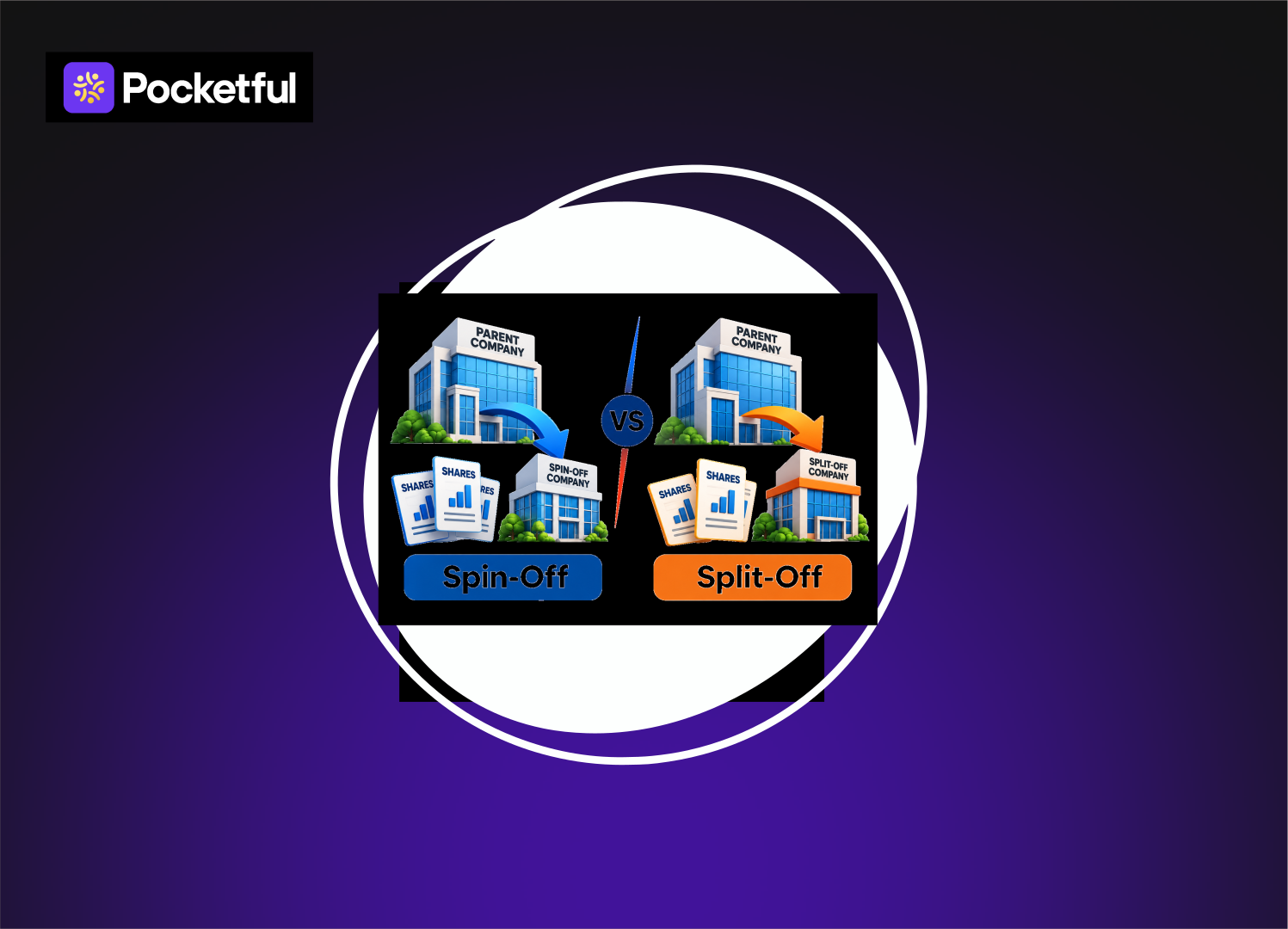
A spin-off and a split-off are ways businesses make new companies and build shares. The main difference is how the shareholders get the new shares. In a spin-off, the shares are given to them. In a split-off, they have to exchange their old shares to get the new ones.
This guide explains both, with examples, and how they are taxed in India.
What Is a Spin-Off?
A spin-off happens when a parent company separates one of its divisions. This makes it an independent company. This will offer two things:
- The shareholders keep the existing shares.
- They get new shares of the new company.
For example, say a company separates its retail clothing sectors. Now, this is a new company, and it announces 5% shares to all existing shareholders. So, anyone holding 100 shares will receive 20 new shares.
But both businesses will work on their own and will have separate financial management.
How a Spin-Off Works
The company first decides which business will be separated. It decides on every single detail. A record date is then announced, along with the ratio in which new shares will be allotted.
Shareholders who meet the eligibility conditions receive the new shares in their demat accounts. Once the company is listed, both stocks begin trading separately.
What Is a Split-Off?
A split-off also separates a business, but the shareholder has a choice to make.
Instead of receiving the new shares automatically, investors are offered an exchange. They can give up some or all of their parent company shares and receive shares of the separated company in return.
If they do not want to participate, they can continue holding the parent company.
This makes a split-off quite different from a spin-off because the investor decides whether to move part of the holding into the new business.
How a Split-Off Works
The parent company announces the exchange ratio and the period during which shareholders can participate. Investors who accept the offer tender their parent shares and receive the new company shares according to the stated terms.
The parent shares taken back through the transaction are generally cancelled, which can reduce the total number of shares outstanding.
Spin-Off vs Split-Off: Key Differences
| Basis | Spin-Off | Split-Off |
|---|---|---|
| How new shares are received | Distributed to eligible shareholders | Received in exchange for parent shares |
| Shareholder action | Usually no action is needed | Shareholder has to decide whether to participate |
| Parent shares | Remain with the shareholder | Shares tendered in the exchange are surrendered |
| Holding after the transaction | Investor generally owns both companies | Depends on how many parent shares are exchanged |
| Parent share count | Usually remains unchanged because of the distribution | Can reduce after surrendered shares are cancelled |
| Common use in India | Seen mainly through demergers | Comparatively rare |
What Is an Example of a Spin-Off?
India has seen several large business separations that work in a similar way to spin-offs.
Reliance Industries separated its financial services business into Jio Financial Services in 2023. All eligible shareholders received one Jio Financial Services share. This was for every Reliance Industries share they held.
ITC also separated its hotel business into ITC Hotels. Shareholders received one ITC Hotels share for every ten ITC shares, while ITC retained a stake in the hotel company.
In both cases, shareholders received exposure to the separated business without surrendering their original parent company shares.
Read Also: Mutual Funds vs Segregated Funds: Key Differences
What Is an Example of a Split-Off?
General Electric’s 2015 separation of Synchrony Financial is a well-known split-off example.
GE shareholders could decide whether they wanted to exchange their GE shares for Synchrony shares. They were free to exchange some, all, or none of their shares.
That is exactly what makes the transaction different from a spin-off. The investor had to make a choice rather than simply receiving the new shares.
| Are Split-Offs Used in India?Split-offs are not common in India. Indian companies usually use a demerger structure when they want to separate a business and give shares of the new company to existing shareholders. |
Spin-Off vs Demerger in India
A demerger is the structure commonly used in India when a company wants to separate a business and allot shares of the resulting company to its shareholders.
The transaction is carried out through a scheme of arrangement. Shareholders may need to approve the scheme. There is a regulatory or NCLT approval needed as well.
Once the scheme becomes effective, the specified business is transferred to the resulting company, and eligible shareholders receive shares according to the approved ratio.
So, while spin-off is a commonly used market term, demerger is the structure investors will often see in Indian corporate announcements.
Why Do Companies Choose a Spin-Off?
Companies may separate a business when the two operations have reached a stage where they need different strategies.
A consumer business, for example, may have very different capital requirements from a technology or financial services business. Running them separately can give each management team more flexibility. This will help with better management of revenue, profit, debt, and growth.
Why Do Companies Choose a Split-Off?
A split-off gives investors more choice. Shareholders who prefer the parent business can remain invested there, while those who prefer the separate business can exchange their shares.
The transaction may also reduce the number of parent company shares outstanding. The shares received will be cancelled, which is a great deal.
For investors, the decision should still depend on the financial strength and future prospects. This will be a better analysis point for growth.
What Happens to the Stock Price After a Spin-Off?
The parent company share price usually adjusts after the separated business moves out.
This happens because a part of the value that earlier sat inside the parent company is now represented by a separate stock. The adjustment itself should not be confused with a normal market fall.
Suppose a company was worth ₹500 per share before the separation and part of that value belonged to the business being spun off. Once the new company trades separately, the parent share may open at a lower adjusted price.
Your overall position is now spread across two companies instead of one.
How Is a Spin-Off Taxed in India?
In a qualifying demerger, shareholders are generally not taxed merely for receiving shares of the resulting company. Tax normally becomes relevant when those shares are eventually sold.
The original cost of the investment is divided between the parent and the resulting company.
Section 49(2C) of the Income Tax Act determines the cost of acquisition of the new shares based on the proportion of net book value transferred. Section 49(2D) reduces the cost of the original shares by the same amount.
A Simple Tax Example
Suppose you originally bought shares for ₹60,000. The business transferred to the new company represents 25% of the relevant net worth.
In that case, ₹15,000 of the original cost may be allocated to the new shares, while ₹45,000 remains as the cost of the parent shares.
The total does not change. It is simply divided between the two investments for future capital gains calculations.
Spin-Off vs Stock Split vs Carve-Out
| Event | What Happens |
|---|---|
| Spin-off | A business becomes a separate company and shareholders receive its shares |
| Stock split | The number of shares in the same company increases |
| Carve-out | The parent sells part of a subsidiary to outside investors. This is often through an IPO |
What Should Investors Check When a Spin-Off Is Announced?
Start with the official company announcement. Check all the details of the announcement and also how you will get the shares.
It is also worth examining how debt and assets are divided. A business that looked attractive inside a large group may have a very different financial position once it operates independently.
Keep the scheme document as well. It can be useful later when working out the cost of acquisition for tax purposes.
Which Is Better for Investors?
Neither a spin-off nor a split-off is automatically better. While both give you a great opportunity to work on your portfolio, the choice is highly based on the plan and the type of your portfolio. This should be synced with the plan, and this will help you better.
Read Also: Cyclical vs Defensive Stocks: Key Differences
Conclusion
A spin-off lets shareholders keep their parent company shares while receiving shares of the separated business. A split-off is an exchange in which shareholders give up parent shares to receive new ones.
But as an investor, it is important to actually analyse and compare the options. This will help to invest better and ensure that you build a stronger portfolio. You can also use Pocketful to track your holdings and corporate actions affecting your portfolio.
Frequently Asked Questions (FAQs)
01
What Is the Main Difference Between a Spin-Off and a Split-Off?
A spin-off gives eligible shareholders shares of the separated business while they continue holding the parent company. A split-off requires shareholders to exchange parent shares for the new shares.
02
Are Spin-Off Shares Taxable When Received?
Shares received through a qualifying demerger are generally not taxed at the time of receipt. Tax normally arises when the shares are sold.
03
Is It Compulsory to Participate in a Split-Off?
No. Shareholders can generally decide whether they want to participate in the exchange offer.
04
Why Does the Parent Share Price Change After a Spin-Off?
The parent share price adjusts because part of the business value has moved into the newly separated company.
05
Is a Spin-Off the Same as a Stock Split?
No. A stock split only changes the number of shares in the same company. A spin-off creates a separate company with its own shares.
Disclaimer

The information shared in this content is intended solely for educational and informational purposes and should not be considered financial, investment, or trading advice. Any references to stocks, mutual funds, or market instruments are purely for informational purposes and do not constitute recommendations. Investments in financial markets are subject to market risks, and past performance is not indicative of future returns. Readers are advised to conduct independent research, review official documents carefully, and consult a qualified financial advisor before making any investment or trading decisions.
Article History