


| Type | Description | Contributor | Date |
|---|---|---|---|
 | Post created | Pocketful Team | Oct-21-26 |
Read Next
- Nifty CPSE Index: Meaning, Stocks & Weightage
- Spin-Off vs Split-Off: Key Differences, Examples & Tax in India
- Trendline Trading: Types, Strategies & How to Draw
- What Is Freak Trade in the Stock Market?
- What Is Active Trading? Types, Strategies & Risks
- USD INR Trading: Lot Size, Strategies & How to Trade
- What Is a Trading Halt in the Stock Market?
- Binary Options Trading: How to Trade?
- What is Carbon Credit Trading Scheme? Types & Example
- How to Reactivate a Trading Account Online: Step-by-Step Guide
- Equity Curve in Trading: Meaning, Analysis & Examples
- How to Place an Order During CAS Window
- What is the Impact Cost in Trading?
- Stock Market Crash in India: History & Causes
- Fundamental Trading: A Beginner’s Guide
- What is MetaTrader 4 (MT4)?
- Types of Financial Instruments available for Trading in the Capital Market
- Importance Of Algo Trading In Futures And Options For Traders
- Convexity in Options Trading: Meaning, Benefits & Risks
- Best AI Trading Tools in India 2026: Top 5 Tools
Short Selling vs Put Options: Key Differences
Published on : 21st October 2026
|Updated on : 21st October 2026



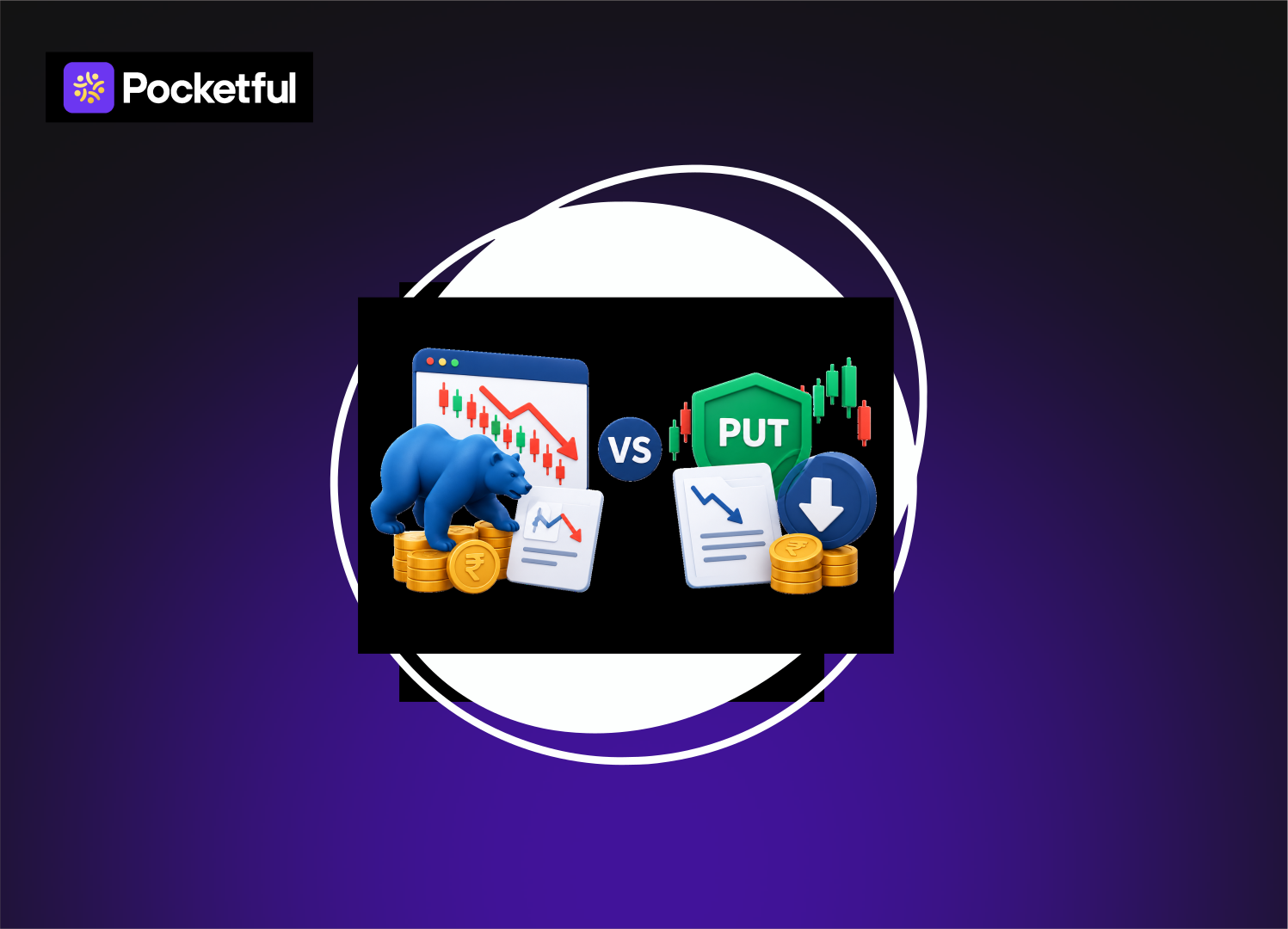
Short selling and buying put options can both be used when you expect a stock price to fall. However, both differ in terms of position, risk, and money involved.
Short selling gives direct exposure to the stock price. A put option comes with a premium, strike price, and expiry date. Read this guide to know about both and understand the difference.
What Is Short Selling?
Short selling is the process of selling shares that you do not currently own, with the belief that their price will fall. You sell the shares at the current market price and buy them back later at a lower price, aiming to earn a profit from the difference.
Example: Say a stock trades at ₹1,000. You short sell 100 shares. The price falls to ₹900, and you buy the shares back. The difference is ₹100 per share.
Your gross profit is ₹100 × 100 shares = ₹10,000.
Now, say price reaches ₹1,100. Now, you lose ₹10,000 when you buy back.
This makes the risk uneven. A share can only fall to zero, so the profit has a limit. But a share can keep going up with no limit. So the loss can keep growing.
In India, SEBI allows short selling of eligible securities.
How Does Short Selling Work?
A short position has three stages.
- You sell the shares at the market price. In some cases the shares have to be borrowed first.
- You buy the shares back later. This is called covering the short.
- The difference between your selling price and buying price is your profit or loss, after charges.
In an intraday short trade, you sell and buy back in the same session. If you want to carry a cash market short position to the next day, the securities must be available for settlement.
Brokers also have to collect margin. NSE says at least 20% upfront margin is needed in the capital market segment in lieu of VaR and ELM. Other margins can also apply.
What Is a Put Option?
A put option is a derivative contract. Its value depends on an underlying stock or index. This is a contract. So, when you buy a put, you have the right to sell. This is at the underlying at a fixed strike price. The contract has an expiry date. You pay a premium to get this right.
Example: Say a stock trades at ₹1,000. You buy a ₹1,000 strike put. The same is set for a premium of ₹35.
If the stock falls sharply, the put can gain value. If the fall does not come before expiry, the put can lose value or expire worthless.
A put buyer can lose only the premium paid, plus trading charges. This is one of the biggest differences between short selling and put options.
Short Selling vs Put Options: Key Differences
To understand the difference, here are the details:
| Factor | Short Selling | Buying Put Options |
|---|---|---|
| Market view | Bearish. | Bearish. |
| Position | Sell shares first. | Buy a put contract. |
| Maximum loss | Theoretically unlimited. | Usually limited to the premium paid. |
| Maximum profit | Limited, as the stock cannot fall below zero. | Limited by the strike price and the premium. |
| Expiry | A cash short trade has no option expiry. | The contract has a fixed expiry. |
| Time decay | No direct effect. | Can reduce the option value. |
| Volatility | Mainly the stock movement matters. | Implied volatility affects the premium. |
| Capital | Margin and settlement needed. | Premium paid upfront. |
| Price movement needed | A fall in price helps directly. | The fall must also cover the premium. |
| Hedging use | Possible, but less simple. | Commonly used to hedge a fall. |
Put options is on selected stocks and indices that are traded in the Indian derivatives market. The contracts, strike prices, lot sizes, and expiry cycles are all based on the exchange.
Short Selling vs Put Options Example
Take a stock at ₹1,000. Now, think that trader A shorts the stock at ₹1,000. Trader B buys a ₹1,000 strike put and pays a ₹35 premium.
The following table gives you a bit insight on the same:
| Stock Price Later | Short Selling, Per Share | Put at Expiry, Per Unit |
|---|---|---|
| ₹850 | ₹150 profit. | ₹115 profit. |
| ₹950 | ₹50 profit. | ₹15 profit. |
| ₹980 | ₹20 profit. | ₹15 loss. |
| ₹1,000 | No profit or loss. | ₹35 loss. |
| ₹1,100 | ₹100 loss. | ₹35 loss. |
Look at the ₹980 row. The view was right, because the stock fell. The short seller made money. The put buyer still lost, because the fall was not enough to cover the premium.
Look at the ₹1,100 row. The short seller is down ₹100 per share. The put buyer loses only the ₹35 premium in this example.
Read Also: GIFT Nifty vs Nifty 50: Key Differences
How Does Risk Differ?
Risk is the most important point in a short stock vs put option.
A short seller is exposed as the price goes up. If a ₹1,000 stock goes to ₹1,500, the loss is ₹500 per share. If it goes higher, the loss grows more.
A short squeeze makes this worse. Traders who want to close their shorts have to buy the stock. That adds more buying, and the price goes up further.
A put buyer knows the premium before entering the trade. Even if the stock moves hard the other way, the loss stops at the premium.
But this has a cost. The premium works against the buyer if the move does not come in time.
How Do Time and Volatility Affect the Two Strategies?
Short selling follows the stock more directly. If the stock falls ₹20, the short position gains about ₹20 per share before charges.
A put option has more parts. Its price can change because of:
- Movement in the underlying stock.
- Time left before expiry.
- Implied volatility.
- The strike price.
- Interest rates and other pricing inputs.
Time decay matters more as expiry gets closer as this is the time when the option slowly loses its time value when other factors remain the same.
Implied volatility also moves the premium. When volatility rises, option prices can go up. When it falls, they can go down.
So trading puts is harder than just guessing if a stock will go up or down.
When May Traders Consider Short Selling?
Short selling may suit traders who expect a fairly direct fall in a share price, and who understand the margin and settlement rules.
It may be considered when:
- Bearish view is mainly about price direction.
- Traders want direct exposure to the fall.
- The trader can watch the position closely.
- There is enough capital for the margins.
- The trader understands the risk of a sudden rise.
Risk management is very important here, because the loss has no fixed upper limit.
When May Traders Consider Buying Put Options?
A put option may be useful when a trader expects a decline over a certain period and wants to limit the maximum loss before entering.
Puts are also used to hedge. An investor who holds shares can buy a put to gain protection against a decline without selling the shares.
A put may be considered when:
- The maximum loss on the trade needs to be fixed.
- The trader expects a big enough fall before expiry.
- The trader understands premiums and time decay.
- An existing position needs protection.
The premium matters. A costly put needs a bigger fall before the buyer reaches breakeven.
Short Selling vs Put Options: Which Is Better?
There is no one answer for every bearish trade.
Short selling has a cleaner link to the stock price. A ₹50 fall gives about ₹50 profit per share before costs. But a sudden rally can cause large losses.
A put has a fixed risk. But the trade also has to deal with expiry, premium, volatility and time decay. Being right on direction may not be enough.
So your choice depends on the size and timing of the fall you expect, the capital you have, and how much you can afford to lose.
Read Also: Gold ETF vs Gold Mutual Fund: Differences and Similarities
Conclusion
Short selling and put options both give bearish exposure. But the payoff is very different. Short selling follows the stock price directly. If not managed well, you can end up in huge losses. On the other hand, the put places a limit on the losses. This is why you need to evaluate both well before you select one.
This is where you can gain support from Pocketful. Get all the insights and support you need to start investing better and ensure your portfolio grows well.
| S.NO. | Check Out These Interesting Posts You Might Enjoy! |
|---|---|
| 1 | Mutual Fund vs ETF. Are They Same Or Different? |
| 2 | Difference Between Trading and Investing |
| 3 | ETF vs Index Fund: Key Differences You Must Know |
| 4 | Gold BeES vs Silver BeES: Which is the Better Investment? |
| 5 | Digital Gold vs Gold ETF: Which is Better? |
Frequently Asked Questions (FAQs)
01
Is buying a put safer than short selling?
A put buyer has a fixed maximum loss equal to the premium paid. Short selling can lead to much larger losses if the stock price rises sharply.
02
Can you lose money on a put even when the stock falls?
Yes. The stock may not fall enough to cover the premium. Time decay and changes in implied volatility can also affect the option value.
03
What is the maximum profit in short selling?
The maximum profit comes if the share price falls to zero. So the profit is limited by the price at which the shares were first sold.
04
Can put options be used for hedging?
Yes. Investors can buy puts on stocks or market exposure to reduce the effect of a fall. How well it works depends on the strike, the expiry and the premium.
05
Do put buyers need margin?
A put buyer usually pays the option premium upfront. NSE needs upfront margins in the F&O segment. But the margin depends on the position and the exchange rules.
Disclaimer

The information shared in this content is intended solely for educational and informational purposes and should not be considered financial, investment, or trading advice. Any references to stocks, mutual funds, or market instruments are purely for informational purposes and do not constitute recommendations. Investments in financial markets are subject to market risks, and past performance is not indicative of future returns. Readers are advised to conduct independent research, review official documents carefully, and consult a qualified financial advisor before making any investment or trading decisions.
Article History