



| Type | Description | Contributor | Date |
|---|---|---|---|
 | Post created | Pocketful Team | Sep-29-26 |
Read Next
- How to Place an Order During CAS Window
- Stock Market Crash in India: History & Causes
- Fundamental Trading: A Beginner’s Guide
- What is MetaTrader 4 (MT4)?
- Types of Financial Instruments available for Trading in the Capital Market
- Importance Of Algo Trading In Futures And Options For Traders
- Convexity in Options Trading: Meaning, Benefits & Risks
- Best AI Trading Tools in India 2026: Top 5 Tools
- What Is Vega in Options? Meaning, Importance & Example
- Delta in Options: Meaning, Formula, Uses & Examples
- What is Commodity Pool Operator (CPO)?
- Best Penny Stock Trading Platforms, Brokers & Apps
- Bid Price and Ask Price: Key Differences
- What is After Hours Trading: Definition, Benefits & Risks
- Minimum Capital Required for Options Trading in India
- Trading Terminal: Meaning, Features, Types & Benefits
- MTF Charges vs Normal Trading Charges: Key Differences
- Slippage in Trading: Meaning, Types, Causes & How to Reduce It
- Types of Stock Market Orders Explained
- What Is Cash Trading? Meaning, How It Works & Benefits
What is the Impact Cost in Trading?
Published on : 29th September 2026
|Updated on : 29th September 2026



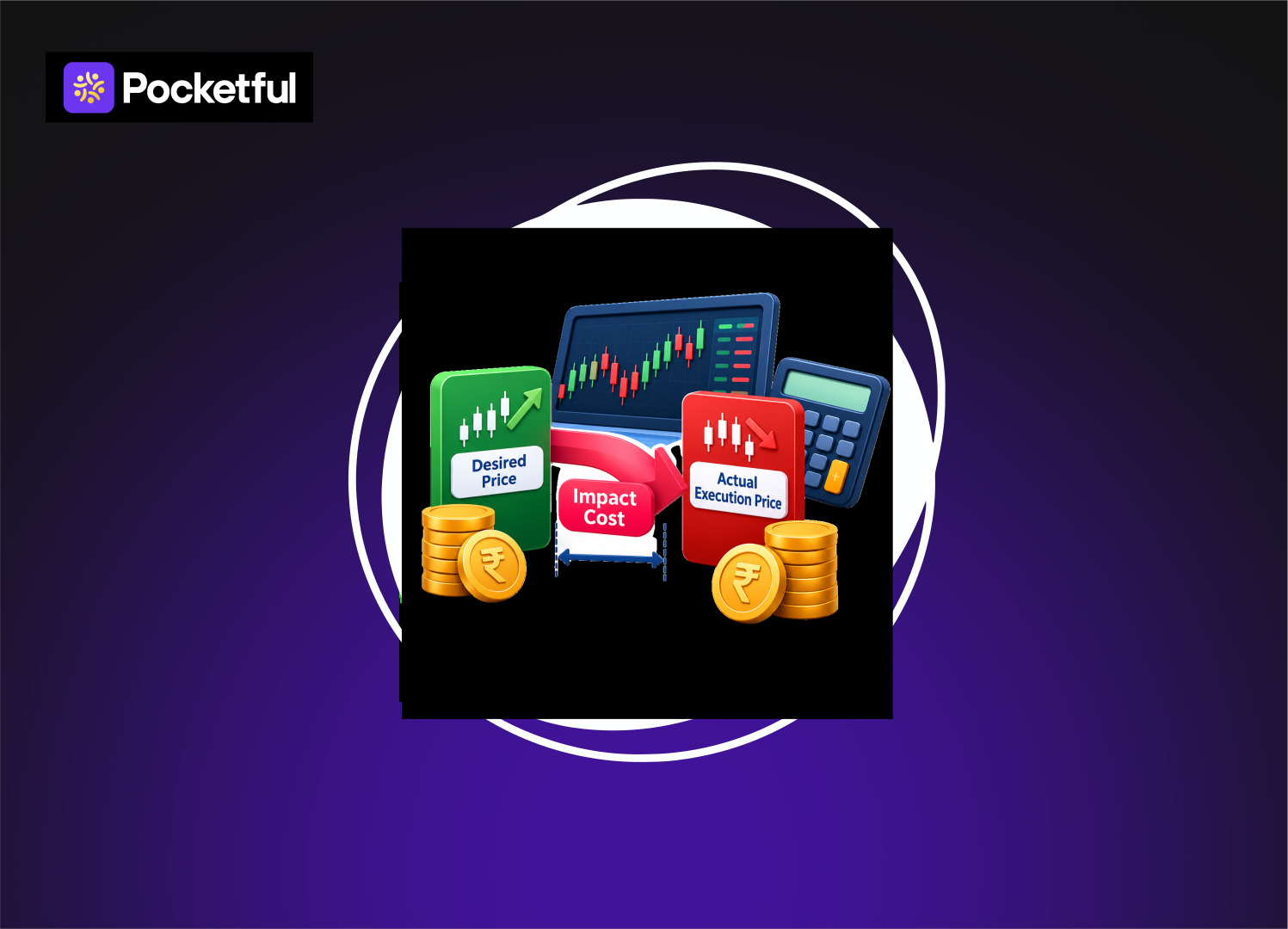
You place a buy order for a stock on NSE. The screen shows ₹500; you hit the button, and your average price comes out at ₹500.30. Not a huge gap. But repeat that across so many trades and larger quantities, and it starts to eat into your returns. That gap has a name, and it is called impact cost.
Most beginners look at brokerage, taxes, and STT when they count trading costs. Impact cost rarely makes the list, even though it can cost more than all of them combined, especially in less liquid stocks.
This blog explains what impact cost is, how to calculate it, and how you can keep it low.
What is Impact Cost?
Impact cost is the difference between the price you expect to trade at and the price you actually get when buying or selling a stock.
Simple Example:
If a stock is trading around ₹100, and you want to buy 100 shares.
- If there are enough sellers, you might buy all 100 shares close to ₹100.
- But if there aren’t enough sellers at ₹100, your order may be filled at ₹100.10, ₹100.20, ₹100.30, and so on.
Because your large order had to move through different price levels, you ended up paying more than the ideal/reference price. That difference is reflected in the impact cost.
And importantly, impact cost is not a fee charged by your broker, like brokerage or GST. It is an execution-related cost.
Formula for Impact Cost?
Impact Cost = (Actual Execution Price – Ideal Price) / Ideal Price * 100
Where, ideal price = (Best Bid Price + Best Ask Price) / 2
Let us understand this with an example;
You bought a share of ABC Company whose
- Ideal price: ₹100 per share
- Actual price at which your order gets executed: ₹100.50 per share
Now, apply the formula:
Impact Cost = (₹100.50 – ₹100) / ₹100 * 100
= ₹0.50 / ₹100 * 100 = 0.50%
So, the impact cost is 0.50%.
This means you paid 0.50% more than the ideal price because your order affected the available prices in the market.
Lower impact cost generally means the stock has better liquidity, while a higher impact cost can indicate lower liquidity.
Importance of Impact Cost in Trading
- It shows the true cost of trading: Brokerage and taxes are printed on your contract note. Impact cost is not. It is hidden inside your execution price, which makes it easy to miss and easy to underestimate.
- It helps you pick better stocks: If you are an active trader or someone who buys in decent size, checking a stock’s liquidity before entering can save you real money. A stock with a 0.05% impact cost and one with 1.5% are not equivalent, even if both look promising on the chart.
- It matters more for short-term strategies: An intraday trader aiming for a 0.5% gain cannot afford to lose 0.3% on entry and another 0.3% on exit. The maths simply does not work. Swing traders and scalpers should treat this as a core filter.
- It affects exits, not just entries: Getting into a stock is usually easy. Getting out during a sharp fall, when buyers vanish, is where high impact cost hurts. A liquid stock lets you leave without a fight.
- Institutions live by it: Mutual funds and FIIs moving crores at a time think a lot about impact cost, and it shapes which stocks they can even hold in meaningful size. Retail investors have a natural edge here: smaller orders mean smaller impact. But that edge disappears in illiquid stocks.
Factors Affecting Impact Cost
- Trading volume and liquidity: If there is more volume, there are more participants and more orders on both the buy and sell sides. This is the biggest driver.
- Order size: Bigger orders walk deeper into the order book. A 50-share order in a mid-cap may have almost zero impact. A 50,000-share order in the same stock might not.
- Market depth: It is not just about the best bid and ask. How many shares are queued at the next few price levels matters just as much. A deep book absorbs large orders gracefully.
- Time of day: Liquidity is usually at its highest in the first hour after 9:15 AM and the last hour before 3:30 PM. Around lunch, the order book is usually stable. Placing large orders in these windows can raise your cost.
- Volatility and news: During results, budget announcements, or sudden global sell-offs, market makers and traders step back. Spreads widen, and depth falls. Impact cost can jump even in stocks that are normally very liquid.
- Market segment and stock category: Nifty 50 stocks generally have far lower impact cost than small-caps, SME stocks, or stocks in the T2T (trade-to-trade) segment, where liquidity can be really patchy.
Read Also: Importance Of Algo Trading In Futures And Options For Traders
Common Misconceptions about Impact Cost
- Impact cost is the same as the bid-ask spread: The bid-ask spread is only one part of the picture. Impact cost also considers what happens when your order moves through different price levels in the order book. Two stocks can have the same spread but very different impact costs.
- Impact cost only matters to big institutions: Not this is not true. Large institutions usually feel the impact more because they place bigger orders. But retail investors can face it too, especially when trading less-liquid small- and mid-cap stocks. For example, a ₹2 lakh order could be a large order for a stock with very little trading activity.
- A liquid stock has zero impact cost: No stock has zero impact cost. Even highly liquid stocks can have some impact cost. The difference is that it is usually small enough not to matter much for normal retail orders.
- Limit orders make impact cost disappear: Limit orders can help you control the maximum price you are willing to pay. But they cannot create more buyers or sellers in the market. If there are not enough orders at your chosen price, your order may remain unfilled or may only be partially filled. So, you may avoid paying a higher price, but you could face a delay in getting your order executed.
- Impact cost is fixed for a stock: No. Impact cost can change depending on your order size, market conditions, trading activity, and even the time of day. So, an impact cost figure you saw earlier may not be the same when you actually place your trade.
Conclusion
Impact cost is one of those concepts that might sound complex but is very common. It asks a simple question: how much extra am I paying because the market cannot fully absorb my order at the price I see?
For large-cap stocks and small orders, the cost can be very minimal. For less-traded stocks, it can be a serious drag. The habit worth building is simple: check volume and market depth before entering, split larger orders, avoid the lunch-hour window, and think about your exit before you even enter. Do that, and you keep more of what you earn.
| S.NO. | Check Out These Interesting Posts You Might Enjoy! |
|---|---|
| 1 | Top Algorithmic Trading Strategies |
| 2 | Is Algorithmic Trading Legal and Profitable in India? |
| 3 | What Is High-Frequency Trading (HFT)? |
| 4 | Best Artificial Intelligence (AI) Stocks In India |
| 5 | What is Quantitative Trading? |
Frequently Asked Questions (FAQs)
01
What is a good impact cost for a stock?
Lower is better. Highly liquid large-caps typically show very small figures. Anything that climbs into the 1% range or higher tells you the stock is less traded.
02
How is impact cost different from slippage?
They are related, but not exactly the same. Slippage is the difference between the price you expected and the price you actually got. It can happen because the price moves very quickly. Impact cost specifically refers to the price change caused by your own order using available orders in the market.
03
Does impact cost apply to both buying and selling?
Yes. On a buy, you pay more than the ideal price. On a sell, you receive less. You bear it at both ends of a trade.
04
Can I reduce my impact cost?
Yes. Trade liquid stocks, avoid very large single orders, split orders into smaller chunks, use limit orders where suitable, and stay away from low-volume periods and highly volatile moments.
05
Is impact cost more important for intraday traders or long-term investors?
It matters for both, but intraday and short-term traders feel it most since their profit margins per trade are small. Long-term investors mainly need to watch it while entering and exiting positions in small or mid-cap stocks.
Disclaimer

The information shared in this content is intended solely for educational and informational purposes and should not be considered financial, investment, or trading advice. Any references to stocks, mutual funds, or market instruments are purely for informational purposes and do not constitute recommendations. Investments in financial markets are subject to market risks, and past performance is not indicative of future returns. Readers are advised to conduct independent research, review official documents carefully, and consult a qualified financial advisor before making any investment or trading decisions.
Article History