



| Type | Description | Contributor | Date |
|---|---|---|---|
 | Post created | Pocketful Team | Sep-01-26 |
Read Next
- How to Place an Order During CAS Window
- What is the Impact Cost in Trading?
- Stock Market Crash in India: History & Causes
- Fundamental Trading: A Beginner’s Guide
- What is MetaTrader 4 (MT4)?
- Types of Financial Instruments available for Trading in the Capital Market
- Importance Of Algo Trading In Futures And Options For Traders
- Convexity in Options Trading: Meaning, Benefits & Risks
- Best AI Trading Tools in India 2026: Top 5 Tools
- What Is Vega in Options? Meaning, Importance & Example
- Delta in Options: Meaning, Formula, Uses & Examples
- What is Commodity Pool Operator (CPO)?
- Best Penny Stock Trading Platforms, Brokers & Apps
- Bid Price and Ask Price: Key Differences
- What is After Hours Trading: Definition, Benefits & Risks
- Minimum Capital Required for Options Trading in India
- Trading Terminal: Meaning, Features, Types & Benefits
- MTF Charges vs Normal Trading Charges: Key Differences
- Types of Stock Market Orders Explained
- What Is Cash Trading? Meaning, How It Works & Benefits
Slippage in Trading: Meaning, Types, Causes & How to Reduce It
Published on : 1st September 2026
|Updated on : 1st September 2026



Suppose you are trading, you place an order at one price, and to your surprise, it got executed at something completely different?
Slippage is one of those things that eats into your profits without you even realising it half the time. New traders do not realise this much, but once you start trading in volume or in fast-moving markets, it becomes something you simply cannot ignore.
So let us break it down properly, in an easy and simple way.
What is Slippage?
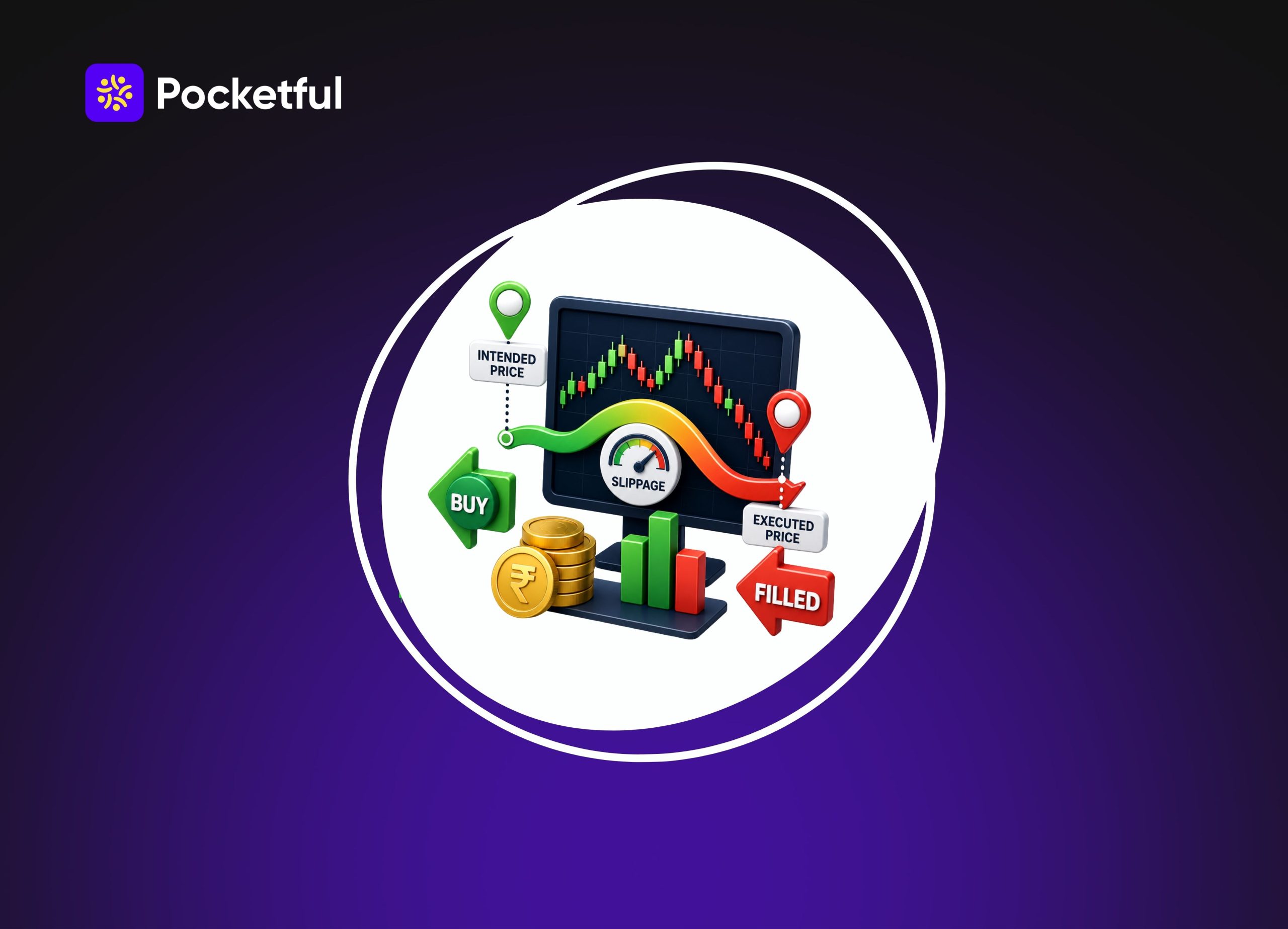
Slippage meaning in trading is the difference between the price at which you expected your order to execute and the price at which it got executed. Slippage can work both ways. Sometimes it goes against you (negative slippage), and sometimes, by luck, it works in your favour (positive slippage). Identifying slippage can help traders make better decisions about order types and manage trading costs more effectively.
Positive Slippage vs. Negative Slippage
1. Positive Slippage
It happens when your order executes at a better price than what you expected. If you place a buy order at Rs 100 and it executes at Rs 98, that is positive slippage working in your favour. Similarly, a sell order placed at Rs 100 that executes at Rs 102 is also a positive slippage.
2. Negative Slippage
It is the opposite. A buy order placed at Rs 100 that executes at Rs 103, or a sell order at Rs 100 that fills at Rs 97, both represent negative slippage. This is the one that eats into your profits or adds to your losses
Example:
Suppose you buy 1,000 shares of a stock at an expected price of ₹200. You are targeting a ₹5 move and expect to make ₹5,000. But because of volatility, your actual execution happens at ₹201.50. You have already lost ₹1,500 in profit because of slippage.
Now imagine you make 10-15 such trades every day. Even small differences in execution price can add up quickly. This is why professional traders do not just look at whether their strategy is profitable on paper; they also pay attention to execution costs.
Why does Slippage Happen?
1. Market Volatility
When there is sudden news, say an RBI policy announcement or a company’s quarterly results, prices can move within seconds. Your order might be in the queue for even half a second, and in that time the price has already moved.
2. Liquidity
Stocks that do not get traded or are traded with less volume, like mid-cap or small-cap are more prone to slippage. If the buyers and sellers in a stock are few, then chances are likely that large orders matching may cause more movements.
Compare this to something like Reliance or HDFC Bank, where liquidity is good and slippage is usually minimal.
3. Order Size
Order size also plays a role. If you are placing a large order, it might not get filled at a single price point. Instead, it gets executed in parts, and the average of those becomes your final execution price.
4. Type of Order
Market orders are far more susceptible to slippage than limit orders, simply because a market order says “execute me at whatever the current price is,” while a limit order says “only execute me at this price or better.”
Read Also: What Is Cash Trading? Meaning, How It Works & Benefits
How much Slippage is Acceptable?
There is no predetermined acceptable amount of slippage as this can vary based on the trade and the trading approach. When you are investing for a longer period, a few paise or a rupee change may not matter that much.
However, for an intraday trader or a scalper, even a slight amount of slippage can become a problem. Let us say you wanted to make ₹2-₹3 per trade, and you ended up losing ₹0.50 due to slippage. In this case, you are already losing a chunk of the profit you were expecting to make.
To understand slippage meaning, you must take into account your trade size, liquidity, volatility, and estimated profit margin per trade. When slippage continues to eat into your profits, you need to once again analyse the stock, order size or order type that you are using.
Therefore, do not search for a single acceptable slippage figure; rather, ask yourself, Will this small slippage still be a reasonable fit for my trading strategy?
How to Reduce Price Slippage?
1. Limit Orders
Switching to limit orders instead of market orders is probably the single most effective step. Sometimes your limit order might not get filled at all if the price moves away too fast. But at least you are in control of the price you are willing to accept.
2. Do not start trading as soon as the market opens
Avoiding trades during the first and last fifteen minutes of the trading session also helps a lot. These windows tend to be the most volatile, partly because of overnight news getting priced in at the open, and partly because of squaring-off activity near the close.
3. Trade Liquid Stocks Only
Sticking to liquid stocks can also fix your concern about slippage. You will usually find high-volume Nifty, Bank Nifty, and large-cap stocks and thus lesser slippage compared to illiquid small-caps or far-out-of-the-money options that barely trade.
4. Breaking up large orders
Breaking up large orders into smaller chunks is also a trick. Instead of placing one huge order that moves the price against you, splitting it into smaller pieces can help you get a better average execution price.
5. Pay Extra Attention
Being extra cautious around major news events and earnings announcements goes a long way. If you know a company is announcing results at 4 PM, or the RBI is making a policy statement, it’s often wiser to avoid placing market orders in such cases.
6. Slippage vs. Bid & Ask Spread
People often mix these two up, but they are different if you look closely.
The bid-ask spread is something you can see on your screen before you hit buy or sell. It is just the gap between the highest price that a buyer is offering and the lowest price a seller is asking for.
Slippage works the opposite way and is only known after your order executes, and it results from the market moving between the time you place the order and the time it gets executed.
So if you had to put it simply: the spread is the entry fee for stepping into the market, while slippage is more like bad timing or placing a large order at the wrong moment.
How Slippage Affects Profit & Loss
For long-term investors, slippage hardly matters. A few rupees of difference in your entry price should not worry you when your investment horizon runs into years.
It is a different story for intraday traders, options buyers, and people who trade on margins. When you are targeting a small, specific move in price, slippage can turn what should have been a profitable trade into a loss-making one, or reduce your gains more than expected. Traders who place a high number of trades in a day feel this effect cumulatively.
As far as risk management is concerned, your stop-loss and target levels are usually calculated based on your expected entry price. If slippage shifts your entry away from what it initially was, your entire risk-reward calculation for the trade shifts along with it, sometimes without you even realising it in the moment.
Read Also: What is Quoted Price in Commodity Trading?
Conclusion
Slippage is not something to be scared of, but it is definitely something worth understanding properly, especially if you are active in intraday or F&O trading. It is simply a natural part of how markets function. The traders who do well over time are not the ones who avoid slippage entirely, because nobody can. They are the ones who understand when and why it happens, and adjust their order types, timing, and stock selection accordingly. So the next time your order executes at a different price than expected, you will know the exact reason.
| S.NO. | Check Out These Interesting Posts You Might Enjoy! |
|---|---|
| 1 | What is the Best Time Frame for Swing Trading? |
| 2 | MCX Trading: What is it? MCX Meaning, Features & More |
| 3 | What is Pair Trading? |
| 4 | What is Speculation in Trading |
| 5 | What is Spread Trading? |
Frequently Asked Questions (FAQs)
01
Can we avoid slippage?
No, we cannot avoid slippage, but traders can reduce it by using the right order types and trading liquid securities.
02
In which order type does more slippage happen?
Market orders are usually more prone to slippage.
03
Does slippage happen in options trading?
Yes, slippage can exist in less-liquid options, especially those with low volumes.
04
What effect does slippage have on long-term investors?
The impact of slippage on long-term investors is usually smaller.
05
Why is slippage higher during volatile markets?
It is high because prices can change quickly even before an order gets executed.
Disclaimer

The information shared in this content is intended solely for educational and informational purposes and should not be considered financial, investment, or trading advice. Any references to stocks, mutual funds, or market instruments are purely for informational purposes and do not constitute recommendations. Investments in financial markets are subject to market risks, and past performance is not indicative of future returns. Readers are advised to conduct independent research, review official documents carefully, and consult a qualified financial advisor before making any investment or trading decisions.
Article History