



| Type | Description | Contributor | Date |
|---|---|---|---|
 | Post created | Pocketful Team | Aug-26-26 |
Read Next
- Short Selling vs Put Options: Key Differences
- Spin-Off vs Split-Off: Key Differences, Examples & Tax in India
- Trendline Trading: Types, Strategies & How to Draw
- What Is Freak Trade in the Stock Market?
- What Is Active Trading? Types, Strategies & Risks
- USD INR Trading: Lot Size, Strategies & How to Trade
- What Is a Trading Halt in the Stock Market?
- Binary Options Trading: How to Trade?
- What is Carbon Credit Trading Scheme? Types & Example
- How to Reactivate a Trading Account Online: Step-by-Step Guide
- Equity Curve in Trading: Meaning, Analysis & Examples
- How to Place an Order During CAS Window
- What is the Impact Cost in Trading?
- Stock Market Crash in India: History & Causes
- Fundamental Trading: A Beginner’s Guide
- What is MetaTrader 4 (MT4)?
- Types of Financial Instruments available for Trading in the Capital Market
- Importance Of Algo Trading In Futures And Options For Traders
- Convexity in Options Trading: Meaning, Benefits & Risks
- Best AI Trading Tools in India 2026: Top 5 Tools
What is Max Pain Theory?
Published on : 27th August 2026
|Updated on : 26th August 2026



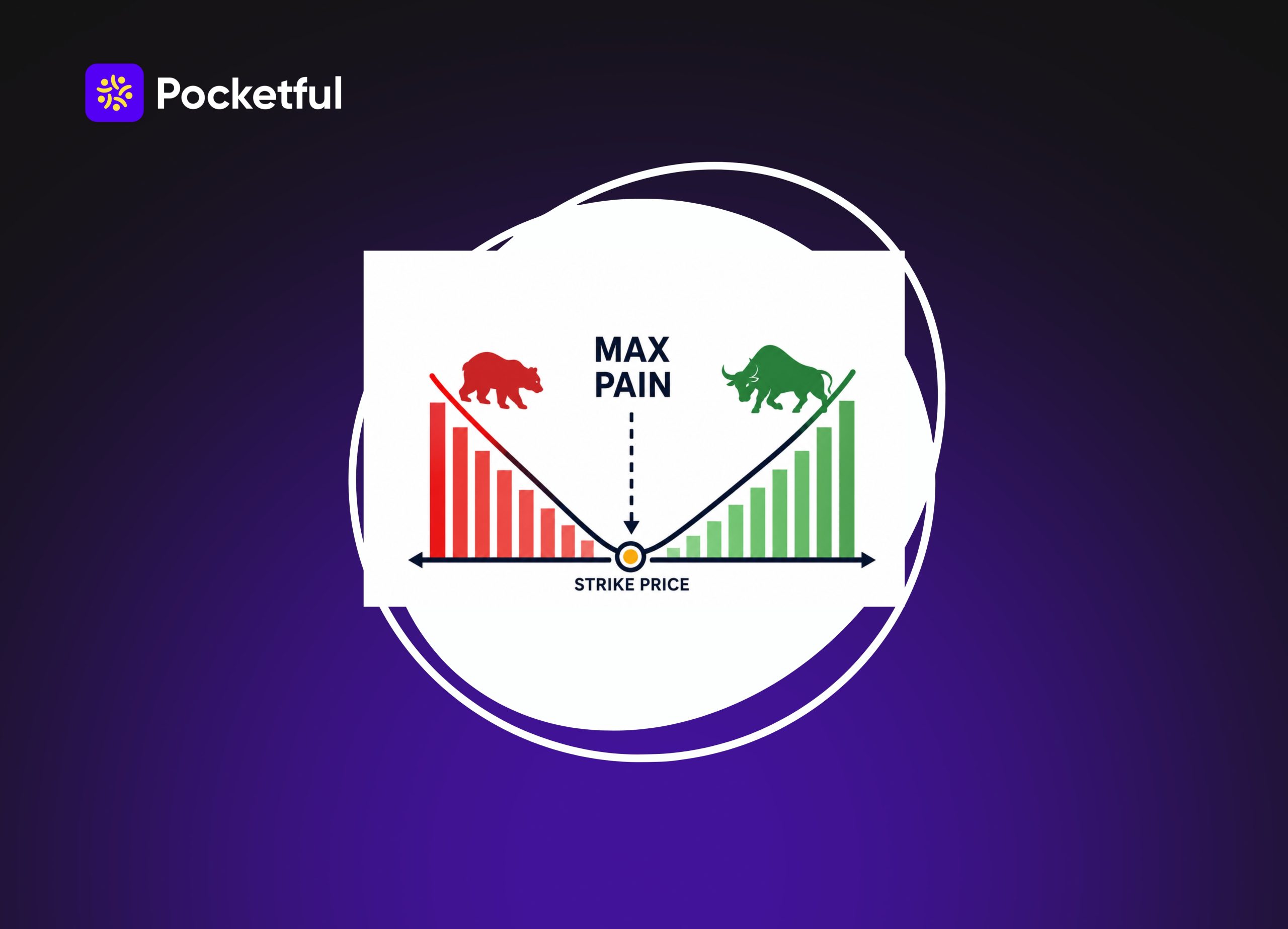
If you are trading in options, then you must have heard about the term Max Pain Theory. This helps a trader identify the strike price where option buyers could theoretically suffer the maximum combined loss at expiry.
In today’s blog post, we will give you an overview of Max Pain Theory along with its importance and limitations.
What is Max Pain Theory?
To understand the max pain meaning, it is important to note that Max Pain theory is a concept used in options trading to identify the strike price at which option buyers could theoretically incur the maximum loss nearing expiry. This concept was developed by a quantitative researcher known as Jeff Augen. To calculate the max pain level, traders look at the open interest for both call and put options across different strike prices. The theory suggests that the underlying price sometimes moves towards the max pain level near expiry.
What is Max Pain Sensex?
It refers to the strike price at which the combined theoretical loss of Sensex buyers is considered to be the highest at expiry. This is calculated using the open interest of Sensex call and put options across different strike prices.
How Does Max Pain Theory Work
The step-by-step working of max pain theory is mentioned below:
- Collection of Data: The first step is to collect the option chain data, including the open interest of both call and put options for different strike prices.
- Different Expiry Prices: In this step, the calculation is made for various possible prices at which the underlying asset could expire.
- Calculate the Loss of Option Buyer: For every possible expiry price, the payout of every outstanding call and put option is calculated.
- Comparison of Losses: The losses across all the strikes are added for each possible expiry price.
- Identify the maximum pain point: The strike price at which total loss for option buyers is highest is considered the max pain price.
Example of Max Pain Theory
Let’s understand the max pain theory through an example.
Suppose a stock named ABC Limited is trading at ₹ 100 and its options are approaching expiry. Based on the option, the following is the open interest:
| Strike Price | Call Open Interest | Put Open Interest |
|---|---|---|
| ₹ 90 | 1000 | 4000 |
| ₹ 95 | 2000 | 3500 |
| ₹ 100 | 3000 | 3000 |
| ₹ 105 | 4000 | 2000 |
| ₹ 110 | 5000 | 1000 |
Now, to find the level of max pain, let’s assume that ABC Limited expires at different strike prices and calculate the theoretical payout that option buyers would receive at each price.
The calculation is as follows:
| Expiry Price | Call Payout | Put Payout | Total Theoretical Payout |
|---|---|---|---|
| ₹90 | ₹0 | 97,500 | ₹97,500 |
| ₹95 | ₹5,000 | 50,000 | 55,000 |
| ₹100 | ₹20,000 | ₹20,000 | 40,000 |
| ₹105 | ₹50,000 | ₹5000 | 55,000 |
| ₹110 | ₹1,00,000 | ₹0 | 1,00,000 |
Based on the above table, the total theoretical payout to option buyers is lowest at ₹100, at ₹40,000. Therefore, ₹100 is the max pain price in this example.
In other words, if ABC Limited expires around ₹100, the combined theoretical payout to option buyers is the lowest among the prices considered. From the perspective of the max pain theory, this represents the point where option buyers collectively face the highest theoretical loss.
However, max pain is only a theoretical concept and does not guarantee that the stock will move toward or expire at the calculated level. Actual prices can be influenced by market sentiment, news, volatility, institutional activity and other factors.
Formula to Calculate Max Pain
The formula to calculate the max pain is as follows
Max Pain = Strike Price at which the total theoretical payout to all option buyers is minimum.
Or, to simplify it, it may be understood as
Max Pain = Strike Price at which the theoretical loss of option buyers is maximum.
Importance of Max Pain Theory
The key reasons why an investor must pay attention are as follows:
- Understanding Behaviour: The max pain is particularly important around expiry. Traders use it as a reference to understand the price at which the underlying asset may potentially settle.
- Market Indicator: Traders generally rely on price charts; they can also use Max Pain along with open interest volume, volatility, etc. to get a broader view of the option chain.
- Option Seller: Option sellers monitor the max pain level while executing their trades. If the underlying price is close to the max pain level, it provides additional information for assessing expiry position.
- Comparing Strike Prices: It allows traders to compare the potential impact of different expiry prices based on open interest. It provides a clearer picture of where the maximum loss for option buyers occurs.
- Informed Decision Making: Max pain must not be used as the only trading signal; it can be combined with various other indicators such as support, resistance, trend analysis, etc. to make a more informed decision.
Read Also: What is Dow Theory? Meaning, Principles, and Examples
Limitations of Max Pain Theory
There are certain limitations of max pain theory that are as follows:
- No Guaranteed Expiry Price: The key limitation of max pain theory is that the underlying asset does not necessarily expire at the max pain level. It represents the price where option buyers would theoretically face the highest loss based on existing open interest.
- Frequent Changes of Max Pain: The open interest changes very frequently as traders buy and sell their existing positions. This results in the max pain level also changing very frequently.
- Market News: The calculation of max pain is based on the option chain. They generally do not account for unexpected events such as news, company results, economic data, etc.
- Misinterpretation: Certain traders assume that option writers will deliberately move the market towards the max pain price. The market price is influenced by various factors such as demand and supply, hedging, etc.
How to Check Sensex Max Pain Today?
If you are looking for Sensex Max Pain today, you can check the latest Sensex option chain and analyse the open interest rate to access various calls and puts. As the open interest continues to change, max pain can also change before expiry.
How to Check Nifty Max Pain Today?
Traders can find Nifty Max Pain today by analysing the latest Nifty option chain. Open interest across different strike prices of call and put decides the max pain level. However, it should be treated only as a reference, not a guaranteed prediction.
Conclusion
On a concluding note, max pain is a theory that sounds complicated initially, but once you get to understand about it helps you in identifying the price level at which the option buyers might face maximum pain or loss near expiry. It is useful to analyse the option chain and understand the dynamics of different strike prices. However, max pain is not a guaranteed prediction of the expiry price. The market can move well above or below the max pain level due to various reasons such as news, volatility, etc. But in the end, it is always advisable to consult your investment advisor before making any investment in options.
Frequently Asked Questions (FAQs)
01
What is Max Pain Theory?
It is a theory that is often used by options traders to identify the strike price where option buyers would experience maximum loss near expiry.
02
Are Max Pain and Open Interest the same thing?
No, max pain and open interest are both different concepts. Open interest shows only the outstanding option contracts, whereas max pain indicates the expiry price at which the option buyers experience maximum loss.
03
Can Max Pain change?
Yes, max pain can change anytime before expiry because of various factors such as news, market movement, etc.
04
Are max pain useful for both call and put traders?
Yes, max pain theory is useful for both call and put buyers as it is calculated using the open interest of both call and put options across different strike prices.
05
What factors are required to calculate the max pain level?
The key factors that are required for calculating the max pain level are: call open interest and put open interest of the relevant option chain.
Disclaimer

The information shared in this content is intended solely for educational and informational purposes and should not be considered financial, investment, or trading advice. Any references to stocks, mutual funds, or market instruments are purely for informational purposes and do not constitute recommendations. Investments in financial markets are subject to market risks, and past performance is not indicative of future returns. Readers are advised to conduct independent research, review official documents carefully, and consult a qualified financial advisor before making any investment or trading decisions.
Article History