



| Type | Description | Contributor | Date |
|---|---|---|---|
 | Post created | Pocketful Team | Sep-02-26 |
Read Next
- How to Place an Order During CAS Window
- What is the Impact Cost in Trading?
- Stock Market Crash in India: History & Causes
- Fundamental Trading: A Beginner’s Guide
- What is MetaTrader 4 (MT4)?
- Types of Financial Instruments available for Trading in the Capital Market
- Importance Of Algo Trading In Futures And Options For Traders
- Convexity in Options Trading: Meaning, Benefits & Risks
- Best AI Trading Tools in India 2026: Top 5 Tools
- What Is Vega in Options? Meaning, Importance & Example
- Delta in Options: Meaning, Formula, Uses & Examples
- What is Commodity Pool Operator (CPO)?
- Best Penny Stock Trading Platforms, Brokers & Apps
- Bid Price and Ask Price: Key Differences
- What is After Hours Trading: Definition, Benefits & Risks
- Minimum Capital Required for Options Trading in India
- MTF Charges vs Normal Trading Charges: Key Differences
- Slippage in Trading: Meaning, Types, Causes & How to Reduce It
- Types of Stock Market Orders Explained
- What Is Cash Trading? Meaning, How It Works & Benefits
Trading Terminal: Meaning, Features, Types & Benefits
Published on : 2nd September 2026
|Updated on : 2nd September 2026



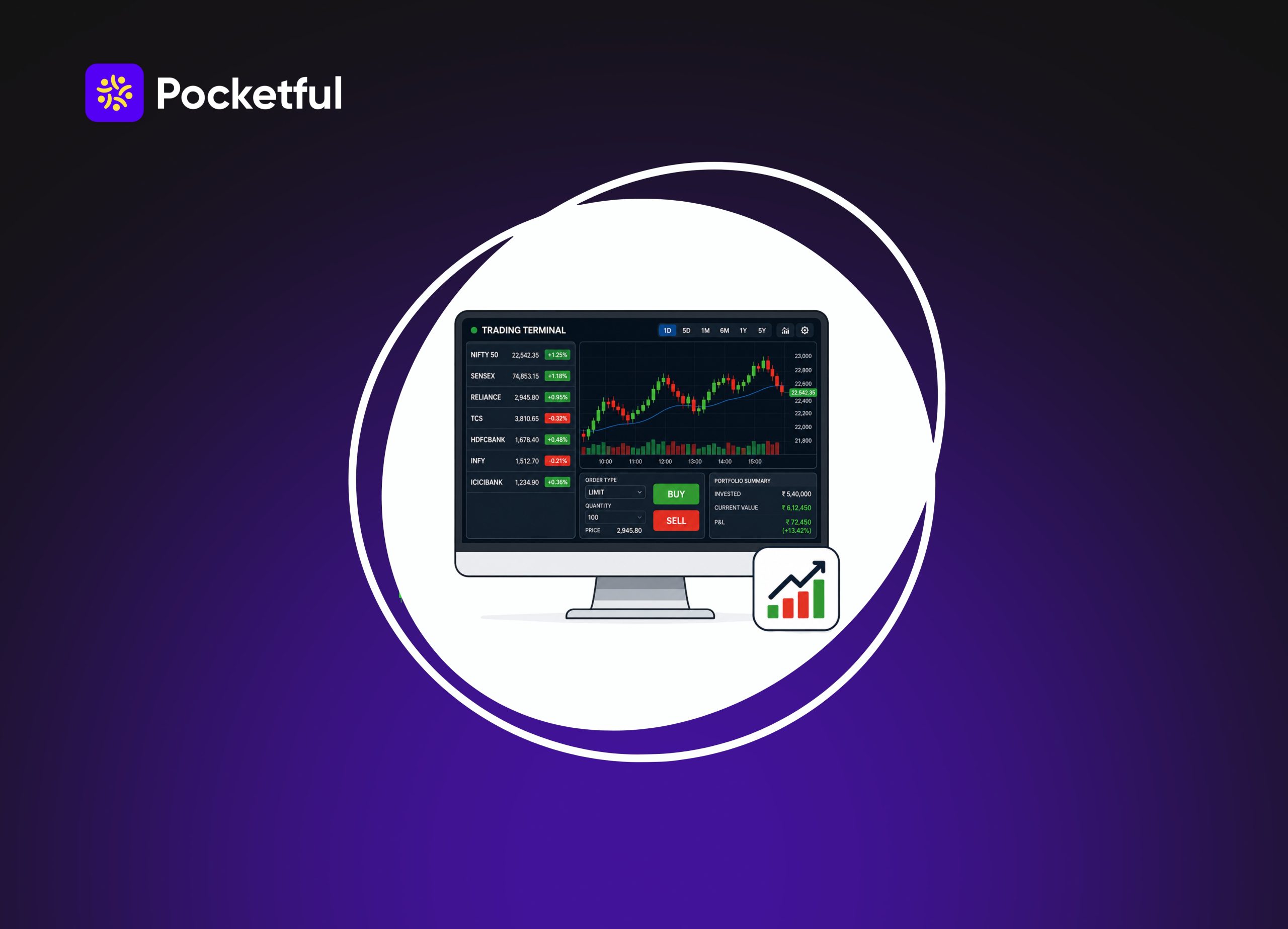
The stock market has evolved exponentially over time, and so have trading patterns. Earlier, one used to call their broker to get their trades done, but it took time and delayed the execution of the trade. That’s where a trading terminal comes in because it is a personalised workspace for trading.
In today’s blog post, we will give an overview of a trading terminal key benefits.
What is Trading Terminal?
A trading terminal is a platform or software provided by your broker that allows a trader to execute their trade. It provides real-time market updates and has built-in tools for analysing various securities. Trading terminals allow you to execute trades across different asset classes, such as stocks, commodities, and other financial instruments. Through a trading platform, one can check prices of stocks, create a watchlist, analyse charts, place orders, track positions, etc., from a single screen.
Key Features of a Trading Terminal
The key features of a trading terminal are as follows:
- Real-Time Market Data: A trading terminal provides live market data such as trading volume, stock prices, etc. This helps investors make informed decisions.
- Market Depth: A trading terminal shows the market depth, which shows available buy and sell orders at different price levels. This gives traders an idea about demand and supply.
- Execution of Order: A trader can directly place an order from the trading terminal. This helps them execute trades faster.
- Secure Access: Security is another important feature of a trading terminal. It uses a secure login method and protects investors’ financial information.
How Does a Trading Terminal Work?
The working process of a trading terminal is as follows:
- Login: The first step is to log in to the trading terminal provided by your broker using your credentials.
- Checking Market Information: The next step is to check the live market information, including stock price movement, trading volume, etc.
- Technical Charts: Before placing any purchase order, one should analyse stocks based on various parameters such as technical indicators, etc.
- Selecting Type of Order: After you decide on your trade, the next option will be selecting the order type. There are various types of orders, such as market orders, limit orders, stop-loss orders, etc.
- Matching Order: The exchange system of trading matches your order with a corresponding order from the available orders in the system.
- Monitor Portfolio: Once the execution is completed, your trades start to appear in your trading account. One can use their terminal to monitor their positions.
- Exit Position: Whenever you decide to close your position, you can place a sell or buy order depending on your initial position.
Read Also: What is a Stock Broker?
Types of Trading Terminal
Depending on the investor’s requirements, they can choose a suitable trade terminal for accessing the market. The common types of trading terminals are as follows:
- Desktop-Based Trading Terminal: This type of trading terminal is installed on your computer or laptop. It is commonly preferred by active traders who regularly trade and use advanced charts, technical tools, multiple screens, etc. It runs on a computer; therefore, it is convenient for traders who prefer to spend several hours on screen analysing charts.
- Web-Based Terminal: This terminal is accessible directly through an internet browser and does not require separate software. One can simply log in to the website of their broker and access their trading account. You can access this from any computer that has an internet connection and a browser.
- Mobile Trading Terminal: This is a trading application through which you can access the market. It is installed on your mobile device and offers features such as a watchlist, market data, etc. The mobile trading terminal is preferred by traders who prefer trading on the go.
How to Invest with Your Trading Terminal
The step-by-step process to invest through a trading terminal is as follows:
- Opening a Trading and Demat Account: To start using a trading terminal, you are required to open a trading and demat account.
- Login into Trading Terminal: After your account is opened, you can log in to the trading terminal of your choice from a desktop platform, website, or mobile application.
- Research and Analysis: The next step would be analysing the companies in which you wish to invest. The stock must be evaluated based on various factors such as historical price movement, financial performance, volume, etc.
- Adding stocks to watchlist: The selected stock needs to be added to the watchlist. This helps an investor track the price movement of the chosen stock.
- Placing a Buy Order: Once you have decided to invest, you can place the buy order based on your capital. The order can be entered using different order types such as market, limit, etc.
- Tracking Order Status: The placed order needs to be tracked in the order book, and investors are required to check whether it has been placed or not.
- Monitoring Investment: One can also use a trading terminal to keep track of their holdings and overall portfolio so the profits can be booked in a timely manner.
Benefits of Using a Trading Terminal
With the adoption of online investing, a trading terminal India has become an important tool for traders, and the benefits of using a trading terminal are as follows:
- Quick Access: One can easily access the commodity and capital market data through the trading terminal. This allows an investor to track and manage market movements.
- Instant Order Execution: The buy and sell orders can be executed immediately from the trading terminal. It is especially useful for intraday traders.
- Real-Time Updates: Trading terminals provide access to market data such as bid and ask prices, volume, market depth, etc. This helps traders in making informed decisions.
- Customised Watchlist: Traders who regularly track certain stocks can use a trading terminal to add to a customised watchlist. It allows easy monitoring of securities without the hassle of searching for them repeatedly.
- Tracking: One does not need to maintain a separate record to track how their investments are performing. The trading terminal can easily show your holdings, open positions, etc., in one place.
Read Also: What Is Day Trading and How to Start With It?
How to Choose a Trading Terminal
The key factor that one is required to consider before choosing a trading terminal is as follows:
- Comparison of Brokerage Charges: One should evaluate the brokerage cost and other account-related charges and should choose a broker that offers affordable brokerage along with other features.
- User Interface: The trading terminal must have a clean and easy-to-use interface. It makes trading easier, and one can find watchlists, charts, etc., in one place.
- Check for Speed and Reliability: Active traders rely on the speed and reliability of the trading terminal. It should load market information smoothly and allow placing trades instantly.
- Analysis Tools: Traders rely on various technical tools and charting features to analyse stocks. Hence, the trading terminal must be equipped with advanced trading tools.
Conclusion
On a concluding note, a trading terminal is a one-stop solution for active traders who generally prefer to track live market data regularly and study charts. A trading terminal brings the convenience of order placement, portfolio tracking, market data, etc., in one place. However, choosing a trading terminal should not be based only on the number of features; it must be equipped with speed, charting tools, etc. But it is advisable to consult your investment advisor before choosing a broker and evaluate all the key features of the trading terminal.
| S.NO. | Check Out These Interesting Posts You Might Enjoy! |
|---|---|
| 1 | What Is Cash Trading? |
| 2 | What is Averaging Up in Stock Trading? |
| 3 | What is Speculative Trading in Stock Market? |
| 4 | What is Quoted Price in Commodity Trading? |
| 5 | How To Use Directional Movement Index In Trading? |
Frequently Asked Questions (FAQs)
01
What is the difference between a trading terminal and a trading account?
A trading account is a type of account through which an investor buys and sells securities of different types, such as shares, ETFs, etc. Whereas a trading terminal is a platform or interface provided by your broker through which you can operate and access your trading account.
02
Are there any charges for using a trading terminal?
Yes, there are fixed fees charged on a monthly basis by the brokers to use a trading terminal. However, there are certain brokers that allow an investor to use a trading terminal at zero cost.
03
What is market depth in a trading terminal?
Market depth in a trading terminal shows the total number of buy and sell orders placed at different price levels. This only gives an idea about the liquidity, demand, and supply of a stock.
04
Can I do algo trading through trading terminals?
Yes, there are various brokers that offer algo trading through their trading terminals.
05
What are the factors that need to be considered while choosing a trading terminal?
The key factors to consider while choosing a trading terminal are charting tools, fast order execution, customer support, etc.
Disclaimer

The information shared in this content is intended solely for educational and informational purposes and should not be considered financial, investment, or trading advice. Any references to stocks, mutual funds, or market instruments are purely for informational purposes and do not constitute recommendations. Investments in financial markets are subject to market risks, and past performance is not indicative of future returns. Readers are advised to conduct independent research, review official documents carefully, and consult a qualified financial advisor before making any investment or trading decisions.
Article History