


| Type | Description | Contributor | Date |
|---|---|---|---|
 | Post created | Pocketful Team | Oct-23-26 |
Read Next
- Short Selling vs Put Options: Key Differences
- Spin-Off vs Split-Off: Key Differences, Examples & Tax in India
- Trendline Trading: Types, Strategies & How to Draw
- What Is Freak Trade in the Stock Market?
- What Is Active Trading? Types, Strategies & Risks
- USD INR Trading: Lot Size, Strategies & How to Trade
- What Is a Trading Halt in the Stock Market?
- Binary Options Trading: How to Trade?
- What is Carbon Credit Trading Scheme? Types & Example
- How to Reactivate a Trading Account Online: Step-by-Step Guide
- Equity Curve in Trading: Meaning, Analysis & Examples
- How to Place an Order During CAS Window
- What is the Impact Cost in Trading?
- Stock Market Crash in India: History & Causes
- Fundamental Trading: A Beginner’s Guide
- What is MetaTrader 4 (MT4)?
- Types of Financial Instruments available for Trading in the Capital Market
- Importance Of Algo Trading In Futures And Options For Traders
- Convexity in Options Trading: Meaning, Benefits & Risks
- Best AI Trading Tools in India 2026: Top 5 Tools
Nifty CPSE Index: Meaning, Stocks & Weightage
Published on : 23rd October 2026
|Updated on : 23rd October 2026



India’s stock market has a number of indices. Every index is used to track the performance of different groups of companies. The Nifty CPSE Index is one of them. The Nifty CPSE Index follows a select group of Central Public Sector Enterprises listed on the exchange. These are companies where the Central Government holds a majority stake, and you will recognise a few of them straight away, such as NTPC, Coal India and Bharat Electronics.
Put together, they show how government-run businesses are faring in the market. Because the index leans heavily on power, oil and gas, and infrastructure, it also shows how those sectors are doing.
In this blog, we look at what the index is, how it works, and the ways you can invest in it.
What is the NIFTY CPSE Index
The NIFTY CPSE Index is a thematic equity index managed by NSE Indices Limited. It includes selected listed CPSEs that meet the eligibility criteria set by the exchange. It started with a base date of 1 January 2009 and a base value of 1,000, and it was launched on 18 March 2014. It is a small and concentrated index. As per the latest factsheets, it holds 11 stocks.
Why was the NIFTY CPSE Index created?
This index was formed to support the government’s disinvestment programme.
Disinvestment simply means that the government sells a part of its holding in public sector companies to raise funds.
An exchange-traded fund (ETF) gave the government a more organised route. Retail and institutional investors could buy a single product that held several CPSE stocks together, and the government could sell its stake through that product in phases.
The NIFTY CPSE Index was built to be the benchmark for that ETF. So the index exists first as a source of disinvestment and as an investment theme.
Features of the NIFTY CPSE Index
- Follows a Theme: It is a thematic index, which means it follows one idea (government-owned enterprises) rather than the whole market. It is not a broad, diversified benchmark like the NIFTY 500.
- Free-float Market Capitalisation: It uses a free-float market capitalisation approach with capping. Free float means only the shares available for public trading are counted, not the shares held by the government. Capping helps to limit how much weight any single stock can carry at the time of rebalancing, so that one large company does not take over the index.
- Reviewed Quarterly: The index is reviewed, and its weights are realigned every quarter. Between those dates, a stock’s weight can drift higher or lower with its share price.
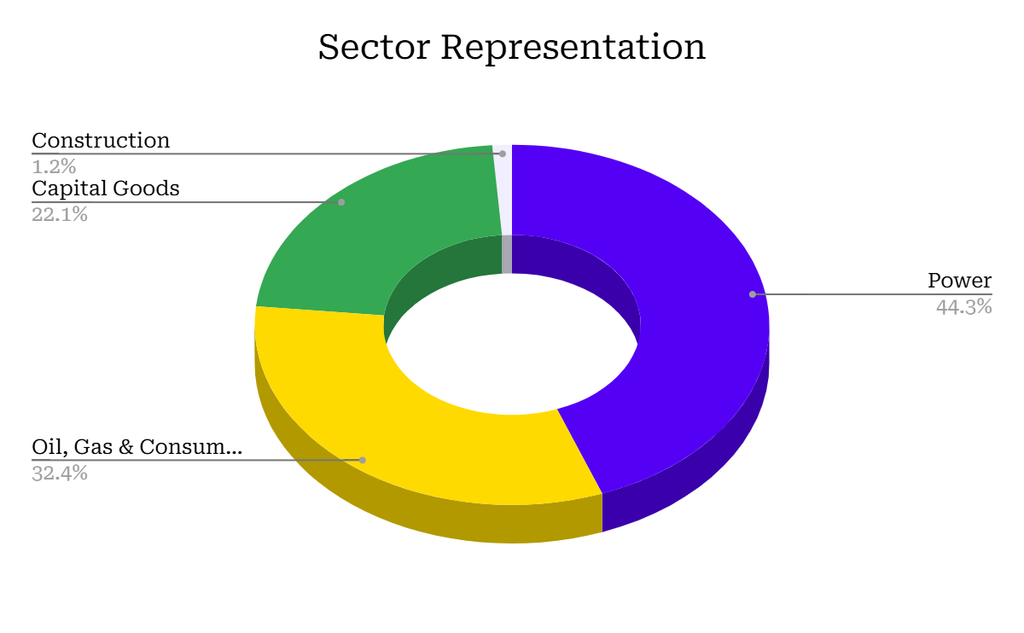
- Concentrated to 11 stocks: Sector exposure is narrow. The May 2026 factsheet showed power holdings in power, oil, gas and consumable fuels, capital goods, and construction. There is no banking, IT or consumer goods in the mix, which is a big difference from the NIFTY 50.
- Regular Dividend Payouts: The index has also tended to pay decent dividends, since many PSUs distribute a good part of their profits. The aggregate dividend yield has generally stayed in the range of roughly 2% to 3%, though it moves with prices.
Factors Affecting the NIFTY CPSE Index
1. Government Policies
- Every company in the index is government-controlled, so a policy call in Delhi can show up in the share price the same day.
- Disinvestment announcements, dividend directions and regulatory changes are the usual triggers.
- Pricing rules matter as well, particularly for power, gas and fuel companies, where the government has a say in what can be charged.
2. Commodity Prices
- Coal India’s earnings track coal realisations. The oil and gas names track crude.
- A sharp fall in either can affect profits within a quarter or two.
- Since these sectors carry a heavy share of the index, the effect is rarely small.
3. Infrastructure Spending
- Higher capital spending by the Centre on power projects, transmission lines and defence orders helps NTPC, Power Grid and Bharat Electronics.
- Power was close to 45% of the index in the May 2026 factsheet. If that spending slows, the index feels it more than a diversified one would.
4. Company Performance
- Results and dividends drive each stock, as with any listed company.
- The difference here is size. With just 11 stocks, one disappointing quarter from a large constituent can drag the whole index.
5. Overall Market Conditions
- Interest rates, foreign investor flows, and general sentiment all play a part.
- A weak market can pull PSU shares down even when the companies themselves have posted decent numbers.
Read Also: CPSE ETF: What Is It, Benefits, Risks & How to Invest
How does it work?
NSE Indices selects the stocks according to its methodology. In simple terms, the company must be a CPSE where the government holds the required stake, it must be listed, and it must meet liquidity and size requirements. Eligible stocks are then weighted by free-float market capitalisation, with the cap applied.
The index value is calculated in real time during market hours. Every quarter, the weights are reset to match the methodology. When a stock no longer qualifies, or a new one becomes eligible, the constituent list is updated.
You cannot buy the index directly. Investors can invest through an ETF or an index fund that tracks it. Since these products try to replicate the index, their returns will be close to the index, after adjusting for a small tracking difference and expenses.
Selection Criteria for Nifty CPSE Index
The CPSEs selected meet the below-mentioned parameters:
- Included in the list of CPSEs published by the Department of Public Enterprises
- Listed on the National Stock Exchange of India Ltd. (NSE)
- Having more than 51% government holding (stake via Govt. of India or President of India) under the promoter category.
- Companies having average free float market capitalization of more than 1000 Cr. for 6 months period ending December 2019 are selected.
- Companies which are IRDA dividend norms compliant shall be considered eligible to be included in the index
Weightage of Sectors in CPSE Index
| Sector | Weight (in%) |
|---|---|
| Power | 44.3 |
| Oil, Gas & Consumable Fuels | 32.35 |
| Capital Goods | 22.12 |
| Construction | 1.23 |
Top Index Constituents by Weightage
Below is the list of NIFTY CPSE Index Stocks
| S. No | Company Name | Weight (%) |
|---|---|---|
| 1 | NTPC Ltd. | 20.23% |
| 2 | Bharat Electronics Ltd. | 20.20% |
| 3 | Power Grid Corporation of India Ltd. | 17.84% |
| 4 | Coal India Ltd. | 15.39% |
| 5 | Oil & Natural Gas Corporation Ltd. | 13.26% |
| 6 | NHPC Ltd. | 4.15% |
| 7 | Oil India Ltd. | 3.70% |
| 8 | Cochin Shipyard Ltd. | 1.92% |
| 9 | NLC India Ltd. | 1.44% |
| 10 | NBCC (India) Ltd. | 1.23% |
Nifty CPSE Index Performance
| Index Returns (%) | QTD | YTD | 1 Year | 5 Years | Since Inception |
|---|---|---|---|---|---|
| Price Return | -6.99% | -2.14% | -3.57% | 21.40% | 10.85% |
| Total Return | -6.26% | -0.60% | -1.55% | 24.71% | 14.30% |
Read Also: What Is Nifty ETF?
Conclusion
This index shows how a group of government-owned companies is performing in the stock market. Most of them come from power, oil and gas, and infrastructure. If you like the idea of investing in these businesses but do not want to pick and track each stock yourself, an ETF that follows the index is the simpler way to do so.
That said, PSU stocks do not move only on company results. A policy change, a pricing decision by the government, a shift in the market, or a slowdown in the sector can all pull them up or down. So before putting money in, look at the risks properly and ask whether this kind of exposure fits what you are trying to achieve with your money.
| S.NO. | Check Out These Interesting Posts You Might Enjoy! |
|---|---|
| 1 | GIFT Nifty vs Nifty 50: Key Differences |
| 2 | Nifty Weekly Options Strategy for Beginners |
| 3 | Bank NIFTY Intraday Options Trading: Steps, Strategies & Tips |
| 4 | NIFTY Next 50 – Meaning, Types & Features |
| 5 | Options Trading Strategies |
Frequently Asked Questions (FAQs)
01
What is the NIFTY CPSE Index?
It is an NSE index that tracks listed Central Public Sector Enterprises. It was designed to support the government’s disinvestment programme through the ETF route.
02
How many stocks are in the NIFTY CPSE Index?
As per recent factsheets, it holds 11 stocks. These can change after a review.
03
When is the index rebalanced?
The weightage of these stocks is realigned every quarter, and the constituent list is updated when companies stop or start meeting the eligibility criteria.
04
Does the index pay dividends?
The companies in it have a record of paying dividends, and the index’s aggregate dividend yield has usually stayed between roughly 2% and 3%. Dividends are not guaranteed.
05
What is the P/E ratio of the CPSE index?
P/E Ratio of this index is 12.02 as of 30th September, 2026.
Disclaimer

The information shared in this content is intended solely for educational and informational purposes and should not be considered financial, investment, or trading advice. Any references to stocks, mutual funds, or market instruments are purely for informational purposes and do not constitute recommendations. Investments in financial markets are subject to market risks, and past performance is not indicative of future returns. Readers are advised to conduct independent research, review official documents carefully, and consult a qualified financial advisor before making any investment or trading decisions.
Article History