


| Type | Description | Contributor | Date |
|---|---|---|---|
 | Post created | Pocketful Team | Jul-30-25 |
 | Update content | Nisha | Apr-09-26 |
Read Next
- What Is Breakeven Point & How to Calculate It?
- Ulcer Index: Meaning, Formula, and Uses
- Directional Trading Strategies: Overview, Types & Examples
- Nifty CPSE Index: Meaning, Stocks & Weightage
- Short Selling vs Put Options: Key Differences
- Spin-Off vs Split-Off: Key Differences, Examples & Tax in India
- Trendline Trading: Types, Strategies & How to Draw
- What Is Freak Trade in the Stock Market?
- What Is Active Trading? Types, Strategies & Risks
- USD INR Trading: Lot Size, Strategies & How to Trade
- What Is a Trading Halt in the Stock Market?
- Binary Options Trading: How to Trade?
- What is Carbon Credit Trading Scheme? Types & Example
- How to Reactivate a Trading Account Online: Step-by-Step Guide
- Equity Curve in Trading: Meaning, Analysis & Examples
- How to Place an Order During CAS Window
- What is the Impact Cost in Trading?
- Stock Market Crash in India: History & Causes
- Fundamental Trading: A Beginner’s Guide
- What is MetaTrader 4 (MT4)?
8 Best AI Tools for Stock Market Analysis in 2026
Published on : 31st July 2025
|Updated on : 16th October 2026



Artificial intelligence is changing how investors research companies, analyse market trends, and evaluate trading opportunities. Tasks that once required hours of reading financial reports, studying charts, and comparing stock market data can now begin with a simple question to an AI tool.
For Indian investors, the best AI tools for stock market analysis can make financial information easier to understand and help organise research more efficiently. In this guide, we explore eight useful AI tools and how to choose the right one for your needs.
What Are the Best AI Tools for Stock Market
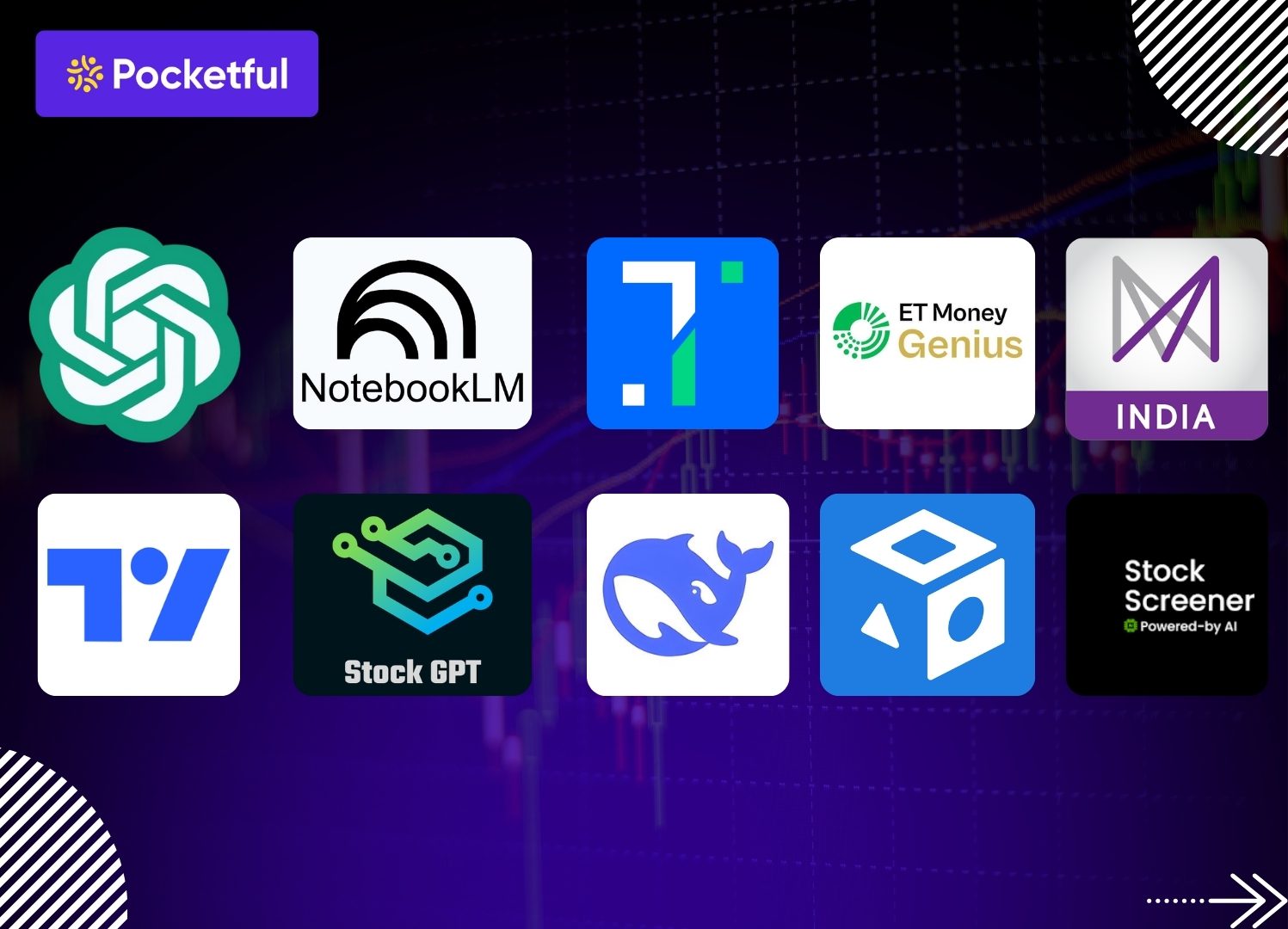
The best AI tools for stock market analysis include ChatGPT, Pocketful GPT, Trendlyne and many more. These platforms support different research needs, from understanding financial statements and analysing charts to researching market news and identifying potential trading opportunities.
8 Best AI Tools for Stock Market Analysis
Here is a quick comparison of the tools covered in this guide.
| AI Tool | Best For | Primary Use |
|---|---|---|
| 1. ChatGPT | General stock research | Explaining financial concepts and analysing reports |
| 2. Pocketful GPT | Stock market research | Exploring stocks, market developments, and trading concepts |
| 3. Perplexity | AI-powered research | Finding information with supporting sources |
| 4. TradingView | Technical analysis | Charting, indicators, screening, and strategy testing |
| 5. Google NotebookLM | Document analysis | Understanding annual reports and earnings transcripts |
| 6. Trendlyne | Indian stock screening | Comparing companies and financial indicators |
| 7. Screener.in | Fundamental analysis | Studying financial statements and valuation ratios |
| 8. Trade Ideas | Active trading | AI-assisted stock scanning, primarily for US markets |
Overview of the Best AI Tools for Stock Market Analysis
An overview of the top 10 AI tools for stock market analysis is given below:
1. ChatGPT (by OpenAI)
ChatGPT is a general AI assistant that could help investors understand financial terms, organise research and analyse company data. Its interface allows users to ask questions in natural language instead of manually searching through various sources. It is able to answer questions in natural language .
For instance, when doing due diligence on a company, an investor could ask ChatGPT to describe revenue growth, operating margins, return on equity, or debt to equity ratios. It could also help break down financial statements, compare business models and highlight the risks that need to be investigated.
Features at a glance:
- Explains the concepts of fundamental and technical analysis.
- Summarises earnings call transcripts and financial reports.
- Makes it easier to compare companies and interpret financial ratios.
- uploaded spreadsheets and financial data for analysis.
- Facilitates scenario analysis and research planning.
Best for: Beginners, finance students, and investors who want to understand complex financial information.
Limitation: ChatGPT is not a dedicated stock exchange data terminal. The availability and freshness of market information depend on the tools and sources used. Verify important figures against official filings and reliable market data.
2. Pocketful GPT
An AI-powered platform called Pocketful GPT was created to increase accessibility to stock market research, trading, and investing. To obtain tokens for using the platform’s features, users can connect their Pocketful Demat account and log in via the official Pocketful GPT website.
Pocketful GPT’s ability to consolidate various market elements into one location is what makes it beneficial. You can ask questions in natural language and receive AI-assisted insights to support your research, whether you want to analyze a company’s fundamentals & Technicals, investigate market trends, or learn about trading strategies.
Key features and use cases:
- Fundamental Analysis: Examine the company’s financials, business performance, and key ratios to get a better sense of the company’s fundamentals.
- Technical Analysis: Find price trends, chart patterns and technical indicators to spot potential trading opportunities.
- Trade Execution: Execute trades as instructed via Pocketful GPT, subject to available features and permissions.
- Trading and Investing: Use AI-assisted knowledge to assist your research on various trading and investment strategies.
- Market Education- Understand stock market concepts, trading strategies and financial instruments in simple, easy to understand language.
Why Pocketful GPT?
It can be hard to understand financial data and what it means for an investment. Pocketful GPT makes stock market research more accessible by allowing you to ask questions in plain English and take your time to explore the subjects.
Whether you are learning the basics or researching a specific company, it can help you get started without getting lost in complex financial terms. But AI-generated insights should be considered a first step, not a substitute for independent research. Do your own due diligence always before making any investment decisions.argin, unrealized P&L, and full portfolio in one place.
3. Perplexity
Perplexity your personal research assistant powered by artificial intelligence (AI). This tool will help you explore any topic of interest by gathering information from the web. With its ability to provide source-linked responses, this could be ideal if you’re seeking details about company announcements, their earnings results, any industry developments, or even macroeconomic events.
For example, suppose an investor wanted to understand what was happening with banking stocks. In that case, they might use perplexity’s capabilities to research recent announcements from the RBI, interest rate changes, company results, and anything else going on economically pertinent to the situation. Once they had done this, they’d simply click through all these links and see the actual stuff referenced.
Key features:
- Research current business and market developments.
- Provides source links for further verification.
- Summarises company announcements and industry news.
- Helps investigate economic and sector-related events.
- Organises information into concise research summaries.
Best for: Investors who follow market news and want to investigate the reasons behind stock movements.
Limitation: A cited answer is not automatically correct. Check the original source, publication date, and context before using the information in an investment decision.
4. TradingView
TradingView’s powerful AI Copilot feature for creating charts with stock indicators and performing market screenings. We’ll cover key use cases where AI Copilot comes into play – everything from interpreting technical information on your charts to exploring market data to creating Pine Script indicators & strategies that define your unique trading style.
The beauty of this functionality is that traders can interactively engage with their charts while simultaneously managing technical indicators. For example, traders could request an assistant to mark certain levels (support/resistance), analyze particular technical indicators such as moving averages, etc. Then historical strategy testing would be conducted to understand whether this specific trading approach actually worked when backtested against historical price action.
Key features:
- Interactive charts and technical indicators.
- AI-assisted chart analysis and screening.
- Pine Script indicator and strategy generation.
- Historical backtesting and performance analysis.
- Watchlists, alerts, and market research tools.
Best for: Intraday traders, swing traders, and investors who use technical analysis.
Limitation: AI Copilot requires an eligible TradingView plan and a separate add-on under its current offering. Feature availability can change. Historical backtesting does not guarantee future results.
5. Google NotebookLM
Google NotebookLM is an artificial intelligence research tool that assists people in comprehending data from chosen documents and sources. This technology is especially valuable to investors who frequently read volume documents, including annual reports, and transcripts of earnings calls, among others.
For instance, an investor may utilize a company report to analyze changes in revenue, and management’s opinions, and investment risks to understand the situation of the business. Rather than traversing through these documents, investors are able to pose specific questions and find answers for effective further analysis.
Key features:
- Summarises lengthy documents.
- Answers questions using supplied research sources.
- Helps identify themes across multiple documents.
- Organises information for further investigation.
- Supports structured financial research.
Best for: Long-term investors, finance students, and analysts who work with company reports.
Limitation: NotebookLM is not a dedicated live stock market analysis terminal. Check current prices, results, and announcements separately.
6. Trendlyne
Trendlyne is a research platform on the Indian stock market that gives data on companies, stock screening, indicators for finance, and tools for research. It helps professionals in the market filter through the thousands of companies listed under particular parameters.
As an illustration, it is possible for investors to pick companies with increasing levels of profits, good ratios of profit, and low levels of debts before looking into the specific company.
Key features:
- Stock screening and financial filters.
- Company fundamentals and valuation indicators.
- Technical analysis tools and market insights.
- Stock alerts and research features.
- Company comparison and performance tracking.
Best for: Indian investors who want to compare companies and identify stocks for further research.
Limitation: Access to advanced features may depend on the subscription plan. Screening results and scores should not be treated as automatic buy or sell signals.
7. Screener.in
Screener.in is a popular platform for fundamental analysis of Indian listed companies. It helps investors examine historical financial statements, profitability, debt, cash flow, valuation ratios, and other business indicators.
For instance, an investor searching for companies with consistent sales growth and improving return on capital can create a custom screen and then investigate the shortlisted businesses.
Key features:
- Historical financial statements and ratios.
- Custom stock screening using financial criteria.
- Company comparisons and financial trend analysis.
- Information supporting fundamental research.
- Tools for building repeatable screening strategies.
Best for: Long-term investors and fundamental analysts researching Indian equities.
Limitation: Screener.in is primarily a financial data and screening platform, not a dedicated conversational AI trading assistant. Verify figures against the latest company disclosures.
8. DeepSeek
DeepSeek is an open-source large language model (LLM) that you can use for stock market research. If you are a quant developer, you can train it on historical price information and company financials to create your own personalized screener, recommendation bot, or trend predictor. It is perfect for professionals who want to move beyond ready-made tools and build their own AI ecosystem. In 2026, many fintech startups will integrate it into their internal research workflows.
8. Trade Ideas
Trade Ideas is an AI-assisted trading research platform focused primarily on US equities. Its tools help active traders scan the market for stocks that meet selected conditions and identify potential trading setups.
For example, a trader can use scanning tools to find unusual price or volume activity instead of manually reviewing hundreds of stocks. This can make market monitoring more systematic.
Key features:
- AI-powered stock scanning.
- Market alerts and monitoring.
- Tools for identifying potential intraday setups.
- Trading research and strategy evaluation features.
Best for: Active traders focusing on US stock markets.
Limitation: It is not primarily designed for Indian market requirements. Check supported markets, subscription plans, and current feature availability before choosing it.
Read Also: How AI is Transforming Stock Market Predictions
How to Choose the Right AI Tool for Stock Market Analysis
The right tool depends on your research requirements and trading style.
| Requirement | Suitable Tool |
|---|---|
| Understanding financial concepts | ChatGPT |
| AI-assisted stock market research | Pocketful GPT |
| Researching news and sources | Perplexity |
| Technical analysis and charting | TradingView |
| Analysing financial documents | Google NotebookLM |
| Screening Indian stocks | Trendlyne |
| Fundamental analysis | Screener.in |
| Scanning US stocks | Trade Ideas |
Before selecting a platform, consider these factors:
- Data Accuracy: Check whether information is current and supported by verifiable sources.
- Market coverage: Indian investors should confirm support for exchanges like NSE and BSE stocks and the financial data they need.
- Analysis Objectives: Decide whether your priority is fundamental research, technical analysis, news, or screening.
- Ease of use: Choose a platform that helps you understand information without hiding important assumptions or risks.
- Cost and access: Compare free features, subscription charges, usage limits, and advanced capabilities.
How to Use AI for Stock Market Analysis Effectively
AI is best used as part of an organised research process.
- Shortlisted stocks: Use screeners to find companies that match your initial criteria.
- Start with the basics: revenue growth, profitability, debt, cash flow and valuation.
- Chart analysis: Look at price action, volume, technicals and key levels.
- Research news and developments: Read recent earnings, company announcements and credible market news.
- Risks: Challenge your investment thesis with AI and identify potential pitfalls.
- Check details: Verify key numbers against company filings and exchange disclosures.
- Plan risk management: Please consider your risk tolerance, position size and exit conditions before trading.
For example – Take a bank stock, Artificial intelligence can help explain things like asset quality, profitability and interest-rate sensitivity. The investor should then look at the underlying numbers and consider valuation, the economic backdrop and downside risks.
Can AI Predict Stock Market Movements?
AI can dig into past prices, financial data, news, and key market indicators. Some advanced tools even send out alerts or let you test trading strategies using old market data.
But don’t expect AI to predict every move or promise you profits. Stock prices jump around for all sorts of reasons: unexpected news, shifts in the economy, changes in liquidity, how investors are feeling, or even big world events. On top of that, AI sometimes gets it wrong or works with data that isn’t complete.
So, use AI to spot opportunities, make sense of the numbers, and uncover risks. Just don’t treat it like a crystal ball handing out flawless buy or sell advice.
Conclusion
AI tools are making stock market research more accessible by helping investors understand financial information, screen companies, analyse charts, and investigate market developments. However, their usefulness depends on choosing the right platform and verifying the information behind its conclusions.
For Indian investors, Pocketful GPT is worth exploring as an AI assistant for stock market research. Tools such as TradingView, Trendlyne, and Screener.in can complement that research with charting, screening, and fundamental data, while ChatGPT, Perplexity, and NotebookLM help explain concepts and organise information.
| S.NO. | Check Out These Interesting Posts You Might Enjoy! |
|---|---|
| 1 | How to Use AI for Smarter Investing in India |
| 2 | How AI and Machine Learning Are Transforming Trading Strategies? |
| 3 | Benefits of AI in the Stock Market |
| 4 | Best AI-Based Trading Strategies Explained |
| 5 | Can AI Predict the Stock Market? |
Frequently Asked Questions (FAQs)
01
Which is the best AI tool for stock market analysis in 2026?
The best AI tools really depend on what you need. For basic information and education, Chat GPT and Perplexity are great options. If you’re looking to trade or invest, Pocketful offers all the relevant information you might need.
02
Are there free AI tools for stock market analysis?
Some platforms offer free access or limited features, while advanced tools may require subscriptions. Pricing, usage limits, and data access vary, so check the latest plans before choosing.
03
Can AI help with fundamental and technical analysis?
Yes. AI assistants can explain financial ratios, summarise earnings reports, and interpret technical indicators. Dedicated platforms can provide screening, charting, alerts, and backtesting capabilities. Verify the underlying data before relying on the results.
04
Is AI stock analysis suitable for beginners?
Yes. AI can explain financial terminology and help beginners organise research. However, investors should also learn about valuation, diversification, financial statements, and market risks instead of relying entirely on generated answers.
05
Can AI tools automatically buy and sell stocks?
Some platforms support trading automation or broker integrations, but not every AI research assistant executes trades. Check the platform’s actual capabilities, applicable regulations, permissions, and risk controls before enabling automated trading.
Disclaimer

The information shared in this content is intended solely for educational and informational purposes and should not be considered financial, investment, or trading advice. Any references to stocks, mutual funds, or market instruments are purely for informational purposes and do not constitute recommendations. Investments in financial markets are subject to market risks, and past performance is not indicative of future returns. Readers are advised to conduct independent research, review official documents carefully, and consult a qualified financial advisor before making any investment or trading decisions.
Article History