



| Type | Description | Contributor | Date |
|---|---|---|---|
 | Post created | Pocketful Team | May-25-26 |
Read Next
- Best Stop Loss Strategies for Day Trading in 2026
- Best ETF Trading Strategies in India
- What is Overnight Trading?
- Why Option Buyers Lose Money in Trading
- Formulas used to Calculate Profit and Loss in Nifty Options
- How to Trade Fake Breakouts Using Options: 5 False Breakout Strategies
- Trade Breakouts with Options Without Overpaying IV
- How to Use MTF in the Stock Market?
- Understanding Bull Put Spread Option Strategy
- NSE Extends F&O Trading Hours by 10 Minutes
- Expiry Day Trading Explained
- High Premium Selling: Risk vs Reward Explained
- Delta Neutral Trading Strategy: What it is & How it works
- Hard vs Soft Commodities: Key Differences
- How to Become a Systematic Trader: Beginner’s Guide
- 5-Minute ORB System for Option Scalping
- What is Automated Trading?
- Weekly vs Monthly Expiry in Options Trading: Key Differences
- Opening Range Breakout (ORB) Strategy
- Understanding the Equity Trade Life Cycle
Selling Penny Options: Small Gains, Massive Risk
Published on : 26th May 2026
|Updated on : 26th May 2026



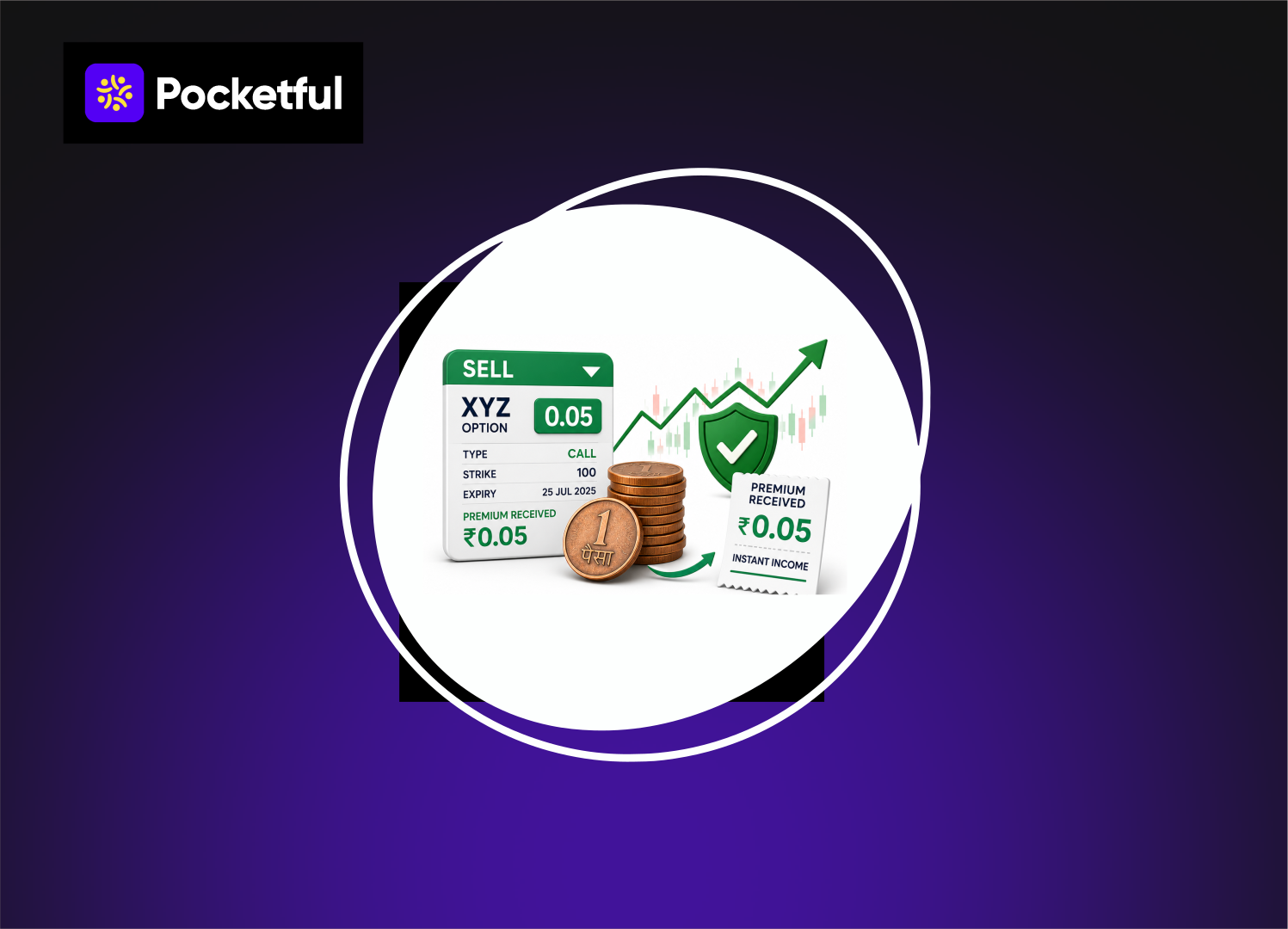
Selling penny options feels simple. You sell far out-of-the-money contracts, collect a small premium, and in most cases, the options expire worthless. The profits come in regularly, and over time, it starts to look like a steady income stream.
The problem is what you do not see in those quiet periods. The strategy runs smoothly until a sharp market move hits. When that happens, the loss is not just large; it can undo months of gains in a single move. That gap is what most traders overlook.
What Are Penny Options
Penny options are far out-of-the-money contracts that trade at very low premiums, usually between Rs. 1 and Rs. 10. These options sit far away from the current price of indices like Nifty 50, which makes their chances of expiring in the money quite low.
For example, if Nifty is trading around 23,500, a 21,000 Put or a 26,000 Call may be priced at Rs. 3 to Rs. 5. For these options to gain value, the market would need a sharp move within a short time. Since that rarely happens, many traders sell these options to collect small, frequent premiums.
The Core Problem: Asymmetric Payoff
Asymmetric payoff simply means the profit and loss in a trade are not equal. One side is limited, while the other can grow much larger. This is exactly how penny option selling works.
To understand this clearly, look at a simple example on Nifty 50.
Assume a trader sells a Rs. 5 call and a Rs. 5 put every week.
- Total premium collected: Rs. 10
- Lot size: 65
- Weekly profit: Rs. 650
- After costs: around Rs. 550
This creates a steady and consistent income over time.
Now consider one adverse move.
- The option price rises to Rs. 200
- Loss per lot: Rs. 13,000
What this means:
- Weekly profit: around Rs. 550
- One loss: Rs. 13,000
- Time to recover: nearly 25 weeks
This is the asymmetry. The profits come in small amounts over many weeks, but a single loss is large enough to erase months of gains.
Why The Strategy Feels Attractive
At a surface level, selling penny options appears simple and rewarding. The experience of frequent profits creates a sense of control. But this attraction comes from how the outcomes are perceived, not from how the risk actually works.
- High Win Rate Creates Confidence: Most far-out-of-the-money options expire worthless. This means traders win on a large number of trades. Over time, this builds strong confidence in the strategy, even though the size of each win remains small.
- Consistent Small Gains Feel Reliable: The profits come in regularly. Week after week, the premiums collected add up. This creates a smooth and steady profit curve, which gives the impression of a stable strategy.
- Losses Feel Unlikely: Since large market moves are rare, they start to feel irrelevant. Traders begin to believe that extreme scenarios will not happen frequently enough to matter. This leads to underestimating the real risk.
- Low Effort Execution: The strategy does not require constant monitoring. Positions are placed, and in most cases, they expire without any action. This simplicity makes it appealing, especially for traders who cannot track markets all day.
- Gradual Increase In Position Size: As confidence builds, traders often increase their position sizes. Since losses have not occurred recently, the strategy feels safe. This increases exposure, which makes the impact of a single adverse move much larger.
This is why the strategy feels attractive. The experience is built around frequent small wins, while the risk remains hidden until a rare event brings it into focus.
Read Also: Government Penny Stocks in India
How Black Swan Events Break The Strategy
The real risk in penny option selling becomes visible during rare but sharp market moves. These are often referred to as Black Swan events. They are unpredictable, fast, and usually happen when traders are least prepared.
1. Option Prices Expand Rapidly
Far out-of-the-money options can remain low for days. But once the market starts moving towards those strikes, their prices increase very quickly.
- A Rs. 5 option can move to Rs. 50 or Rs. 100 within hours.
- This happens because price sensitivity increases as the option gets closer to the market price.
2. Multiple Factors Work Against The Seller
In such moves, several forces act together. This means there will be factors that will be out of your control. Some of the factors to know are:
- Delta increases, meaning the option reacts more to price changes.
- Gamma accelerates this reaction further.
- Implied volatility rises, which increases option premiums even more.
This combination leads to sharp and fast losses.
3. Exits Become Difficult
In volatile conditions, execution becomes a challenge, and in case of any delay or miscalculation, you can face losses or a reduction in expected outcomes. This can be due to:
- Liquidity in far OTM options reduces.
- Bid-ask spreads widen significantly.
- Traders may not get the expected exit price.
This means losses can be higher than anticipated.
4. Moves Happen Without Warning
These events often occur suddenly. Most of these will not be in your control, which means you won’t be in a position to make decisions previously.
- Overnight global developments can cause large gaps at market open.
- There is limited time to react or adjust positions.
This makes risk control difficult in real time.
5. Volatility Does Not End Immediately
After one sharp move, the market often remains unstable. This creates uncertain situations which are hard to gauge.
- Volatility stays elevated for multiple sessions.
- Another adverse move can follow before recovery is complete.
This is what makes such events damaging. The losses are not only large but also fast, and they come at a time when managing positions becomes the hardest.
What Traders Should Do Instead
Selling options is not the problem. The issue is taking unlimited risk for a small, fixed reward. A few practical changes can make the strategy more balanced and sustainable.
- Use Defined Risk Strategies: Instead of selling naked options, use spreads. This means selling one option and buying another at a further strike. The premium received is lower, but your maximum loss becomes fixed. Even in a sharp market move, the downside is capped.
- Follow Strict Position Sizing: The size of each trade plays a critical role in risk management. Avoid allocating a large portion of your capital to a single position. Keep margin usage conservative so that one adverse move does not significantly impact your overall account.
- Apply Stop Loss Discipline: Ignoring stop losses is a common mistake in this strategy. Even if the premium looks small, define an exit level before entering the trade. Many traders use a 3x to 5x rule on the premium and exit without delay when that level is reached.
- Avoid High Volatility Phases: Market conditions matter. During high volatility, option prices react more aggressively to price movements. Far out-of-the-money options can spike quickly, increasing the risk. Being selective during such phases can help reduce exposure.
- Focus On Risk First, Not Income: The objective should not be to earn a fixed weekly income. It should be to protect capital. Skipping trades when conditions are not favourable is often a better decision than forcing positions for consistency.
Take The Smarter Approach With Pocketful
Understanding risk is only one part of the process. Applying it consistently is what actually protects your capital. That is where having the right platform and tools makes a difference.
With Pocketful, you can track your trades, manage positions with better visibility, and make more informed decisions. This will help you build your approach with clarity, consistency, and the right support.
Frequently Asked Questions (FAQs)
01
What Is A Penny Option?
A penny option is a far out-of-the-money option that trades at a very low premium, usually between Rs. 1 and Rs. 10. These options have a low probability of expiring in the money, which is why many traders choose to sell them to collect small premiums.
02
Why Do Traders Sell Penny Options?
Traders are attracted to the high win rate. Most of these options expire worthless, which creates consistent small profits. Over time, this builds confidence, even though the underlying risk remains significant.
03
What Is The Main Risk In Selling Penny Options?
The main risk is the payoff structure. Profit is limited to the premium collected, while losses can become very large if the market moves sharply. This imbalance makes the strategy risky over the long term.
04
Can Penny Option Selling Be Done Safely?
It can be made safer with proper risk management. Using spreads instead of naked positions, keeping position sizes small, applying stop losses, and avoiding high volatility periods can help reduce risk.
05
What Are Black Swan Events In Options Trading?
Black Swan events are rare and unexpected market moves that cause sharp price changes. These events can significantly increase option prices in a short time, leading to large losses for traders who are selling options without protection.
Disclaimer

The information shared in this content is intended solely for educational and informational purposes and should not be considered financial, investment, or trading advice. Any references to stocks, mutual funds, or market instruments are purely for informational purposes and do not constitute recommendations. Investments in financial markets are subject to market risks, and past performance is not indicative of future returns. Readers are advised to conduct independent research, review official documents carefully, and consult a qualified financial advisor before making any investment or trading decisions.
Article History
