



| Type | Description | Contributor | Date |
|---|---|---|---|
 | Post created | Pocketful Team | Jul-22-26 |
Read Next
- Delta in Options: Meaning, Formula, Uses & Examples
- What is Commodity Pool Operator (CPO)?
- Best Penny Stock Trading Platforms, Brokers & Apps
- Bid Price and Ask Price: Key Differences
- What is After Hours Trading: Definition, Benefits & Risks
- Minimum Capital Required for Options Trading in India
- Trading Terminal: Meaning, Features, Types & Benefits
- MTF Charges vs Normal Trading Charges: Key Differences
- Slippage in Trading: Meaning, Types, Causes & How to Reduce It
- Types of Stock Market Orders Explained
- What Is Cash Trading? Meaning, How It Works & Benefits
- What is Max Pain Theory?
- What is Averaging Up in Stock Trading?
- What Is an After Market Order (AMO)? Meaning, Timing & How It Works
- How to Reduce Risk in Options Trading: 10 Tips
- What is Speculative Trading in Stock Market?
- What is Pair Trading?
- What is Quoted Price in Commodity Trading?
- Best Strategies to Trade from Charts
- How To Use Directional Movement Index In Trading?
Buying vs Selling Options: Which Is Riskier?
Published on : 24th July 2026
|Updated on : 24th July 2026



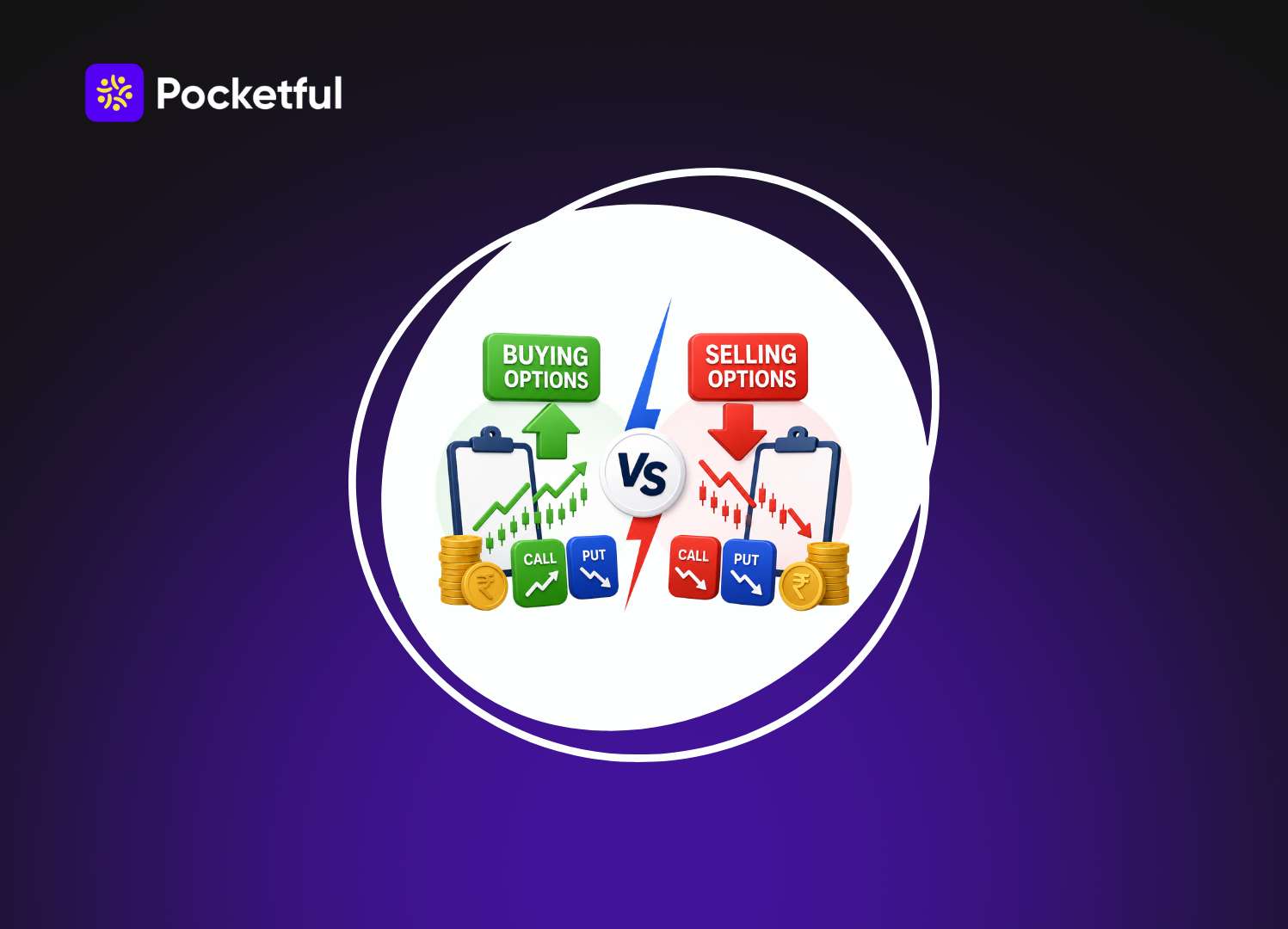
Every trader who moves from equity into derivatives eventually runs into the same question: is option buying and selling equally risky, or not? The honest answer is that they are risky in almost opposite ways.
Option buying caps your loss but stacks the odds against you over time. Option selling flips that trade-off, handing you better odds of profit in exchange for a loss that can, in theory, run far beyond what you put in.
This guide breaks down option buying vs option selling in plain terms, compares the actual numbers, and explains why option selling is costly in ways that are not obvious until a trader has already been burned by it.
What Is Option Buying
When you buy a call or a put, you pay a premium upfront for the right, not the obligation, to buy or sell the underlying stock or index at a fixed strike price before expiry. That premium is the maximum you can lose in the simplest terms.
This is what makes option buying attractive to newer traders. You know your downside before you place the trade. If Nifty falls the wrong way after you buy a call, you lose the premium and nothing else. There is no margin call, no unlimited loss, and no overnight panic about how far the market can move against you.
The catch lies in the odds of the trade working in your favor. Options lose value every single day through time decay, a factor known as theta. A bought option is fighting the clock from the moment you buy it.
Even if your view on direction is correct, you can still lose money if the move happens too slowly or the option’s implied volatility falls after you buy it. Data compiled by SEBI on individual investor trading in the equity derivatives segment has repeatedly shown that a large majority of retail option buyers lose money over a financial year, precisely because time decay works against them by default.
Example: Option Buying
Suppose Nifty is at 25,000. You expect it to rise, so you buy a 25,100 Call Option at a premium of ₹100.
- Lot Size: 65
- Premium Paid: ₹100 × 65 = ₹6,500
If the premium rises to ₹150, your profit is:
(₹150 − ₹100) × 65 = ₹3,250
If the market doesn’t move and the option expires worthless, your maximum loss is only the premium paid, i.e., ₹6,500.
Simple takeaway: Option buyers can lose only the premium they pay, but the market needs to move in the expected direction before time decay reduces the option’s value.
Profit/Loss shown is before brokerage, taxes, and other applicable charges.
What Is Option Selling
Option selling, also called option writing, works the other way. You collect the premium upfront and take on the obligation to buy or sell the underlying if the option is exercised against you. Your maximum profit is capped at the premium received. Your maximum loss, in the case of an uncovered or naked position, is theoretically unlimited on a call and very large on a put.
Time decay, the same force that hurts option buyers, works in the seller’s favor. Every day that passes without an adverse move, the option loses value, and that lost value is the seller’s profit. This is why professional traders and institutions dominate the option-selling side of the market. Probability tends to favor the seller, since most options expire worthless or below the buyer’s break-even level.
The trade-off is capital and exposure. Option selling requires posting margin, sometimes a large amount of it, because your exchange and broker need protection against the possibility of a large adverse move. A single sharp, unexpected event, like a surprise rate decision or a geopolitical shock, can wipe out weeks or months of collected premium in one session.
Example: Option Selling
Suppose Nifty is trading at 25,000. You believe it will stay below 25,200, so you sell the 25,200 Call Option at a premium of ₹120.
- Lot Size: 65
- Premium Received: ₹120 × 65 = ₹7,800
- Margin Required: Approximately ₹1.3 lakh (varies by broker and market conditions)
Scenario 1: Trade Works
The market stays below 25,200, and the option premium falls to ₹30.
Profit = (₹120 − ₹30) × 65 = ₹5,850
Scenario 2: Trade Goes Against You
Nifty rallies sharply, and the option premium rises to ₹320.
Loss = (₹320 − ₹120) × 65 = ₹13,000
If you don’t exit and the market continues to rise, the loss can keep increasing, which is why option selling is considered a high-risk strategy despite the higher probability of earning the premium.
Note: Profit/Loss shown is before brokerage, taxes, and other applicable charges.
One important point: There is no single “real-life” calculation because option premiums and margin requirements change every second based on Nifty’s level, volatility (IV), and time left to expiry. The numbers above are realistic illustrations, not live market quotes.
Buying and Selling Options: The Core Risk Difference
The clearest way to see the difference in buying and selling options is to compare the shape of the payoff, not just the odds of winning.
| Factor | Option Buying | Option Selling |
|---|---|---|
| Maximum loss | Limited to premium paid | Can be very large or unlimited |
| Maximum profit | Can be large or unlimited | Limited to premium received |
| Time decay | Works against you | Works in your favor |
| Win probability | Generally lower | Generally higher |
| Capital required | Premium only | Margin, often substantial |
| Stress under a big move | Fixed, known in advance | Can escalate fast |
This table is the reason the honest answer to option buying vs option selling is not a single word. Buying risks a small, known amount frequently. Selling risks a small win frequently, in exchange for a rare but potentially severe loss. Statistically, sellers win more often, but the losses they eventually take can erase many winning trades at once.
Read Also: Best Option Selling Strategy in India
Why Option Selling Is Costly When It Goes Wrong
Why option selling is costly comes down to three specific mechanics that many new traders underestimate.
- Unlimited or Near-unlimited Loss Potential: A naked call seller has no ceiling on loss if the underlying keeps rising. A naked put seller can lose up to the strike price if the stock collapses toward zero. Compare that to a buyer, whose loss is capped the moment the trade is placed.
- Margin Calls and Forced Liquidation: When a sold position moves against you, your broker’s risk system will ask for additional margin, and if you cannot provide it, your position gets squared off, often at the worst possible price during a fast market move. This is very different from option buying, where there is no margin call because your loss is already paid upfront.
- Gamma Risk Near Expiry: As expiry approaches, an option’s price becomes extremely sensitive to small moves in the underlying, a factor known as gamma. Sellers who hold positions close to expiry can watch a small adverse move balloon into a large loss within minutes, especially in weekly index options where this effect is magnified.
None of this means that option selling should be avoided. It means option selling is a business that runs on strict position sizing, hedging, and margin discipline, not on collecting premiums and hoping nothing goes wrong.
Which Side Is Actually Riskier
If risk means how much you can lose on a single trade, option selling is clearly riskier, since the potential loss is far larger than the fixed premium a buyer risks.
If risk means how often you lose money, option buying is riskier, since decay and unfavorable odds mean most bought options expire worthless, and studies of retail trading behavior consistently show buyers losing more frequently over time.
The most accurate framing is this: option buying risks small amounts often, and option selling risks large amounts rarely. Neither side is safe by default. Both require a plan.
How Traders Manage Risk on Both Sides
Serious traders rarely operate as a pure buyer or a pure seller. They combine both sides into spreads that cap risk while still collecting or paying only what the strategy requires.
- Covered calls let you sell calls against stock you already own, removing the unlimited upside risk of a naked call
- Credit spreads cap a seller’s maximum loss by simultaneously buying a further strike option as protection
- Debit spreads reduce a buyer’s cost and improve the odds of profit compared to buying a single option outright
- Stop losses and defined exit rules matter more for sellers, since an unmanaged sold position is the single fastest way to a large drawdown
- Position sizing relative to margin available keeps a single bad trade from threatening the entire trading account
Platforms with a built-in options chain and live Greeks, such as Pocketful, make this kind of risk assessment easier, since traders can see delta, theta, and implied volatility for every strike before placing a trade rather than guessing at exposure after the fact.
Read Also: 5 points to be considered before buying or selling any stocks
Conclusion
Option buying vs option selling is not a contest with one clear winner. Buying limits your loss to a known number but statistically loses more often due to time decay. Selling improves your odds of winning on any single trade but exposes you to losses that can be severe and fast-moving when the market turns.
The safest approach for most traders sits between the two extremes: using defined-risk spreads, respecting margin requirements, and treating option selling with the same seriousness as running a business rather than collecting easy premium. Whichever side of the trade you take, know your maximum loss before you place the order, not after.
And if you are not sure and still looking for an option that supports you, then you need to have a platform that offers you insights, tools, and support. This is where registering with Pocketful can be really helpful to you.
| S.NO. | Check Out These Interesting Posts You Might Enjoy! |
|---|---|
| 1 | GIFT Nifty vs Nifty 50: Key Differences |
| 2 | Margin Trading vs Short Selling – Key Differences |
| 3 | Differences Between MTF and Loan Against Shares |
| 4 | Difference Between Trading and Investing |
| 5 | ETF vs Index Fund: Key Differences You Must Know |
Frequently Asked Questions (FAQs)
01
Is option buying or option selling riskier for beginners?
Option selling is generally riskier for beginners because losses can exceed the margin a new trader expects, especially on naked positions. Option buying limits loss to the premium paid, which makes it easier to understand and survive early mistakes, even though it wins less often.
02
Why do most retail traders lose money buying options?
Time decay reduces an option’s value every day, so a buyer needs the underlying to move quickly and strongly enough to overcome that decay before expiry. Data from SEBI’s studies on individual investor derivative trading has repeatedly shown that most retail buyers lose money over a financial year for exactly this reason.
03
Can option selling cause unlimited losses?
Yes, on an uncovered or naked call, since there is no ceiling on how high the underlying can rise before expiry. A naked put seller’s loss is capped only by the stock falling to zero, which is still a very large potential loss relative to the premium collected.
04
Is option selling suitable for small trading accounts?
Option selling requires posting margin, which is usually far larger than the premium collected, so small accounts often cannot sell options safely without using defined-risk strategies like credit spreads that cap the maximum possible loss.
05
What is the safest way to combine option buying and selling?
Spread strategies that combine a bought and a sold option at different strikes, such as credit spreads or debit spreads, cap the maximum loss on both sides while still allowing a trader to benefit from time decay or directional movement, making them a more balanced approach than trading either side alone.
Disclaimer

The information shared in this content is intended solely for educational and informational purposes and should not be considered financial, investment, or trading advice. Any references to stocks, mutual funds, or market instruments are purely for informational purposes and do not constitute recommendations. Investments in financial markets are subject to market risks, and past performance is not indicative of future returns. Readers are advised to conduct independent research, review official documents carefully, and consult a qualified financial advisor before making any investment or trading decisions.
Article History